
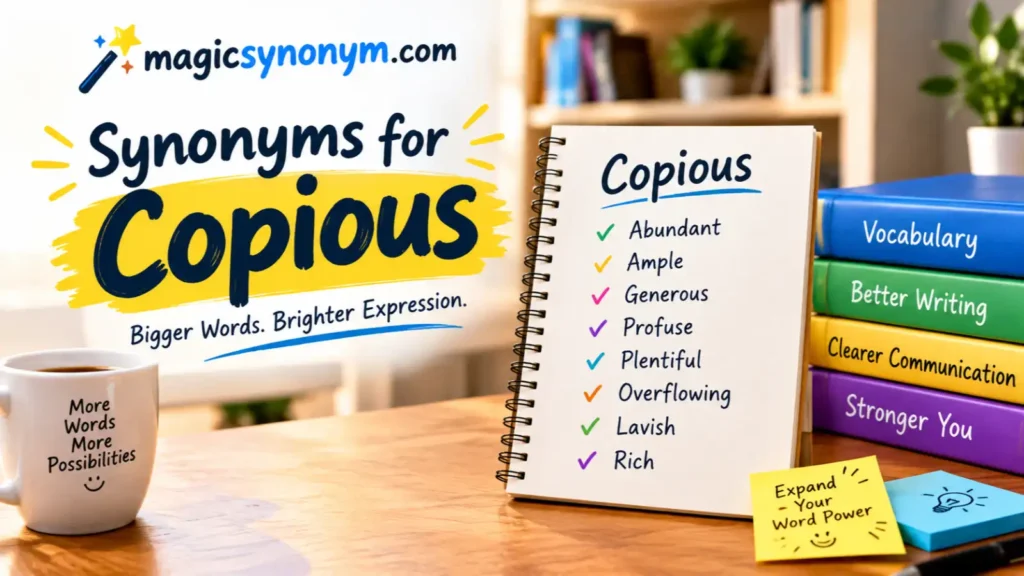
If you need 32+ synonyms for copious, the key is understanding that not every alternative works in every sentence. Copious generally means existing or available in large amounts, and it often describes things such as information, evidence, amounts of liquid, writing, food, or resources.
The best replacement depends on what you are describing and how formal you want to sound. Some choices are direct synonyms, while others are broader or more specific. Below, you’ll find practical alternatives for essays, professional emails, reports, everyday writing, and conversation.
Quick Answer
Copious means abundant, plentiful, or present in a large amount. Useful synonyms include abundant, ample, plentiful, profuse, bountiful, generous, voluminous, extensive, lavish, rich, plentiful, and substantial. The right choice depends on context: profuse suits strong abundance, while ample often suggests more than enough.
Quick List: 32 Useful Alternatives to Copious
Closest alternatives
- Abundant — available in large quantities
- Plentiful — existing in large amounts
- Profuse — abundant, often to an excessive degree
- Ample — more than enough
- Bountiful — abundant and generous
- Plenteous — existing in great quantity
- Lavish — abundant or generous, especially with spending or provision
- Generous — larger than expected or necessary
- Voluminous — very large in quantity or volume
- Considerable — fairly large or substantial
Formal alternatives
- Substantial
- Extensive
- Copiousness-producing: abundant
- Prolific
- Extensive in quantity
- Sizable
- Numerous
- Multitudinous
Neutral alternatives
- Large
- Great
- Plentiful
- Ample
- Rich
- Full
- Numerous
- A lot of
Contextual alternatives
- Overflowing
- Teeming
- Brimming
- Well-stocked
- Well-supplied
- Generously supplied
- In abundance
- In large quantities
Not all 32 expressions are interchangeable. For example, prolific usually describes productivity or output, while voluminous emphasizes size or volume.
synonyms for copious Formal Alternatives to Copious
Abundant
Meaning: Present in large quantities.
Explanation: Abundant is one of the closest general synonyms for copious. It works for physical things, information, resources, and abstract concepts.
Example: The report contains abundant evidence supporting the conclusion.
Best Use: Academic writing, reports, formal descriptions, and professional communication.
Worst Use: Very casual conversation where simpler wording sounds more natural.
Tone: Formal to neutral.
Plentiful
Meaning: Existing in large supply.
Explanation: Plentiful is close to copious but often has a warmer or more practical feel. It is especially natural for food, resources, opportunities, and supplies.
Example: Fresh produce is plentiful during the summer months.
Best Use: General writing, informational articles, and descriptions of supplies.
Worst Use: Highly technical writing where a more precise term is needed.
Tone: Neutral.
Profuse
Meaning: Abundant, excessive, or produced in very large quantities.
Explanation: Profuse is a strong alternative. It can suggest an unusually large amount rather than simply a healthy supply.
Example: The author offered profuse examples throughout the chapter.
Best Use: Formal writing and descriptions of unusually large quantities.
Worst Use: Situations where the amount is merely adequate.
Tone: Formal.
Ample
Meaning: More than enough for a particular purpose.
Explanation: Ample focuses on sufficiency rather than sheer abundance. A person can have ample time without having an enormous amount of time.
Example: We have ample time to complete the assignment.
Best Use: Business emails, instructions, academic writing, and practical communication.
Worst Use: Describing an extremely excessive quantity.
Tone: Neutral to formal.
Bountiful
Meaning: Abundant and plentiful, often in a positive or generous sense.
Explanation: Bountiful is particularly natural when describing harvests, nature, food, gifts, or resources.
Example: The region produced a bountiful harvest this year.
Best Use: Descriptive and literary writing.
Worst Use: Technical business reports where plain precision is preferable.
Tone: Positive and somewhat literary.
Plenteous
Meaning: Existing in great quantity.
Explanation: This is a genuine synonym, but it is much less common in modern American English than plentiful.
Example: The valley has plenteous water during the rainy season.
Best Use: Literary, historical, or deliberately elevated writing.
Worst Use: Everyday emails.
Tone: Formal or old-fashioned.
Lavish
Meaning: More than is necessary or expected; abundant or generous.
Explanation: Lavish adds an idea of generosity or excess. It does not always mean simply “large in quantity.”
Example: The organization provided lavish resources for the project.
Best Use: Spending, praise, decoration, hospitality, rewards, or generous provision.
Worst Use: Neutral scientific descriptions of quantities.
Tone: Strong and expressive.
Generous
Meaning: Larger or more plentiful than expected or necessary.
Explanation: Generous can replace copious when the quantity is viewed positively or as more than sufficient.
Example: The guide provides a generous amount of detail.
Best Use: Customer communication, recommendations, reviews, and friendly professional writing.
Worst Use: Technical measurements requiring exact quantities.
Tone: Neutral and positive.
Voluminous
Meaning: Very large in volume, size, or quantity.
Explanation: Voluminous is particularly useful for documents, records, books, reports, and collections of information.
Example: The committee reviewed voluminous records before reaching its decision.
Best Use: Legal, academic, administrative, and professional writing.
Worst Use: Simple everyday sentences where large or extensive would be clearer.
Tone: Formal.
Considerable
Meaning: Fairly large or substantial.
Explanation: Considerable is a near synonym rather than a perfect replacement. It suggests a significant amount but does not necessarily imply abundance.
Example: The project required a considerable amount of research.
Best Use: Professional and academic writing.
Worst Use: When you specifically need to emphasize a very large quantity.
Tone: Formal to neutral.
synonyms for copious Semi Formal and Neutral Alternatives

Extensive
Meaning: Large in amount, range, or scope.
Explanation: Extensive works particularly well with research, experience, knowledge, analysis, and information. It describes breadth as much as quantity.
Example: She conducted extensive research before writing the paper.
Best Use: Academic and professional contexts.
Worst Use: Physical quantities where abundant is more precise.
Tone: Professional.
Substantial
Meaning: Large enough to be important or significant.
Explanation: Substantial emphasizes significance rather than abundance alone.
Example: The proposal received substantial support.
Best Use: Business reports, academic writing, and formal communication.
Worst Use: Describing something merely plentiful but insignificant.
Tone: Formal and neutral.
Prolific
Meaning: Producing a large amount or number of something.
Explanation: Prolific is related to abundance but focuses on production or productivity. A prolific writer produces a lot of work.
Example: She is a prolific writer who has published several books.
Best Use: Writers, artists, researchers, creators, and producers.
Worst Use: Replacing copious for a static supply of resources.
Tone: Positive and professional.
Sizable
Meaning: Fairly large.
Explanation: Sizable is a useful general alternative when the quantity is significant but not necessarily abundant.
Example: The company attracted a sizable audience.
Best Use: General professional writing.
Worst Use: Highly formal academic prose if a more precise word is available.
Tone: Neutral.
Numerous
Meaning: Existing in large numbers.
Explanation: Numerous applies primarily to things that can be counted. It is therefore narrower than copious.
Example: The study identified numerous factors affecting the results.
Best Use: Academic and professional writing.
Worst Use: Uncountable substances such as water or sand.
Tone: Neutral to formal.
Rich
Meaning: Containing a large amount of something valuable or notable.
Explanation: Rich is contextual. A text can be rich in detail, a soil can be rich in nutrients, and an experience can be rich in meaning.
Example: The article provides a rich source of historical information.
Best Use: Describing content, culture, nutrients, ideas, and experiences.
Worst Use: When a simple numerical quantity is the main point.
Tone: Neutral and descriptive.
synonyms for copious Full
Meaning: Containing as much as it can reasonably hold or containing a large amount.
Explanation: Full is much simpler and more conversational than copious. It is not always a direct substitute.
Example: The library has a full collection of reference materials.
Best Use: Everyday communication.
Worst Use: Formal contexts where greater precision is needed.
Tone: Casual to neutral.
synonyms for copious Informal and Contextual Alternatives

English has relatively few genuinely informal one-word synonyms for copious. In everyday speech, people usually simplify the sentence rather than choose another sophisticated synonym.
A lot of
Meaning: A large quantity or number.
Example: We received a lot of feedback after the presentation.
When natural: Conversation, casual emails, and informal messages.
When to avoid: Academic papers and highly formal reports.
Tone: Casual.
Lots of
Meaning: A large amount or number.
Example: There are lots of opportunities available online.
When natural: Conversation and informal writing.
When to avoid: Formal business or academic writing.
Tone: Casual.
In abundance
Meaning: In large quantities.
Example: Fresh water was available in abundance.
When natural: Descriptive writing and polished general prose.
When to avoid: Very casual conversation if a simpler expression sounds better.
Tone: Neutral to formal.
Overflowing
Meaning: So full that something extends beyond its normal limits.
Example: The market was overflowing with fresh produce.
When natural: Descriptive and vivid writing.
When to avoid: Neutral quantitative reporting.
Tone: Expressive.
Brimming with
Meaning: Filled with a large amount of something.
Example: The presentation was brimming with useful ideas.
When natural: Articles, reviews, creative writing, and informal professional content.
When to avoid: Technical reports requiring literal precision.
Tone: Friendly and vivid.
synonyms for copious True Synonyms vs. Contextual Alternatives
| Type | What It Means | Can It Replace Copious? |
|---|---|---|
| True synonym | Nearly the same basic meaning of abundant quantity | Usually |
| Near synonym | Similar but with a small difference in emphasis | Sometimes |
| Contextual alternative | Works in particular situations but changes the meaning slightly | Only in suitable contexts |
| Broader expression | Communicates the general idea without the same precision | Often, depending on context |
| Narrower expression | Applies to a more limited type of quantity | Only when that narrower meaning fits |
For example, abundant and plentiful are close general replacements. Extensive is more about range or scope, numerous applies to countable things, and prolific focuses on production.
synonyms for copious Industry-Specific Uses of Copious and Its Alternatives
Business Writing
Business writing usually benefits from precise alternatives rather than unusually ornate vocabulary.
Instead of:
The department collected copious feedback.
You could write:
The department collected extensive feedback.
Or:
The department received a substantial amount of feedback.
Extensive often works well for research, feedback, analysis, and documentation.
Corporate Communication
For reports and internal documents, substantial, extensive, numerous, and ample are often clearer than copious.
- Extensive documentation
- Substantial investment
- Numerous requests
- Ample resources
Choose according to the exact meaning rather than simply replacing one adjective with another.
Academic Writing
Academic prose frequently uses:
- abundant
- extensive
- substantial
- numerous
- considerable
- voluminous
For example:
The researchers examined extensive historical records.
This is usually more precise than saying the researchers examined copious records if the emphasis is on the breadth of the material.
Customer Service
Customer-facing writing should be clear and approachable.
Instead of:
We have copious information about the service.
Try:
We have plenty of information about the service.
Or:
Our website contains detailed information about the service.
The second version may be preferable when the actual point is detail rather than quantity.
Legal Writing
Legal documents may use terms such as numerous, extensive, substantial, considerable, or voluminous, depending on the facts.
Be careful with substitution. A legal statement about a quantity, scope, or evidentiary record may carry a specific meaning in context. Replacing a term simply because it appears similar can change the intended scope. Legal drafting should prioritize precision and the governing jurisdiction’s terminology.
Email Communication
For professional email, ample, substantial, extensive, and generous are generally easier to understand than copious.
For example:
We have ample time to review the proposal.
This sounds more natural than:
We have copious time to review the proposal.
The latter is grammatically possible in limited contexts but is not a natural collocation.
synonyms for copious Email Examples

Email 1 — Project Research
Subject: Research Materials for the Proposal
EmailResearch Materials for the Proposal
Research Materials for the Proposal
Hi Maya,
I’ve attached the research collected for the proposal. We now have extensive background material covering the main areas we discussed.
I’ll organize the most relevant findings before our meeting on Thursday.
Best,
Jordan
Email 2 — Available Time
Subject: Review Timeline
EmailReview Timeline
Review Timeline
Hi Daniel,
There should be ample time to review the document before the final submission. Please send me any comments by Wednesday afternoon so I can make the necessary updates.
Thanks,
Elena
Email 3 — Customer Information
Subject: Additional Product Details
EmailAdditional Product Details
Additional Product Details
Hello Marcus,
We have a wealth of information about the product, including specifications, setup instructions, and maintenance recommendations.
If you tell me what you need to know, I can point you to the most relevant section.
Best,
Priya
Email 4 — Large Record Set
Subject: Documents for Review
EmailDocuments for Review
Documents for Review
Hi Rachel,
The archive contains voluminous records, so I suggest we begin with the documents from the previous two years.
That should help us identify the key material before reviewing the older files.
Regards,
Thomas
Email 5 — Audience Response
Subject: Strong Response to the Survey
EmailStrong Response to the Survey
Strong Response to the Survey
Hi Alex,
We received substantial feedback after sending the survey. I’ve grouped the responses by topic and highlighted the issues that appeared most frequently.
I’ll share the summary this afternoon.
Best,
Nina
synonyms for copious Short Dialogue Examples
Workplace
Person A: Do we have enough information for the report?
Person B: Yes. We have ample data to support the main findings.
Classroom
Person A: How much research did you find?
Person B: Quite a lot. There were numerous sources on the topic.
Customer Service
Person A: Can I find more details about the warranty?
Person B: Absolutely. The website has extensive information about coverage.
Casual
Person A: Did many people come to the event?
Person B: Yes, there were lots of people there.
Professional
Person A: Did the committee receive much feedback?
Person B: Yes, it received substantial feedback from members.
synonyms for copious How to Replace Copious in a Sentence
Example 1
Original: The researcher gathered copious evidence.
Alternative: The researcher gathered abundant evidence.
Why it works: Abundant preserves the original idea of a large quantity.
Example 2
Original: The report contains copious details.
Alternative: The report contains extensive details.
Why it works: Extensive emphasizes the breadth and scope of the information.
Example 3
Original: We have copious time to finish.
Alternative: We have ample time to finish.
Why it works: Ample is the natural choice when the intended meaning is more than enough time.
Example 4
Original: The archive contains copious records.
Alternative: The archive contains voluminous records.
Why it works: Voluminous emphasizes the large size or volume of the record collection.
Example 5
Original: The farm produced copious crops.
Alternative: The farm produced a bountiful harvest.
Why it works: Bountiful adds a positive sense of abundance and works naturally with harvests.
Example 6
Original: She wrote copious articles.
Alternative: She was a prolific writer.
Why it works: Prolific shifts attention from the quantity of the articles to the writer’s high level of output.
Example 7
Original: The study identified copious factors.
Alternative: The study identified numerous factors.
Why it works: Numerous is more natural because factors are countable.
Example 8
Original: The organization provided copious resources.
Alternative: The organization provided generous resources.
Why it works: Generous suggests that the resources exceeded what might normally be expected.
Example 9
Original: The garden had copious flowers.
Alternative: The garden was brimming with flowers.
Why it works: The alternative is more vivid and conversational.
Example 10
Original: The author included copious information.
Alternative: The author included a wealth of information.
Why it works: This natural expression emphasizes the richness and usefulness of the information.
synonyms for copious Comparison Table
| Phrase | Tone | Meaning / Scope | Best Use | Example |
|---|---|---|---|---|
| Abundant | Formal/neutral | Large quantity | General writing | Abundant resources |
| Plentiful | Neutral | Large supply | Food, resources | Plentiful supplies |
| Profuse | Formal | Very abundant | Strong abundance | Profuse praise |
| Ample | Neutral/formal | More than enough | Time, space, resources | Ample time |
| Bountiful | Descriptive | Abundant and generous | Harvests, nature | Bountiful harvest |
| Extensive | Professional | Broad or large in scope | Research, information | Extensive research |
| Substantial | Formal | Large/significant | Support, investment | Substantial funding |
| Numerous | Neutral/formal | Large number | Countable nouns | Numerous examples |
| Voluminous | Formal | Very large volume | Documents, records | Voluminous files |
| Prolific | Formal/neutral | Producing a lot | Writers, creators | Prolific author |
| Generous | Neutral | More than expected | Amounts, offers | Generous portion |
| A lot of | Casual | Large quantity | Conversation | A lot of work |
| Overflowing | Expressive | Excessively full | Descriptions | Overflowing shelves |
| In abundance | Neutral/formal | In large supply | General descriptions | Available in abundance |
synonyms for copious Which Alternative Should You Choose?
For formal writing: Choose abundant, substantial, extensive, profuse, or voluminous, depending on the noun.
For business communication: ample, substantial, extensive, and considerable are usually natural.
For academic writing: abundant, extensive, numerous, substantial, and considerable offer useful precision.
For legal writing: Prefer the term that accurately describes the quantity, scope, or record. Avoid substituting based only on style.
For professional emails: ample, extensive, substantial, or generous often sound more natural than copious.
For everyday conversation: a lot of, lots of, plenty of, and a large amount of are usually easier.
For casual messages: Use simple phrases such as a lot of or plenty of unless a more vivid expression suits the situation.
synonyms for copious Grammar and Usage Guide
Copious Is an Adjective
Copious modifies a noun:
- copious information
- copious amounts
- copious notes
- copious evidence
- copious resources
You would not normally use copious by itself as a noun.
Copious Often Works With Uncountable Nouns
Common combinations include:
- copious amounts of water
- copious information
- copious evidence
- copious detail
- copious research
It Can Also Modify Plural Countable Nouns
Examples include:
- copious notes
- copious examples
- copious records
- copious references
Watch the Preposition
The common construction is:
copious amounts of + noun
For example:
The experiment generated copious amounts of waste.
Avoid Unnatural Collocations
Not every noun pairs naturally with copious. For example, copious time sounds awkward in most modern contexts. Ample time is much more idiomatic.
Likewise, numerous water is incorrect because water is uncountable. Use a large amount of water or abundant water depending on the intended meaning.
synonyms for copious Common Mistakes to Avoid
- Treating every alternative as an exact synonym: Extensive, numerous, and prolific each have different emphasis.
- Using numerous with uncountable nouns: Say numerous examples, but a large amount of information.
- Using copious when you mean enough: Ample is usually better for sufficiency.
- Using prolific for static quantities: Prolific normally describes high output or productivity.
- Overusing formal vocabulary: Simple alternatives can improve readability.
- Using lavish without its extra meaning: Lavish often implies generosity, excess, or extravagance.
- Ignoring collocations: Ample time sounds natural, while copious time generally does not.
- Confusing extensive with abundant: Extensive can emphasize scope or breadth rather than sheer quantity.
- Using casual alternatives in formal documents: Lots of may weaken the tone of an academic or business document.
- Choosing a synonym without checking the noun: The best alternative depends heavily on what follows the adjective.
synonyms for copious When Not to Use Copious
You may want to avoid copious when:
- The audience prefers plain, everyday English.
- You mean more than enough, making ample more precise.
- You are describing a large number of countable items, where numerous may work better.
- You are emphasizing broad coverage, where extensive is clearer.
- You are describing someone’s high output, where prolific is more accurate.
- The context calls for a simple phrase such as a lot of or plenty of.
- The noun does not naturally collocate with copious.
Still, copious is a perfectly useful word. It can be especially effective when you want to emphasize a very large quantity in polished writing.
synonyms for copious Advanced Writer Tips
Control the Strength
These words do not all communicate the same degree of abundance.
- Ample → enough and more
- Abundant → a large supply
- Profuse → very abundant, sometimes excessive
- Overflowing → vividly suggests excess
Choose the word that matches the actual degree.
Match the Noun
Think about the thing being described first.
- Information → abundant, extensive, detailed
- Time → ample, plenty of
- Records → voluminous, extensive
- Examples → numerous, abundant
- Resources → ample, abundant, substantial
- Writer’s output → prolific
- Harvest → bountiful
Prefer Precision Over Variety
Do not replace copious simply to avoid repeating a word. Repetition is better than an inaccurate synonym.
If you mean “more than enough,” use ample. If you mean “many countable items,” use numerous. If you mean “producing a lot,” use prolific.
Keep Professional Emails Natural
Professional communication usually sounds stronger when it is clear rather than unnecessarily elaborate.
Instead of:
We have copious information available.
Try:
We have extensive information available.
Or:
We have plenty of information available.
The right version depends on the audience.
Related Questions
What is another way to say copious?
Common alternatives include abundant, plentiful, ample, profuse, substantial, extensive, and generous. The best choice depends on the noun and whether you want to emphasize quantity, sufficiency, scope, or excess.
What is a professional alternative to copious?
Abundant, extensive, substantial, ample, and considerable are useful professional alternatives. Extensive works particularly well for research and information, while substantial often suits investments, support, or amounts.
Is copious a formal word?
Yes. Copious is generally considered a formal or elevated word, especially compared with everyday phrases such as a lot of or lots of. It is common in polished writing but less common in casual conversation.
Is abundant the same as copious?
They are very close, but copious can emphasize a particularly large quantity, while abundant generally means plentiful or available in large supply. In many contexts, they can replace one another.
What is the difference between copious and ample?
Copious emphasizes a large quantity, while ample emphasizes having more than enough for a particular need. For example, copious rainfall means a large amount of rain, while ample time means sufficient time with some extra available.
FAQs:
What are the closest synonyms for copious?
The closest general synonyms are abundant, plentiful, profuse, ample, and plenteous. Among these, abundant and plentiful are often the easiest direct replacements because they preserve the basic idea of a large quantity.
What is a simple word for copious?
A lot of is one of the simplest everyday alternatives. Plenty of is also natural when you mean that there is more than enough of something.
What is a formal synonym for copious?
Abundant, profuse, extensive, substantial, and voluminous can all work in formal writing, but each has a slightly different meaning. Choose based on whether you mean quantity, scope, significance, or physical volume.
Can numerous replace copious?
Sometimes. Numerous specifically describes a large number of countable things, such as examples, books, or questions. It cannot directly replace copious when describing an uncountable substance such as water or information.
Can ample replace copious?
Only when the intended meaning is more than enough. Ample is about sufficiency, whereas copious is primarily about abundance. Therefore, the two words overlap but are not always interchangeable.
What is the opposite of copious?
Common opposites include scarce, sparse, limited, insufficient, meager, scant, and small in quantity. The most appropriate antonym depends on whether you want to emphasize shortage, low quantity, or insufficiency.
Is copious positive or negative?
Copious itself is generally neutral. The surrounding noun and context determine whether the large quantity is desirable or undesirable. Copious rainfall may be beneficial for crops but problematic during flooding.
Conclusion:
Copious is a useful word when you want to describe something that exists in a very large quantity. However, the best replacement depends on exactly what you want to communicate.
Abundant and plentiful are reliable general alternatives, while ample is better when you mean more than enough. Extensive works well for research and information, numerous suits countable items, and voluminous is particularly useful for large collections of documents or records.
If the focus is on someone’s productivity, prolific is more accurate than simply saying copious. For casual communication, phrases such as a lot of, lots of, and plenty of are usually more natural.
The goal is not to find the fanciest substitute. It is to choose the word that preserves your intended meaning while fitting the sentence, audience, and tone.

I’m Daniel Carter, an English vocabulary writer who enjoys making words simple and easy to understand. At CrazySynonym.com, I create helpful guides on synonyms, meanings, antonyms, and everyday word usage to help readers choose the right words with confidence.