

The best synonyms for vain depend on what you want to describe. If someone thinks too highly of their appearance or abilities, words such as conceited, arrogant, and self-important may fit. If you mean something that produces no useful result, alternatives like futile, pointless, and fruitless are more accurate.
People search for synonyms for vain to improve essays, professional emails, creative writing, and everyday conversations. However, not every alternative carries the same meaning. Some describe excessive pride, while others suggest wasted effort or a lack of success.
This guide explains 36+ useful alternatives, their meanings, and how to choose the right word for your audience. You will also find practical examples, email samples, grammar advice, and comparisons to help you express your ideas clearly.
Quick Answer: What Are the Best Synonyms for Vain?
The best synonyms for vain include conceited, egotistical, arrogant, self-important, narcissistic, boastful, proud, pretentious, futile, pointless, fruitless, unsuccessful, ineffective, and useless. For a person who thinks too highly of themselves, use conceited or egotistical. For an unsuccessful attempt, choose futile or fruitless.
synonyms for vain Quick List of Alternatives
Here are more than 36 alternatives to the word vain, grouped by meaning and tone.
Closest Alternatives for a Person
These words describe someone who has an overly high opinion of themselves.
- Conceited
- Egotistical
- Arrogant
- Self-important
- Narcissistic
- Vainglorious
- Pompous
- Pretentious
- Haughty
- Self-centered
- Overconfident
- Boastful
Formal and Professional Alternatives
These choices suit reports, essays, evaluations, and more formal writing, depending on context.
- Egotistical
- Self-aggrandizing
- Ostentatious
- Presumptuous
- Inflated
- Self-absorbed
- Supercilious
- Grandiose
- Vain-glorious
- Self-admiring
Usage note: Some of these are narrower alternatives rather than exact synonyms. For instance, ostentatious usually describes showy behavior, while presumptuous suggests acting with too much confidence or taking liberties.
Neutral Alternatives
These words communicate a related idea without always sounding strongly insulting.
- Proud
- Self-focused
- Self-conscious
- Appearance-conscious
- Image-conscious
- Overly confident
- Attention-seeking
- Status-conscious
- Self-assured
- Unsuccessful
- Ineffective
- Unproductive
The last three groups include contextual alternatives. Self-assured can be positive, while unsuccessful and ineffective apply to results rather than personal vanity.
Casual Alternatives
Use these expressions in everyday conversations when the situation is informal.
- Full of oneself
- Big-headed
- Full of hot air
- A show-off
- Up oneself
- All talk
- Obsessed with looks
- Trying too hard
These expressions vary by region. For example, up oneself is more common in British and Australian English than in American English.
Alternatives for Vain Efforts
When vain means unsuccessful or unable to achieve a desired result, choose words from this group.
- Futile
- Pointless
- Fruitless
- Unsuccessful
- In vain
- Ineffective
- Unproductive
- Unavailing
- Useless
- Hopeless
- Unrewarded
- Without success
The correct choice depends on whether you want to emphasize wasted effort, a lack of results, or the absence of a reward.
synonyms for vain Formal Alternatives
Formal alternatives help you describe pride, self-importance, or unsuccessful efforts with greater precision. They are useful in academic writing, workplace evaluations, and professional communication.
1. Egotistical
Meaning: Having an excessive opinion of one’s own importance or abilities.
Explanation: Egotistical is a close synonym for vain when describing someone who focuses too much on their own importance. It emphasizes the ego more than physical appearance.
Example: The manager’s egotistical attitude made it difficult for the team to share ideas.
Best Use: Performance reviews, character analysis, and formal discussions of behavior.
Worst Use: Describing someone who simply takes reasonable pride in good work.
Tone: Formal, critical.
2. Self-aggrandizing
Meaning: Making oneself appear more important, powerful, or successful than one really is.
Explanation: This term focuses on efforts to increase one’s public importance. It is more specific than vain.
Example: His self-aggrandizing speech gave little credit to the people who helped complete the project.
Best Use: Reports, political commentary, biographies, and workplace criticism.
Worst Use: Casual conversations where a simpler word would be clearer.
Tone: Formal, strongly critical.
3. Vainglorious
Meaning: Excessively proud of one’s achievements, qualities, or reputation.
Explanation: Vainglorious is one of the closest direct synonyms for vain, especially when the focus is excessive pride.
Example: The vainglorious ruler expected every visitor to praise his achievements.
Best Use: Literary analysis, historical writing, and formal descriptions.
Worst Use: Everyday emails, where it may sound unnecessarily old-fashioned.
Tone: Formal, literary.
4. Supercilious
Meaning: Behaving as though other people are less intelligent or important.
Explanation: Supercilious overlaps with vain when vanity appears as a superior attitude. However, it emphasizes looking down on others rather than admiring oneself.
Example: Her supercilious response discouraged the junior employees from asking questions.
Best Use: Character descriptions and critical reviews of behavior.
Worst Use: Describing someone who is merely proud of an achievement.
Tone: Formal, disapproving.
5. Pompous
Meaning: Showing exaggerated self-importance through speech or behavior.
Explanation: A pompous person often tries to appear impressive. The word emphasizes an inflated manner rather than private vanity.
Example: The speaker’s pompous introduction lasted longer than the presentation itself.
Best Use: Essays, reviews, and descriptions of public behavior.
Worst Use: Professional feedback that needs to remain diplomatic.
Tone: Formal to neutral, often critical.
6. Haughty
Meaning: Proud in a way that shows disdain for others.
Explanation: Haughty describes an arrogant attitude and is useful when vanity leads someone to treat people as inferior.
Example: The director gave a haughty reply to a reasonable question.
Best Use: Literary writing and formal character descriptions.
Worst Use: Describing a person who is simply concerned about appearance.
Tone: Formal, negative.
7. Pretentious
Meaning: Trying to seem more intelligent, important, cultured, or sophisticated than one really is.
Explanation: Pretentious is related to vanity because both can involve an inflated self-image. It specifically suggests an attempt to impress others.
Example: The restaurant’s pretentious menu used complicated words for ordinary dishes.
Best Use: Reviews, cultural commentary, and descriptions of behavior.
Worst Use: Criticizing genuine expertise or sophisticated writing without evidence.
Tone: Formal to conversational, critical.
8. Ostentatious
Meaning: Designed to attract attention through an obvious display of wealth, style, or importance.
Explanation: Ostentatious is a contextual alternative, not a direct synonym. It describes showiness rather than vanity itself.
Example: The executive arrived in an ostentatious car that attracted everyone’s attention.
Best Use: Describing clothing, possessions, events, or displays of status.
Worst Use: Describing someone’s private thoughts about themselves.
Tone: Formal, descriptive, sometimes disapproving.
9. Grandiose
Meaning: Excessively ambitious, impressive, or exaggerated in scale or importance.
Explanation: Grandiose can describe an inflated view of oneself or one’s plans. It does not always imply vanity.
Example: His grandiose promises were far beyond what the small team could deliver.
Best Use: Formal reports, project reviews, and critical writing.
Worst Use: Describing an ordinary but ambitious goal.
Tone: Formal, often critical.
10. Presumptuous
Meaning: Taking liberties or assuming a level of authority, familiarity, or importance that may not be justified.
Explanation: Presumptuous is not a true synonym for vain. It is useful when self-importance leads someone to overstep reasonable boundaries.
Example: It was presumptuous of the consultant to dismiss the client’s concerns without listening.
Best Use: Professional feedback and descriptions of inappropriate behavior.
Worst Use: Describing someone who cares too much about their appearance.
Tone: Formal, disapproving.
11. Narcissistic
Meaning: Showing excessive self-focus, a strong need for admiration, or an inflated sense of importance.
Explanation: Narcissistic overlaps with vain, especially when attention and admiration are central. It can carry psychological implications, so it should not be used as a casual diagnosis.
Example: The character’s narcissistic behavior damaged several close relationships.
Best Use: Carefully supported behavioral descriptions and literary analysis.
Worst Use: Labeling someone based on a single selfish action.
Tone: Formal, strongly critical.
12. Unavailing
Meaning: Failing to produce the desired result.
Explanation: Unavailing is a formal alternative when vain describes an unsuccessful effort rather than a person’s personality.
Example: Several unavailing attempts were made to restore the damaged file.
Best Use: Formal reports, historical writing, and literary prose.
Worst Use: Describing an arrogant or self-absorbed person.
Tone: Formal, restrained.
synonyms for vain Neutral and Semi-Formal Alternatives

Neutral wording is especially useful when you want to describe someone’s behavior without making an unnecessarily harsh judgment.
13. Self-important
Meaning: Believing oneself to be more important than one really is.
Explanation: This is a close synonym for vain when the emphasis is on perceived status or importance.
Example: His self-important manner made routine meetings feel uncomfortable.
Best Use: Workplace observations and character descriptions.
Worst Use: Positive descriptions of healthy confidence.
Tone: Neutral to critical.
14. Self-absorbed
Meaning: So focused on oneself that other people’s needs or feelings receive little attention.
Explanation: Self-absorbed overlaps with vain, but it emphasizes attention and concern directed inward.
Example: The self-absorbed speaker talked for an hour without asking the audience a question.
Best Use: Personal essays, fiction, and behavior descriptions.
Worst Use: Describing someone who enjoys dressing well but cares about others.
Tone: Neutral to critical.
15. Self-centered
Meaning: Mainly concerned with one’s own needs, interests, or opinions.
Explanation: Self-centered describes behavior that puts oneself first. It is not limited to pride or appearance.
Example: His self-centered decision ignored the extra work it created for his colleagues.
Best Use: Everyday writing, workplace feedback, and personal communication.
Worst Use: Describing someone who simply takes pride in a skill.
Tone: Neutral, critical.
16. Boastful
Meaning: Talking too proudly about one’s achievements, possessions, or abilities.
Explanation: Boastful is a good alternative when vanity is expressed through repeated self-praise.
Example: Her boastful comments about her sales figures annoyed the rest of the team.
Best Use: Describing speech or writing that repeatedly highlights personal success.
Worst Use: Describing quiet pride that is not expressed publicly.
Tone: Neutral to negative.
17. Overconfident
Meaning: More confident than the situation or evidence justifies.
Explanation: Overconfident is related to vain but focuses on an inflated belief in one’s ability. It does not always imply a desire for admiration.
Example: The overconfident player ignored the coach’s advice and lost the match.
Best Use: Performance reviews, sports writing, and risk assessments.
Worst Use: Describing someone who has realistic confidence.
Tone: Neutral, cautionary.
18. Proud
Meaning: Feeling pleasure or satisfaction in one’s achievements, qualities, or connections.
Explanation: Proud may replace vain in some contexts, but it is often positive. Unlike vain, it does not automatically suggest excessive self-admiration.
Example: She felt proud of the work her team had completed.
Best Use: Personal messages, professional recognition, and positive writing.
Worst Use: Replacing vain when you need to criticize excessive self-importance.
Tone: Neutral to positive.
19. Image-conscious
Meaning: Very aware of how others perceive one’s appearance, behavior, or reputation.
Explanation: This is a contextual alternative for vanity related to public image. It does not necessarily imply arrogance.
Example: The image-conscious candidate carefully considered how each public statement might be received.
Best Use: Marketing, communication, social behavior, and media discussions.
Worst Use: Suggesting that a person is automatically shallow because they care about their reputation.
Tone: Neutral.
20. Appearance-conscious
Meaning: Paying close attention to personal appearance.
Explanation: Appearance-conscious is narrower than vain. It describes attention to looks without necessarily suggesting excessive pride.
Example: He became more appearance-conscious before his first television interview.
Best Use: Fashion, personal style, and everyday descriptions.
Worst Use: Describing arrogance unrelated to physical appearance.
Tone: Neutral.
21. Attention-seeking
Meaning: Behaving in ways intended to attract notice or a response from others.
Explanation: Attention-seeking can be associated with vanity, but the motive may be unrelated to pride. Use it when attracting attention is the central behavior.
Example: The attention-seeking post shifted the conversation away from the team’s achievement.
Best Use: Social behavior and communication analysis.
Worst Use: Assuming that every public or expressive action has this motive.
Tone: Neutral to critical.
22. Self-admiring
Meaning: Showing excessive admiration for oneself.
Explanation: Self-admiring is a close descriptive alternative to vain, especially when the emphasis is on personal qualities or appearance.
Example: The self-admiring character spent more time praising himself than solving the problem.
Best Use: Creative writing and clear explanatory prose.
Worst Use: Formal documents where a more precise term is available.
Tone: Neutral to critical.
23. Futile
Meaning: Incapable of producing the desired result or unlikely to succeed.
Explanation: Futile is a close alternative when vain describes an attempt that cannot achieve its goal. It does not describe a person’s vanity.
Example: Continuing to argue after the decision was final seemed futile.
Best Use: Reports, essays, professional discussions, and everyday writing.
Worst Use: Describing someone’s personality.
Tone: Neutral, formal.
24. Fruitless
Meaning: Producing no useful result.
Explanation: Fruitless emphasizes the lack of results from an effort. It is often less absolute than futile because it describes what happened rather than necessarily suggesting success was impossible.
Example: A fruitless search for the missing document delayed the meeting.
Best Use: Reports, emails, and narratives.
Worst Use: Describing excessive pride or self-importance.
Tone: Neutral, professional.
25. Pointless
Meaning: Having no clear purpose or practical value.
Explanation: Pointless works when a vain effort seems to serve no useful purpose. It can sound blunt, so context matters.
Example: Repeating the same complaint without offering a solution became pointless.
Best Use: Casual writing, everyday conversation, and direct feedback.
Worst Use: Diplomatic communication when a softer phrase would help.
Tone: Neutral to casual.
26. Ineffective
Meaning: Not producing the intended effect.
Explanation: Ineffective focuses on performance rather than wasted effort. It is a useful alternative when discussing methods or actions.
Example: The team’s ineffective strategy failed to attract new customers.
Best Use: Business reports, academic writing, and performance reviews.
Worst Use: Describing a person as vain.
Tone: Neutral, professional.
synonyms for vain Informal and Casual Alternatives
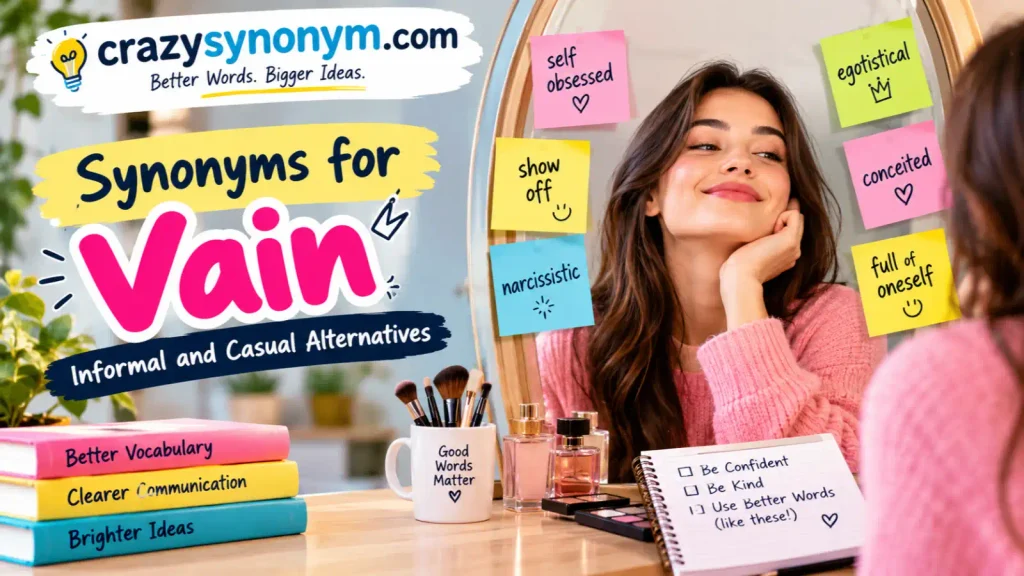
Casual expressions can make conversation sound natural, but some are more insulting or regional than others.
27. Full of Oneself
Meaning: Thinking too highly of oneself.
Explanation: This idiom is a close casual equivalent of vain when describing someone’s personality.
Example: He became so full of himself after winning the contest that he stopped listening to advice.
When Natural: Conversations with friends, informal reviews, and dialogue in fiction.
When to Avoid: Formal reports, workplace complaints, and sensitive discussions.
Tone: Casual, critical.
28. Big-Headed
Meaning: Arrogant or overly pleased with one’s own importance.
Explanation: Big-headed is a casual near synonym for vain. It is especially common in British English, though it is understood elsewhere.
Example: Don’t get big-headed just because your video received a lot of views.
When Natural: Friendly teasing and informal conversation.
When to Avoid: Formal writing or situations where the phrase could sound insulting.
Tone: Casual, mildly negative.
29. A Show-Off
Meaning: Someone who deliberately displays abilities, possessions, or achievements to attract attention.
Explanation: A show-off is a noun describing a person, not a direct adjective replacement for vain.
Example: He acted like a show-off whenever the group discussed sports.
When Natural: Casual conversations and informal storytelling.
When to Avoid: Professional evaluations that require specific, observable behavior.
Tone: Casual, critical.
30. Full of Hot Air
Meaning: Making exaggerated claims without much substance or evidence.
Explanation: This expression emphasizes empty talk rather than vanity itself. It fits someone whose self-praise is unsupported.
Example: The salesman sounded full of hot air when he promised impossible results.
When Natural: Informal criticism and conversational writing.
When to Avoid: Serious business communication or situations requiring a respectful tone.
Tone: Casual, dismissive.
31. Trying Too Hard
Meaning: Making excessive effort to impress others or gain approval.
Explanation: This expression may describe behavior associated with vanity, but it does not necessarily mean a person has an inflated opinion of themselves.
Example: His attempt to impress every guest looked like he was trying too hard.
When Natural: Everyday conversation and informal feedback.
When to Avoid: Serious evaluations unless you explain the specific behavior.
Tone: Casual, mildly critical.
32. Obsessed With Looks
Meaning: Giving excessive attention to physical appearance.
Explanation: This phrase is a contextual alternative for appearance-related vanity. It is stronger than simply being appearance-conscious.
Example: The character was so obsessed with looks that she judged everyone by their clothes.
When Natural: Casual conversation and storytelling.
When to Avoid: Describing someone based only on ordinary grooming or fashion choices.
Tone: Casual, critical.
True Synonyms vs. Contextual Alternatives
Not all words that resemble vain can replace it in every sentence. The table below explains the main differences.
| Type | What It Means | Can It Replace the Original? |
|---|---|---|
| True synonym | A word with nearly the same meaning in a specific context, such as conceited for a vain person | Usually, if the context matches |
| Near synonym | A word with a related but slightly different meaning, such as arrogant | Sometimes |
| Contextual alternative | A phrase suited to one aspect of the meaning, such as image-conscious | Only in relevant contexts |
| Broader expression | A phrase that describes a wider behavior, such as self-centered | Only if the broader meaning fits |
| Narrower expression | A word that describes one specific type of vanity, such as appearance-conscious | Only when that detail matters |
Consider these examples:
- Vain person → conceited person: Both suggest excessive self-admiration.
- Vain attempt → futile attempt: Both can describe an effort that fails to achieve its goal.
- Vain person → image-conscious person: The meaning changes because image-conscious does not necessarily imply arrogance.
- Vain effort → ineffective effort: The emphasis shifts toward performance rather than the futility of the attempt.
synonyms for vain Industry-Specific Usage
Business Writing
In business writing, choose language that describes observable behavior instead of making broad personal judgments.
Instead of writing:
The department head is vain.
Consider:
The department head frequently emphasizes personal achievements while overlooking team contributions.
The second sentence is more specific and gives readers a clearer idea of the behavior being described.
Useful alternatives include self-important, boastful, overconfident, and ineffective, depending on the issue.
Corporate Communication
Internal reports and performance feedback benefit from neutral, evidence-based wording.
For example:
- Instead of vain leadership, use leadership that places excessive emphasis on personal recognition.
- Instead of a pompous announcement, use an announcement that overstates the team’s achievements.
- Instead of vain efforts to improve the process, use unsuccessful efforts to improve the process if the attempts produced no results.
Choose words that distinguish a person’s attitude from the outcome of a project.
Academic Writing
Academic writing calls for precise descriptions and clear distinctions.
- Egotistical: Useful when discussing excessive self-importance.
- Conceited: Suitable for character analysis or critical discussion.
- Futile: Appropriate for an attempt that cannot achieve its intended result.
- Fruitless: Useful when an effort produces no meaningful findings or results.
- Ineffective: Appropriate when evaluating a method or strategy.
Example:
Original: The character was vain and thought he was better than everyone else.
Revised: The character was conceited and repeatedly treated others as inferior.
The revised sentence is more specific because it connects the adjective to observable behavior.
Customer Service
Customer service communication rarely benefits from labeling someone vain, conceited, or arrogant. Describe the problem or result instead.
For example:
- Instead of your request was pointless, write the request would not change the final outcome.
- Instead of your efforts were futile, write the proposed approach did not resolve the issue.
- Instead of the response was pompous, write the response did not address the customer’s main concern.
These alternatives keep the focus on the service issue rather than personal criticism.
Legal Writing
Legal writing requires special care because ordinary synonyms may not preserve the intended meaning of a legal document.
Words such as futile, ineffective, unsuccessful, and unavailing can have different implications depending on the sentence and legal context. Likewise, describing someone as conceited or arrogant introduces a judgment about personality rather than a neutral statement of fact.
When editing legal material, retain the original term if it carries a specific meaning in context. Do not substitute a casual synonym without checking the intended scope and effect.
This is a general language point, not jurisdiction-specific legal advice.
Email Communication
Professional emails should focus on the task, decision, or outcome.
Instead of:
Your proposal was a vain effort.
Write:
Your proposal did not address the project’s current requirements.
Instead of:
He is too vain to accept feedback.
Write:
He has not yet responded constructively to the feedback provided.
These versions reduce unnecessary conflict and give the reader something specific to understand or act on.
synonyms for vain Email Examples Using Alternatives to Vain
Here are six realistic email examples showing how to use different alternatives naturally.
Email 1: Giving Constructive Feedback
Subject: Feedback on the Team Presentation
EmailFeedback on the Team Presentation
Feedback on the Team Presentation
Hi Morgan,
The presentation covered the main points, but some sections placed too much emphasis on individual achievements rather than the team’s results.
For the next version, could you give more attention to shared contributions and project outcomes?
That would make the presentation more balanced and useful for the audience.
Best,
Taylor
Alternative used: Self-focused behavior, expressed through a specific description rather than a personal label.
Why it works: The email identifies the problem without attacking the recipient’s character.
Email 2: Reporting an Unsuccessful Attempt
Subject: Update on the File Recovery
EmailUpdate on the File Recovery
Update on the File Recovery
Hello Priya,
We made several attempts to recover the missing file, but the process was unsuccessful.
The available backup does not contain the latest changes. We are checking whether another copy exists before deciding on the next step.
I’ll send another update once we have more information.
Regards,
Elliot
Alternative used: Unsuccessful.
Why it works: It describes the result directly without implying that the effort was pointless from the start.
Email 3: Addressing Overconfidence
Subject: Review of the Project Timeline
EmailReview of the Project Timeline
Review of the Project Timeline
Hi Daniel,
The current timeline may be overconfident given the remaining testing work.
Could we review the estimates and include additional time for unexpected issues? A more realistic schedule will help the team set expectations with the client.
Thanks,
Renee
Alternative used: Overconfident.
Why it works: It critiques the timeline rather than labeling the person responsible for it.
Email 4: Describing an Ineffective Method
Subject: Alternative Approach for Customer Feedback
EmailAlternative Approach for Customer Feedback
Alternative Approach for Customer Feedback
Hi Sam,
The current survey has produced very few useful responses, so it may be ineffective for reaching our target audience.
I suggest testing a shorter version with a clearer introduction. We can compare the results before deciding whether to keep the existing format.
Best,
Alex
Alternative used: Ineffective.
Why it works: It focuses on measurable performance and proposes a practical next step.
Email 5: Responding to Excessive Self-Promotion
Subject: Draft of the Company Announcement
EmailDraft of the Company Announcement
Draft of the Company Announcement
Hello Jamie,
I reviewed the announcement draft. A few passages sound overly self-promotional and could give readers the impression that the results were achieved by one person alone.
Would you revise those sections to highlight the wider team’s contributions?
That change would better reflect the work behind the project.
Thank you,
Casey
Alternative used: Self-promotional.
Why it works: It identifies the tone and its likely effect on readers without using a personal insult.
Email 6: Explaining Why an Approach Will Not Work
Subject: Next Steps for the Application
EmailNext Steps for the Application
Next Steps for the Application
Hi Noor,
Repeating the same submission without correcting the missing information is unlikely to help.
Let’s review the feedback, update the documents, and submit a complete version instead.
Please send me the revised files when they’re ready.
Best,
Avery
Alternative used: Unlikely to help.
Why it works: It communicates the idea of a futile effort in a constructive, action-focused way.
synonyms for vain Short Dialogue Examples
These short conversations show how alternatives to vain can sound natural in different settings.
Workplace
Person A: Why does Leo keep reminding everyone that he led the project?
Person B: He can sound self-important, especially when he leaves out the team’s work.
Classroom
Person A: Was the extra research a waste of time?
Person B: Not entirely, but the final search was fruitless because the source had been removed.
Customer Service
Person A: Should I tell the customer their complaint is pointless?
Person B: No. Explain why the requested change would not affect the outcome.
Casual Conversation
Person A: He’s been bragging about his new car all evening.
Person B: Yes, he’s getting a little big-headed about it.
Professional Discussion
Person A: Do you think the proposal is unrealistic?
Person B: The targets seem overconfident, so we should review the assumptions before approving it.
synonyms for vain How to Replace Vain in a Sentence
The easiest way to choose an alternative is to identify which meaning the original sentence expresses.
Example 1: Excessive Pride
Original: He is vain about his achievements.
Alternative: He is conceited about his achievements.
Why it works: Conceited preserves the negative meaning of excessive self-admiration.
Example 2: Arrogant Behavior
Original: Her vain attitude upset the team.
Alternative: Her self-important attitude upset the team.
Why it works: Self-important emphasizes an exaggerated sense of importance. It may be less focused on appearance than vain.
Example 3: An Unsuccessful Effort
Original: Their attempts to repair the device were in vain.
Alternative: Their attempts to repair the device were unsuccessful.
Why it works: Unsuccessful clearly states the result without implying that the attempts were pointless from the beginning.
Example 4: A Futile Search
Original: We searched in vain for the missing receipt.
Alternative: Our search for the missing receipt proved fruitless.
Why it works: Fruitless highlights the absence of a useful result.
Example 5: Excessive Attention to Appearance
Original: She is vain about her appearance.
Alternative: She is highly appearance-conscious.
Why it works: Appearance-conscious identifies the focus on looks but removes some of the original criticism.
Example 6: Excessive Self-Praise
Original: His vain speech annoyed the audience.
Alternative: His boastful speech annoyed the audience.
Why it works: Boastful specifically points to proud, self-promoting speech.
Example 7: An Unproductive Strategy
Original: It was a vain attempt to change the decision.
Alternative: It was a futile attempt to change the decision.
Why it works: Futile emphasizes that the attempt had little or no chance of achieving its goal.
Example 8: Self-Importance in a Meeting
Original: The director sounded vain during the meeting.
Alternative: The director sounded pompous during the meeting.
Why it works: Pompous highlights an exaggerated or overly impressive manner. It is not a perfect replacement if the original refers specifically to personal vanity.
Example 9: An Ineffective Method
Original: The team made vain efforts to increase attendance.
Alternative: The team’s efforts to increase attendance were ineffective.
Why it works: Ineffective focuses on the method’s failure to produce the desired effect.
Example 10: Empty Self-Promotion
Original: His vain claims impressed nobody.
Alternative: His self-aggrandizing claims impressed nobody.
Why it works: Self-aggrandizing emphasizes claims intended to make the speaker appear more important.
synonyms for vain Comparison Table
| Phrase | Tone | Meaning / Scope | Best Use | Example |
|---|---|---|---|---|
| Conceited | Negative | Excessive self-admiration | Describing personality | He sounded conceited. |
| Egotistical | Formal, negative | Inflated sense of self | Essays and reports | The egotistical leader ignored advice. |
| Arrogant | Negative | Believing oneself superior | Behavior and attitude | Her arrogant reply ended the discussion. |
| Self-important | Critical | Exaggerated sense of importance | Workplace writing | His self-important manner caused tension. |
| Narcissistic | Strongly critical | Excessive self-focus and admiration | Careful behavioral description | The character displayed narcissistic traits. |
| Boastful | Critical | Excessive self-praise | Speech and writing | His boastful remarks annoyed the audience. |
| Proud | Neutral or positive | Satisfaction in achievements | Recognition and personal writing | She was proud of her work. |
| Image-conscious | Neutral | Concern about public perception | Media and professional contexts | The candidate was image-conscious. |
| Futile | Neutral | Unlikely to succeed | Describing an attempt | Further debate seemed futile. |
| Fruitless | Neutral | Producing no useful results | Searches and efforts | The search proved fruitless. |
| Pointless | Casual | Having no useful purpose | Everyday conversation | The argument became pointless. |
| Ineffective | Professional | Failing to produce an intended effect | Methods and strategies | The campaign was ineffective. |
| Pretentious | Critical | Trying to appear more impressive | Reviews and character descriptions | The dialogue sounded pretentious. |
| Pompous | Critical | Exaggerated self-importance in manner | Speech and behavior | His pompous introduction dragged on. |
| Unavailing | Formal | Failing to achieve a result | Formal or literary prose | Their efforts were unavailing. |
Which Alternative Should You Choose?
Use the meaning and audience of your sentence to guide your choice.
- Formal writing: Choose egotistical, vainglorious, or self-aggrandizing for excessive pride. Use futile or unavailing for failed efforts.
- Business communication: Prefer self-important, boastful, overconfident, or ineffective when the specific behavior or result supports that description.
- Academic writing: Use conceited for a character’s excessive pride, fruitless for an unsuccessful search, and ineffective for a method that fails to work.
- Legal writing: Preserve the original meaning and use precise, evidence-based language. Avoid casual substitutions when the wording affects the intended scope.
- Professional email: Describe the issue rather than attacking someone’s personality. For example, say that an approach was ineffective instead of calling someone’s effort vain.
- Everyday conversation: Conceited, big-headed, and full of oneself sound natural when describing arrogance.
- Casual messages: Pointless and trying too hard may fit informal situations, but they can sound dismissive.
A useful rule is to ask yourself: Am I describing a person’s attitude, an attempt, an outcome, or a concern about appearance? The answer usually reveals the best replacement.
synonyms for vain Grammar and Usage Guide
Understanding how vain works in a sentence helps prevent awkward substitutions.
1. Vain Is an Adjective
Vain describes a person, attitude, attempt, or action.
- Correct: She is vain about her appearance.
- Correct: Their efforts were in vain.
- Incorrect: Their efforts were a vainly attempt.
Vainly is the adverb form, but the sentence needs a different structure:
– Correct: They vainly attempted to change the result.
2. Understand the Expression In Vain
The phrase in vain means without success or without achieving the desired result.
Examples:
- We waited in vain for a response.
- She tried in vain to open the locked door.
- Their efforts were not in vain because they learned what had gone wrong.
The last sentence shows that an unsuccessful attempt can still have value.
3. Use the Right Word With the Right Noun
Different adjectives naturally pair with different nouns.
- Conceited person: A person who thinks too highly of themselves.
- Futile attempt: An effort unlikely to succeed.
- Fruitless search: A search that produces no useful result.
- Ineffective method: A method that fails to produce the intended effect.
- Ostentatious display: A showy display intended to attract attention or impress.
Choosing a natural combination makes writing easier to understand.
4. Do Not Confuse Vain With Vein or Vane
These words sound alike but have different meanings.
- Vain: Excessively proud, or unsuccessful when used in the expression in vain.
- Vein: A blood vessel or a streak of a particular substance.
- Vane: A device that shows the direction of the wind.
Correct: She searched in vain for the missing key.
Incorrect: She searched in vein for the missing key.
5. Watch for Meaning Changes
Vain, conceited, and self-assured are not interchangeable in every sentence.
- Vain often suggests excessive self-admiration.
- Conceited usually expresses a negative judgment about someone’s opinion of themselves.
- Self-assured often suggests healthy confidence.
A sentence can change significantly when you replace one with another.
synonyms for vain Common Mistakes to Avoid
1. Treating Every Alternative as an Exact Synonym
Futile describes an unsuccessful attempt, while conceited describes a person’s attitude. They cannot replace each other in most sentences.
2. Using Negative Words for Positive Confidence
Calling someone vain may imply excessive pride. Calling them self-assured usually suggests confidence. Choose based on the behavior you intend to describe.
3. Overusing Formal Vocabulary
Words such as vainglorious and supercilious can sound unnatural in a simple email. Use familiar wording when clarity matters more than literary style.
4. Confusing Appearance With Personality
An appearance-conscious person is not automatically arrogant. Describe the person’s actual behavior rather than assuming a motive.
5. Making Professional Feedback Personal
Instead of saying that a colleague is conceited, explain the behavior that caused concern. Specific observations are more useful than broad labels.
6. Using Pointless When You Mean Unsuccessful
An unsuccessful effort may still provide useful information. Pointless suggests that the effort has little or no purpose or value.
7. Replacing In Vain With an Awkward Phrase
The expression in vain is often more natural than a longer alternative. For example, We tried in vain to contact him is clear and concise.
8. Using Narcissistic as a Casual Diagnosis
Narcissistic can carry psychological implications. Avoid applying it to someone simply because they brag or enjoy attention.
9. Ignoring Regional Differences
Expressions such as big-headed and up oneself vary in familiarity across English-speaking regions. Choose language that suits your readers.
When Not to Use Vain
Although alternatives can improve your writing, replacing vain is not always necessary.
1. When the Meaning Is Already Clear
If the sentence accurately describes an unsuccessful attempt, in vain may be the simplest choice.
Example: We searched in vain for the missing notebook.
2. When You Need to Express Excessive Self-Admiration
If excessive pride is central to your meaning, vain may be more accurate than image-conscious or self-assured.
3. When Writing About a Literary Character
An author may deliberately use vain to establish a character’s flaws. Replacing it with a more specific word could change the intended characterization.
4. When a Substitute Sounds Too Harsh
Arrogant and narcissistic may communicate stronger criticism than you intend. Sometimes overly concerned with appearance is more balanced.
5. When a Formal Alternative Makes the Sentence Harder to Read
Words such as unavailing and vainglorious have their place, but plain language is usually better when the audience may not know the terms.
6. When the Original Phrase Is More Natural
The phrase in vain is familiar and concise. There is little benefit in replacing it if the sentence already communicates the intended meaning.
synonyms for vain Advanced Writer Tips
Control the Tone
Choose a word that matches the strength of your judgment.
- Mild criticism: self-focused.
- Clear criticism: conceited.
- Strong criticism: arrogant or self-aggrandizing.
- Neutral outcome description: unsuccessful.
- Emphasis on no practical value: pointless.
The strongest word is not always the best word.
Use Evidence in Professional Communication
If you describe someone as boastful or self-important, support the observation with specific behavior. For example, explain that the person repeatedly claimed credit for shared work.
This approach is more useful than relying on a personal label.
Keep Politeness and Precision Together
Professional writing can remain direct without sounding insulting.
Instead of your efforts were futile, try this approach has not produced the intended result. The second version leaves room to discuss another solution.
Match the Word to the Subject
Use adjectives about personality for people, and words about performance for methods or attempts.
- Person: conceited.
- Speech: boastful.
- Display: ostentatious.
- Attempt: futile.
- Search: fruitless.
- Strategy: ineffective.
Prefer Clear Language Over Unnecessary Complexity
A formal synonym is useful only if it communicates the meaning accurately. If readers must stop to interpret a rare word, a familiar alternative may serve them better.
FAQs:
What is another way to say vain?
Another way to say vain is conceited, egotistical, self-important, or arrogant when describing a person. When describing an unsuccessful attempt, use futile, fruitless, or unsuccessful. The correct alternative depends on whether the sentence concerns pride or an outcome.
What is a professional alternative to vain?
Professional alternatives include self-important, overly self-focused, boastful, and overconfident for behavior. For unsuccessful work, use ineffective, unsuccessful, or unproductive. In workplace communication, a specific description of behavior is often more constructive than a personal label.
Is vain a formal or informal word?
Vain is suitable for both formal and informal English. It appears in essays, books, reports, and everyday conversation. However, its meaning depends on context: it can describe excessive self-admiration or an unsuccessful effort in the phrase in vain.
What is the difference between vain and conceited?
Vain can describe excessive pride in appearance, abilities, or importance, as well as an unsuccessful effort. Conceited specifically describes someone who thinks too highly of themselves. Conceited is therefore a close synonym for only one major sense of vain.
What is the difference between vain and futile?
Vain describes excessive self-admiration when applied to a person, but in vain means without success. Futile describes an action or attempt that is unlikely to achieve its goal. For example, a person can be vain, while an attempt can be futile.
What is a positive alternative to vain?
Depending on the intended meaning, positive alternatives include self-assured, confident, and proud. These words do not preserve the negative meaning of vain exactly. They are appropriate when you want to describe healthy confidence or satisfaction rather than excessive self-admiration.
Can vain and narcissistic be used interchangeably?
Not in every situation. Vain often describes excessive pride in appearance or personal qualities. Narcissistic suggests a broader pattern of self-focus or a strong need for admiration and may carry psychological implications. Use narcissistic carefully and avoid treating it as a diagnosis based on limited behavior.
Key Takeaways:
- Conceited, egotistical, and self-important are useful alternatives when vain describes excessive pride.
- Futile, fruitless, and unsuccessful fit the expression in vain when the focus is an unsuccessful attempt.
- Image-conscious describes concern about public perception or appearance without necessarily implying arrogance.
- Professional writing benefits from specific descriptions of behavior, methods, and results rather than broad personal judgments.
- Context determines the best synonym. Check the subject, tone, and intended meaning before replacing the original word.
Conclusion:
Choosing the right alternative to vain starts with understanding what the word means in your sentence. If you are describing someone who thinks too highly of themselves, conceited, egotistical, arrogant, and self-important are strong options. For writing about appearance, appearance-conscious or image-conscious may be more precise and less judgmental.
When vain refers to an unsuccessful effort, the best choices change. Futile emphasizes an attempt that is unlikely to succeed, fruitless highlights a lack of useful results, and ineffective focuses on a method that does not produce the intended outcome.
For professional emails, reports, and academic assignments, choose words that communicate the exact problem without adding unnecessary criticism. Casual expressions such as big-headed and full of oneself work better in informal conversation than in formal documents.
Above all, do not replace a word simply to make your writing sound more sophisticated. Select the alternative that matches your intended meaning, fits your audience, and makes the sentence easier to understand.

I’m Daniel Carter, an English vocabulary writer who enjoys making words simple and easy to understand. At CrazySynonym.com, I create helpful guides on synonyms, meanings, antonyms, and everyday word usage to help readers choose the right words with confidence.