
Finding the right synonym for scenario depends on what you mean. In everyday writing, situation or circumstance may work naturally. In business, case, possibility, projection, or contingency can be more precise. In storytelling, setting, plot, or sequence of events may fit better.
The key is not simply replacing scenario with another word. Some alternatives are true synonyms, while others are broader, narrower, more formal, or useful only in a particular context. This guide explains 37 synonyms for scenario, with examples showing exactly when each alternative works and when it does not.
Quick Answer
The closest synonyms for scenario include situation, circumstance, case, context, setting, possibility, eventuality, contingency, state of affairs, and sequence of events. The best replacement depends on meaning: situation works broadly, contingency suggests a possible future event, while setting usually refers to the surroundings or conditions of a story or event.
Quick List: 37 Useful Alternatives to Scenario
Here are 37 alternatives, grouped by how closely they match the original meaning:
Closest alternatives
- Situation — a set of circumstances at a particular time
- Circumstance — a condition or fact surrounding an event
- Case — a particular situation or example
- Context — surrounding facts that help explain something
- State of affairs — the current condition of things
- Set of circumstances — several conditions considered together
- Eventuality — a possible future event or outcome
- Possibility — something that could happen
- Contingency — a possible event that requires preparation
- Instance — a particular occurrence or example
Formal and professional alternatives
- Hypothetical — an imagined possibility used for discussion
- Projection — an estimate of what may happen in the future
- Forecast — a prediction based on available information
- Prospect — a possible future situation or development
- Case study — a detailed examination of a particular real or hypothetical case
- Model — a structured representation of a possible situation
- Framework — a structure used to analyze or organize possible conditions
- Contingency plan — a plan designed for a possible future problem
- Assumption — something accepted as a basis for considering a situation
- Supposition — an idea accepted temporarily for reasoning
Contextual alternatives
- Setting — the place, time, or circumstances in which something occurs
- Background — surrounding information that provides context
- Environment — surrounding conditions affecting an event
- Condition — a particular circumstance affecting something
- Example — a specific case used to illustrate an idea
- Situation analysis — systematic examination of circumstances
- Course of events — the way events develop
- Sequence of events — events arranged in the order they happen
- Chain of events — connected events leading from one to another
- State — a particular condition at a given time
Storytelling and creative alternatives
- Storyline — the main sequence or development of a story
- Plot — the connected events that form a story
- Narrative — an account or representation of connected events
- Version — one possible form or account of events
- Picture — an overall description or mental representation
- Thought experiment — an imagined situation used to explore an idea
- Hypothetical case — an imagined example used for analysis
Not all 37 are interchangeable with scenario. That distinction matters.
Synonyms for Scenario Formal Alternatives to Scenario
1. Situation
Meaning: A set of conditions or circumstances existing at a particular time.
Explanation: Situation is probably the most flexible replacement for scenario. It can describe something real, current, past, or hypothetical.
Example: The team discussed the situation before making a decision.
Best Use: Everyday writing, business communication, school assignments, and conversation.
Worst Use: Avoid it when you specifically mean a carefully imagined future possibility and need to emphasize that something has not happened.
Tone: Neutral.
2. Circumstance
Meaning: A condition or fact surrounding an event.
Explanation: Circumstance focuses more on the surrounding conditions than on the complete imagined situation.
Example: Under these circumstances, delaying the launch may be reasonable.
Best Use: Formal writing, explanations, reports, and professional communication.
Worst Use: It may sound unnatural if you simply need a general word for a hypothetical situation.
Tone: Neutral to formal.
3. Case
Meaning: A particular situation, example, or instance.
Explanation: Case is especially useful when discussing one specific example.
Example: In this case, the customer received a replacement.
Best Use: Business, academic, legal, and analytical writing.
Worst Use: Do not use it when scenario refers to a broad future possibility unless the context clearly supports that meaning.
Tone: Neutral and professional.
4. Context
Meaning: The surrounding information or conditions that help explain something.
Explanation: Context is related to scenario but is not a perfect synonym. It tells readers what surrounds an event rather than necessarily describing the event itself.
Example: The statement sounds different when viewed in context.
Best Use: Academic writing, communication, analysis, and explanations.
Worst Use: Avoid replacing every occurrence of scenario with context.
Tone: Neutral to formal.
5. State of affairs
Meaning: The current condition or situation.
Explanation: This phrase is more formal than situation and often describes an existing condition.
Example: The report describes the current state of affairs in the industry.
Best Use: Reports, essays, commentary, and formal discussions.
Worst Use: Casual text messages or friendly conversation.
Tone: Formal.
6. Eventuality
Meaning: A possible future event or development.
Explanation: Eventuality is useful when the scenario involves something that might happen later.
Example: The company prepared for the eventuality of a supply shortage.
Best Use: Risk management, planning, business writing, and formal communication.
Worst Use: A simple present situation.
Tone: Formal.
7. Contingency
Meaning: A possible event or condition that may require preparation.
Explanation: This is more specific than scenario. It usually involves uncertainty and the need to prepare for what might happen.
Example: The emergency fund protects the business against an unexpected contingency.
Best Use: Business, finance, operations, project management, and planning.
Worst Use: Ordinary situations that require no planning for uncertainty.
Tone: Formal and professional.
8. Hypothetical
Meaning: Something imagined for the purpose of discussion or reasoning.
Explanation: Hypothetical works when the scenario is deliberately invented rather than describing an actual event.
Example: Let’s consider a hypothetical in which demand suddenly doubles.
Best Use: Academic discussions, training, interviews, debates, and analysis.
Worst Use: A real event that actually happened.
Tone: Neutral to formal.
9. Projection
Meaning: An estimate of a future situation based on current information.
Explanation: Projection is useful when the scenario involves numbers, trends, business results, or expected developments.
Example: The financial projection assumes moderate growth next year.
Best Use: Finance, business, economics, and planning.
Worst Use: A purely fictional situation with no predictive basis.
Tone: Professional.
10. Forecast
Meaning: A prediction about what is likely to happen.
Explanation: A forecast is narrower than scenario because it normally involves an expectation about the future.
Example: The latest sales forecast suggests stronger demand in December.
Best Use: Business, weather, economics, sales, and planning.
Worst Use: A neutral description of a current situation.
Tone: Professional.
Synonyms for Scenario Neutral and Semi-Formal Alternatives
11. Possibility
Meaning: Something that may happen or exist.
Example: One possibility is that the meeting will be moved online.
Best Use: Everyday and professional communication.
When to avoid it: When you need to describe the complete circumstances rather than simply one potential outcome.
Tone: Neutral.
12. Prospect
Meaning: A possible future development or situation.
Example: The prospect of higher costs changed the team’s plans.
Best Use: Formal and professional writing.
Meaning shift: It often emphasizes what may happen rather than describing the entire situation.
Tone: Formal.
13. Instance
Meaning: A particular occurrence or example.
Example: This is an instance where clearer instructions would help.
Best Use: Academic and explanatory writing.
Meaning shift: An instance is usually a specific occurrence, while a scenario can be imagined or broad.
Tone: Neutral.
14. Example
Meaning: A specific case used to explain an idea.
Example: Consider this example: a customer receives the wrong product.
Best Use: Teaching, explanations, guides, and articles.
Meaning shift: Not every scenario is an example, and not every example describes a scenario.
Tone: Neutral.
15. Setting
Meaning: The time, place, or circumstances in which something happens.
Example: The story’s setting is a small coastal town.
Best Use: Literature, storytelling, films, and descriptions.
Meaning shift: Setting focuses strongly on environment, place, and time.
Tone: Neutral.
16. Environment
Meaning: The surrounding conditions in which something operates.
Example: The software performs differently in a high-traffic environment.
Best Use: Technology, business, science, education, and technical writing.
Meaning shift: It describes surrounding conditions rather than a complete sequence of possible events.
Tone: Neutral to professional.
17. Condition
Meaning: A circumstance that affects a person, event, or process.
Example: Under these conditions, the equipment should not be operated.
Best Use: Technical, academic, professional, and everyday writing.
Meaning shift: A condition may be only one part of a scenario.
Tone: Neutral.
18. Background
Meaning: Information or circumstances surrounding an event.
Example: The report provides useful background before discussing the decision.
Best Use: Reports, articles, essays, and presentations.
Meaning shift: Background explains a situation rather than replacing the entire idea of scenario.
Tone: Neutral.
19. Model
Meaning: A structured representation of a possible system or situation.
Example: Analysts created a model of how demand could change.
Best Use: Business, economics, science, technology, and planning.
Meaning shift: A model is a representation, not the situation itself.
Tone: Professional.
20. Framework
Meaning: A structure used to organize or analyze information.
Example: The framework helps managers examine different market conditions.
Best Use: Academic and professional writing.
Meaning shift: A framework organizes thinking; it does not necessarily describe a specific scenario.
Tone: Formal.
Synonyms for Scenario Informal and Contextual Alternatives
There are relatively few true casual synonyms for scenario. Native speakers usually choose ordinary words based on the meaning rather than using slang.
21. Picture
Meaning: A general representation or description of a situation.
Example: That gives us a clearer picture of what might happen.
When natural: Conversation, presentations, and explanatory writing.
When to avoid: Formal technical definitions where precision matters.
Tone: Casual to neutral.
22. Situation
Although situation works in formal writing, it is also extremely common in casual conversation.
Example: That’s a tricky situation.
When natural: Almost any everyday context.
When to avoid: Only when a more precise term such as forecast or contingency is required.
Tone: Neutral.
23. Storyline
Meaning: The main development of a story.
Example: The new episode introduces a completely different storyline.
When natural: Television, books, films, games, and creative writing.
When to avoid: Business or technical writing unless discussing a narrative.
Tone: Neutral and creative.
24. Plot
Meaning: The connected events that make up a story.
Example: The film has an unexpected plot twist.
When natural: Fiction, movies, novels, and storytelling.
When to avoid: Do not use plot for an ordinary business possibility.
Tone: Creative.
25. Narrative
Meaning: An account or representation of connected events.
Example: The documentary presents a compelling narrative about the investigation.
When natural: Journalism, literature, history, and academic writing.
When to avoid: Simple everyday situations where situation is clearer.
Tone: Neutral to formal.
True Synonyms vs. Contextual Alternatives
| Type | What It Means | Can It Replace Scenario? |
|---|---|---|
| True synonym | Very similar meaning in the same context | Often |
| Near synonym | Similar but with a slight meaning difference | Sometimes |
| Contextual alternative | Works in a particular context | Only in suitable contexts |
| Broader expression | Covers a wider idea | Sometimes |
| Narrower expression | Describes only one aspect of a scenario | Only when that aspect is intended |
For example, situation is usually a strong replacement. Contingency is more specific because it normally refers to a possible event that needs preparation. Plot is much narrower because it belongs mainly to storytelling.
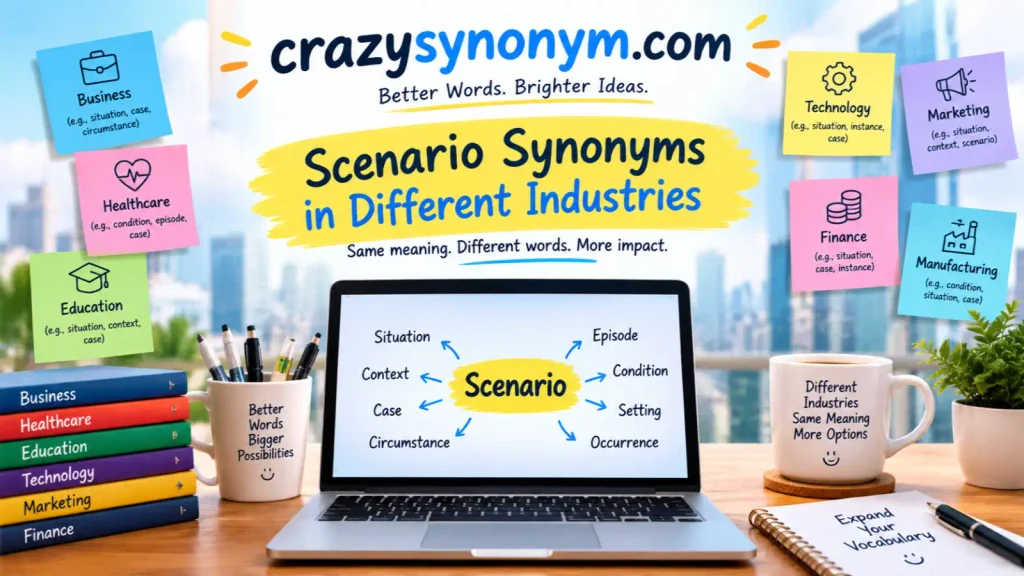
Scenario Synonyms in Different Industries
Business Writing
Business writers often use case, situation, possibility, projection, forecast, and contingency.
Instead of:
The company prepared for several possible scenarios.
You could write:
The company prepared for several possible market conditions.
Or:
The company developed contingency plans for several potential disruptions.
The second version is more precise if preparation is the main point.
Corporate Communication
In reports and internal communications, case, circumstances, state of affairs, and eventuality can sound more precise.
For example:
Under these circumstances, the department will postpone the rollout.
This is clearer than using scenario when the conditions are already known.
Academic Writing
Academic writers often benefit from case, example, hypothetical case, instance, context, and circumstances.
For example:
Consider a hypothetical case in which the sample size is reduced.
That wording tells the reader immediately that the example is imagined.
Customer Service
Customer-facing communication usually benefits from simple language.
Instead of:
In this scenario, your refund may take longer.
Try:
In this situation, your refund may take longer.
Situation is generally easier for a broad audience to understand.
Legal Writing
Legal writing requires extra precision. Words that look like synonyms may have different legal scope.
Terms such as circumstance, condition, case, and event can describe different concepts depending on the document. A casual substitute should not be treated as legally equivalent without considering the specific jurisdiction and document.
Email Communication
For professional emails, situation and circumstances are usually natural:
Given the circumstances, we can move the meeting to Thursday.
For planning emails, possibility or contingency may be better:
We should discuss the possibility of a delayed shipment.
Synonyms for Scenario Email Examples
Email 1 — Workplace Update
Subject: Update on the Delivery
Hi Maya,
Given the current situation, the delivery may arrive one day later than expected. I will send another update as soon as the carrier confirms the new date.
Best,
Jordan
Email 2 — Client Communication
Subject: Project Timeline
Hi Daniel,
One possibility is that we may need an additional two days to complete testing. I wanted to let you know early so we can adjust the schedule if necessary.
Thanks,
Elena
Email 3 — Contingency Planning
Subject: Backup Plan for Friday
Hi Team,
Let’s prepare for the eventuality of heavy traffic affecting Friday’s event. If that happens, we can move the equipment setup to the afternoon.
Regards,
Marcus
Email 4 — Academic Context
Subject: Assignment Question
Professor Lee,
I am considering a hypothetical case in which the original assumption changes halfway through the experiment. Would that be an acceptable approach for the assignment?
Thank you,
Nina
Email 5 — Internal Business Report
Subject: Revised Sales Projection
Hi Aaron,
The latest projection assumes steady demand through the final quarter. I have also included a separate estimate for slower growth.
Best,
Priya
Synonyms for Scenario Short Dialogue Examples
Person A: What should we do if the supplier cancels?
Person B: Let’s consider that possibility before we finalize the order.
Person A: Why did you use the word circumstances?
Person B: Because the decision depends on several conditions, not just one event.
Person A: Is this a real situation?
Person B: No. It’s a hypothetical case for the training exercise.
Person A: What’s the setting of the novel?
Person B: A small mountain town during a harsh winter.
Person A: Do we have a backup plan?
Person B: Yes. The contingency covers a two-week delay.
Sentence Transformations: How to Replace Scenario in a Sentence
1
Original: We need to prepare for every possible scenario.
Alternative: We need to prepare for every possible situation.
Why it works: Situation is broad and natural, although it is slightly less focused on imagined possibilities.
2
Original: In this scenario, the customer receives a refund.
Alternative: In this case, the customer receives a refund.
Why it works: Case works well when describing one particular example.
3
Original: The team discussed a worst-case scenario.
Alternative: The team discussed the possibility of a severe disruption.
Why it works: Possibility emphasizes that the event may happen. It does not automatically carry the same planning meaning as scenario.
4
Original: The company created several business scenarios.
Alternative: The company created several business projections.
Why it works: Projection works when each scenario represents an estimated future business outcome.
5
Original: Under this scenario, costs would increase.
Alternative: Under these circumstances, costs would increase.
Why it works: Circumstances emphasizes the conditions that lead to the result.
6
Original: The report examines a hypothetical scenario.
Alternative: The report examines a hypothetical case.
Why it works: Hypothetical case is natural in academic and analytical writing.
7
Original: The scenario takes place in a rural village.
Alternative: The story’s setting is a rural village.
Why it works: Setting is more precise when discussing the place and environment of a story.
8
Original: The scenario shows what could happen after the policy changes.
Alternative: The projection shows what could happen after the policy changes.
Why it works: Projection fits if the statement is based on an estimate or analytical model rather than pure imagination.
Synonyms for Scenario Comparison Table
| Phrase | Tone | Meaning / Scope | Best Use | Example |
|---|---|---|---|---|
| Scenario | Neutral | A possible or described situation | General writing | Consider another scenario. |
| Situation | Neutral | Conditions at a particular time | Everyday and professional writing | The situation changed quickly. |
| Circumstance | Formal | Conditions surrounding an event | Formal writing | Under these circumstances… |
| Case | Neutral | A particular situation or example | Academic and business writing | Consider this case. |
| Possibility | Neutral | Something that may happen | Planning and conversation | That’s one possibility. |
| Contingency | Formal | Possible event requiring preparation | Risk planning | Prepare for the contingency. |
| Projection | Professional | Estimated future result | Finance and business | The projection is positive. |
| Forecast | Professional | Prediction of future conditions | Business and economics | The forecast changed. |
| Setting | Neutral | Time, place, and surroundings | Stories and literature | The setting is unusual. |
| Context | Formal | Surrounding information | Analysis and education | Consider the context. |
| Plot | Creative | Events forming a story | Fiction and film | The plot is complex. |
| Narrative | Formal | Account of connected events | Journalism and literature | The narrative develops slowly. |
| Eventuality | Formal | Possible future event | Planning | Prepare for that eventuality. |
| Model | Professional | Representation of a system | Science and business | The model predicts demand. |
Synonyms for Scenario Which Alternative Should You Choose?
For formal writing: Use circumstance, state of affairs, eventuality, or case when their specific meanings fit.
For business communication: Choose situation, case, possibility, projection, or contingency according to whether you are discussing current conditions, examples, future possibilities, estimates, or risks.
For academic writing: Case, hypothetical case, instance, and context are often useful.
For legal writing: Choose terminology based on the precise legal meaning intended. Do not replace a specialized term merely to make the prose sound different.
For professional email: Situation is usually the safest general choice. Circumstances works well when several conditions affect a decision.
For everyday conversation: Situation and possibility usually sound more natural than formal terms such as eventuality.
For stories and movies: Use setting, plot, storyline, or narrative when those specific concepts are what you mean.
Synonyms for Scenario Grammar and Usage Guide
Is scenario countable?
Yes. Scenario is a countable noun.
Correct:
- We considered a scenario.
- The team reviewed three scenarios.
- Several possible scenarios were discussed.
Common prepositions
The most common combinations include:
- in a scenario
- under a scenario
- in this scenario
- in that scenario
- a possible scenario
- a hypothetical scenario
- a worst-case scenario
- a likely scenario
However, the exact preposition can change naturally depending on the alternative.
For example:
In this scenario, sales decline.
But:
Under these circumstances, sales decline.
Scenario vs. situation
These words overlap heavily, but scenario often suggests a described possibility, especially one being analyzed.
The current situation is difficult.
describes something real.
Let’s consider a scenario in which demand doubles.
creates a possible case for analysis.
Scenario vs. circumstance
Circumstance usually emphasizes conditions surrounding something.
Due to unforeseen circumstances, the event was canceled.
Here, scenario would not sound natural.
Scenario vs. possibility
A possibility is simply something that may happen. A scenario can describe the fuller set of events or conditions surrounding that possibility.
Scenario vs. setting
A setting identifies the environment, time, or place. It does not normally mean an entire possible chain of events.
Synonyms for Scenario Common Mistakes to Avoid
- Treating every alternative as an exact synonym
Plot and forecast have very different meanings from scenario. - Using formal words unnecessarily
Eventuality may sound stiff when possibility is perfectly clear. - Confusing context with situation
Context provides surrounding information; a situation is the condition itself. - Using forecast for a fictional possibility
A forecast normally has some predictive basis. - Using setting for a business situation
Setting usually points to environment, time, or place. - Ignoring the audience
Customer-facing content often benefits from situation instead of technical terms. - Creating meaning drift
Changing scenario to outcome can change the meaning. An outcome is the result, not the entire situation. - Overusing scenario itself
Repeating the same noun can make professional writing feel mechanical. Choose a more precise alternative when one exists.
When Not to Use Scenario
There are several situations where scenario is not the clearest choice.
When describing a real current condition
Use situation instead:
The current situation requires immediate attention.
When describing surrounding conditions
Use circumstances:
Under these circumstances, postponement makes sense.
When predicting future numbers
Use projection or forecast:
The latest sales forecast indicates slower growth.
When discussing a story’s location
Use setting:
The novel’s setting is a remote island.
When describing a story’s events
Use plot or storyline:
The plot becomes more complicated in the second chapter.
When explaining surrounding information
Use context:
The decision makes more sense when viewed in context.
Still, scenario is often the best choice when you are deliberately describing a possible situation for analysis, planning, training, or discussion.
Advanced Writer Tips
Control the tone
Choose the simplest word that accurately communicates your meaning. Situation is often clearer than a more sophisticated-looking alternative.
Match the level of certainty
Use possibility when something may happen, forecast when there is a prediction, and hypothetical when the situation is intentionally imagined.
Be precise in professional emails
Instead of:
In this scenario, we might need to delay the project.
Try:
If the supplier misses the deadline, we may need to delay the project.
The second sentence explains the actual condition rather than hiding it behind a vague noun.
Prefer concrete wording
Compare:
In this scenario, additional action may be required.
with:
If the shipment arrives late, we may need to change the delivery schedule.
The second version gives readers something specific to understand.
Use context-sensitive synonyms
Don’t replace scenario simply to avoid repetition. Replace it because the alternative communicates something more precise.
Synonyms for Scenario Related Questions
What is another way to say scenario?
The most common alternative is situation. Depending on context, you can also use case, circumstance, possibility, eventuality, contingency, context, or setting.
What is a professional alternative to scenario?
For professional writing, situation, circumstances, case, possibility, contingency, projection, and eventuality can work. The correct choice depends on whether you are discussing current conditions, future possibilities, risks, or predictions.
Is scenario a formal word?
Scenario is a standard neutral word used in everyday, academic, business, technical, and professional English. It is not excessively formal.
What is the difference between scenario and situation?
A situation generally describes existing conditions, while a scenario often describes a possible, imagined, or specifically defined set of circumstances. The meanings overlap considerably.
What is the difference between scenario and possibility?
A possibility is something that may happen. A scenario can describe the broader circumstances, sequence of events, or conditions surrounding that possibility.
What is the difference between scenario and circumstance?
A circumstance is a condition surrounding an event or decision. A scenario can combine several circumstances into a complete possible situation.
Can case replace scenario?
Sometimes. Case is especially useful when discussing a particular example or instance. It should not automatically replace scenario in every sentence.
FAQs:
What is the closest synonym for scenario?
Situation is generally the closest broad synonym for scenario. Other strong choices include case and circumstances, but each can emphasize a slightly different aspect of the meaning.
What is a formal word for scenario?
Formal alternatives include eventuality, contingency, state of affairs, circumstance, hypothetical case, and projection. Choose according to the intended meaning rather than formality alone.
What is a simple word for scenario?
Situation is the simplest and most widely useful alternative. Case and possibility are also easy choices when their meanings fit the sentence.
What is another word for a possible scenario?
You can use possibility, eventuality, contingency, hypothetical case, or potential situation. Contingency is particularly useful when the possibility requires planning.
Is situation and scenario the same thing?
They can overlap, but they are not always identical. Situation commonly describes actual conditions, while scenario often describes a defined or imagined possibility being considered.
What is the opposite of a hypothetical scenario?
A hypothetical scenario is imagined rather than confirmed. Depending on context, the contrasting idea could be a real situation, actual event, or documented case.
Which synonym for scenario is best in academic writing?
There is no single choice for every academic sentence. Case, hypothetical case, instance, context, and circumstances are useful when their specific meanings match the argument.
Key Takeaways
- Situation is the safest general replacement for scenario in most everyday and professional contexts.
- Circumstance emphasizes the conditions surrounding an event, while case focuses on a particular example.
- Possibility, eventuality, and contingency are useful when discussing things that might happen in the future.
- Projection and forecast are better when the scenario represents an evidence-based prediction rather than a simple hypothetical.
- In storytelling, setting, plot, storyline, and narrative can replace scenario only when their more specific meanings are intended.
Conclusion:
The best synonym for scenario is not always the most sophisticated one. In many sentences, situation is the clearest choice because it works across everyday, academic, and professional English. When greater precision is needed, the surrounding meaning should guide your choice.
Use circumstances for surrounding conditions, case for a particular example, possibility for something that may happen, and contingency when preparation for an uncertain event matters. For predictions, forecast and projection are more precise. In creative writing, setting, plot, storyline, and narrative can work, but they describe different parts of a story.
The simplest test is to ask what you really mean by scenario: a current situation, a possible future event, a specific example, a prediction, or a story element. Once that is clear, the right alternative usually becomes obvious.

I’m Daniel Carter, an English vocabulary writer who enjoys making words simple and easy to understand. At CrazySynonym.com, I create helpful guides on synonyms, meanings, antonyms, and everyday word usage to help readers choose the right words with confidence.