

Overstimulated means experiencing more sensory input, mental activity, or emotional pressure than you can comfortably handle. If you are looking for 36+ synonyms for overstimulated, the best alternatives include overwhelmed, overburdened, mentally overloaded, sensory overloaded, frazzled, and overwhelmed by stimuli. Each phrase describes a slightly different experience, so choosing the right one depends on your audience and context.
Writers often need another word for overstimulated in professional emails, academic assignments, personal messages, health-related discussions, or everyday conversations. For example, mentally overloaded may describe having too many tasks to process, while sensory overloaded points to excessive noise, light, movement, or other sensory input. This guide explains the closest synonyms, formal alternatives, casual expressions, grammar rules, and practical examples to help you communicate the intended meaning clearly.
Quick Answer
Common synonyms for overstimulated include overwhelmed, overloaded, mentally exhausted, sensory overloaded, frazzled, overburdened, agitated, and mentally drained. The closest replacement depends on the cause of the experience. Use sensory overloaded for excessive sensory input, mentally overloaded for too much information, and overwhelmed for a broader feeling of being unable to cope comfortably.
synonyms for overstimulated Quick List of Alternatives
Here are 40 alternatives and related expressions, grouped by tone and meaning.
Closest alternatives
- Overwhelmed
- Sensory overloaded
- Overloaded
- Overwhelmed by stimuli
- Overexcited
- Overaroused
- Overburdened
- Mentally overloaded
Formal and professional alternatives
- Experiencing excessive sensory input
- Experiencing sensory overload
- Cognitively overloaded
- Experiencing heightened arousal
- Mentally taxed
- Emotionally overwhelmed
- Subject to excessive stimulation
- Experiencing excessive mental demands
Neutral and everyday alternatives
- Mentally exhausted
- Emotionally drained
- Frazzled
- Agitated
- Distracted
- Restless
- Tense
- Overwhelmed by information
- Unable to process more input
- Mentally fatigued
- Feeling overloaded
- Emotionally overloaded
Casual and conversational alternatives
- Fried
- Maxed out
- Wound up
- Frazzled
- At my limit
- All keyed up
- Burned out
- Swamped
- Mentally wiped out
- On edge
Context-specific alternatives
- Sensory saturated
- Bombarded with stimuli
These expressions are not all exact synonyms. For instance, burned out usually suggests prolonged stress, while wound up suggests heightened excitement or tension. The sections below explain when each alternative works best.
synonyms for overstimulated Formal Alternatives to Overstimulated
Formal alternatives are useful in workplace reports, academic writing, professional correspondence, and descriptive writing where precision matters. Some are direct substitutes, while others describe a particular aspect of overstimulation.
1. Experiencing Sensory Overload
Meaning: Receiving more sensory input than a person can comfortably process.
Explanation: This is one of the closest alternatives when the problem involves sound, light, touch, movement, or crowded surroundings. It describes the experience rather than using an adjective.
Example: The student was experiencing sensory overload during the crowded school assembly.
Best use: Educational reports, accessibility discussions, and descriptive writing.
Worst use: Situations involving only a heavy workload without sensory input.
Tone: Formal and precise.
2. Cognitively Overloaded
Meaning: Having more information or mental tasks to process than one’s current capacity allows.
Explanation: This is a near synonym. It focuses on thinking and information processing rather than sensory stimulation.
Example: Employees felt cognitively overloaded after receiving several complex assignments at once.
Best use: Workplace communication, education, and research discussions.
Worst use: Describing a room that is simply too loud.
Tone: Professional and analytical.
3. Mentally Taxed
Meaning: Required to use considerable mental effort.
Explanation: This contextual alternative suggests mental strain but does not necessarily mean the person has received excessive stimulation.
Example: The analyst felt mentally taxed after reviewing hundreds of records.
Best use: Reports and professional descriptions of demanding tasks.
Worst use: Describing intense sensory discomfort without mental effort being the main issue.
Tone: Formal and measured.
4. Experiencing Heightened Arousal
Meaning: Experiencing increased physiological or psychological alertness.
Explanation: This expression is more technical than overstimulated. Heightened arousal may involve excitement, vigilance, anxiety, or activation, but it does not always indicate distress.
Example: The loud environment appeared to contribute to heightened arousal among participants.
Best use: Technical, educational, or psychological discussions where the term is appropriate.
Worst use: Casual messages or situations where a simple phrase would be clearer.
Tone: Technical and formal.
5. Emotionally Overwhelmed
Meaning: Feeling unable to comfortably manage strong emotions or emotional demands.
Explanation: This near synonym emphasizes emotional pressure rather than excessive sensory input.
Example: The employee felt emotionally overwhelmed after several difficult conversations.
Best use: Personal reflections, workplace well-being discussions, and supportive communication.
Worst use: Explaining a purely physical reaction to bright lights or loud music.
Tone: Professional, empathetic, and clear.
6. Subject to Excessive Stimulation
Meaning: Exposed to more stimulation than is appropriate or comfortable in a particular situation.
Explanation: This formal equivalent emphasizes the conditions causing the experience. It sounds more objective than saying someone feels overstimulated.
Example: Young children may become distressed when subject to excessive stimulation in a noisy environment.
Best use: Formal descriptions, policies, and educational materials.
Worst use: Friendly conversations or personal text messages.
Tone: Formal and descriptive.
7. Mentally Fatigued
Meaning: Experiencing reduced mental energy after sustained cognitive effort.
Explanation: This is a contextual alternative, not an exact synonym. Mental fatigue can follow overstimulation, but it may also result from prolonged concentration or insufficient rest.
Example: After the lengthy training session, the participants appeared mentally fatigued.
Best use: Reports, essays, and workplace updates.
Worst use: Describing immediate excitement or sensory discomfort without tiredness.
Tone: Neutral to formal.
8. Overburdened
Meaning: Carrying more responsibilities, demands, or pressure than one can comfortably manage.
Explanation: This broader alternative usually concerns workload or obligations, not sensory input.
Example: The project team was overburdened by overlapping deadlines.
Best use: Business writing and discussions about responsibilities.
Worst use: Describing an enjoyable but noisy concert.
Tone: Formal and professional.
9. Experiencing Excessive Mental Demands
Meaning: Facing a level of cognitive demand that is difficult to manage.
Explanation: This phrase describes the cause of mental strain rather than the complete experience of overstimulation.
Example: New staff were experiencing excessive mental demands during the software transition.
Best use: Training assessments, organizational reports, and academic writing.
Worst use: Informal conversation where a shorter phrase would be more natural.
Tone: Formal and analytical.
10. Agitated
Meaning: Feeling restless, upset, or visibly unsettled.
Explanation: Agitation may accompany overstimulation, but the words are not interchangeable. A person can be overstimulated without appearing agitated.
Example: The patient became agitated when several people spoke at the same time.
Best use: Descriptions of observable behavior when the term is accurate.
Worst use: Labeling someone who is simply tired or seeking quiet.
Tone: Clinical or neutral, depending on context.
synonyms for overstimulated Neutral and Semi-Formal Alternatives

Neutral expressions work well in everyday writing, emails, classroom discussions, and ordinary conversations. They communicate the experience without sounding too technical.
11. Overwhelmed
Meaning: Feeling unable to manage the amount or intensity of something.
Explanation: This is a strong general-purpose substitute. It covers sensory, emotional, and mental experiences, although it does not identify the cause.
Example: I felt overwhelmed by the noise and activity in the shopping center.
Best use: Everyday conversation, work updates, and personal writing.
Worst use: When a reader needs to know specifically that the problem involves sensory input.
Tone: Neutral and widely understood.
12. Overloaded
Meaning: Carrying or receiving more than can comfortably be handled.
Explanation: This near synonym can refer to information, responsibilities, sensory input, or tasks.
Example: I felt overloaded after three meetings and a long list of messages.
Best use: Professional emails and everyday explanations.
Worst use: When the sentence needs to identify a specific emotional or sensory response.
Tone: Neutral and practical.
13. Mentally Overloaded
Meaning: Having too much information or too many mental demands to process comfortably.
Explanation: This phrase makes the mental aspect clearer than overwhelmed alone.
Example: I became mentally overloaded while trying to follow several conversations.
Best use: Work, education, and discussions about concentration.
Worst use: Describing a physical reaction without a mental component.
Tone: Neutral and descriptive.
14. Emotionally Drained
Meaning: Having little emotional energy left.
Explanation: This contextual alternative emphasizes depletion rather than excessive stimulation itself.
Example: She felt emotionally drained after the crowded family gathering.
Best use: Personal writing and sensitive conversations.
Worst use: Describing someone who feels alert and excited rather than depleted.
Tone: Neutral and empathetic.
15. Distracted
Meaning: Unable to maintain attention because other things draw focus away.
Explanation: Distraction may result from overstimulation, but it describes an effect on attention rather than the full experience.
Example: The student became distracted by the bright screens and constant movement.
Best use: Classroom observations and workplace communication.
Worst use: When the main concern is emotional discomfort rather than attention.
Tone: Neutral.
16. Restless
Meaning: Unable or unwilling to remain calm or still.
Explanation: Restlessness can accompany overstimulation, particularly when someone has difficulty settling down. It does not necessarily imply excessive sensory input.
Example: The child grew restless during the noisy waiting period.
Best use: Describing behavior or a feeling of unease.
Worst use: Replacing overstimulated when the person feels exhausted but remains still.
Tone: Neutral and descriptive.
17. Tense
Meaning: Experiencing physical or emotional strain.
Explanation: This alternative highlights stress rather than the amount of stimulation.
Example: He felt tense after working in the busy office all afternoon.
Best use: Everyday writing and workplace updates.
Worst use: Describing excitement without discomfort or strain.
Tone: Neutral.
18. Frazzled
Meaning: Feeling mentally or emotionally worn out, confused, or stressed.
Explanation: This informal-leaning near synonym is useful when someone feels pulled in too many directions.
Example: I was frazzled after answering calls while finishing a report.
Best use: Friendly workplace communication and everyday conversation.
Worst use: Highly formal reports or technical definitions.
Tone: Conversational but widely understood.
19. Mentally Exhausted
Meaning: Feeling very tired from mental effort or pressure.
Explanation: This phrase describes the fatigue that may follow overstimulation, rather than necessarily describing the stimulation itself.
Example: After the long conference, I was mentally exhausted.
Best use: Personal reflections, emails, and general writing.
Worst use: Describing a brief burst of excitement when no fatigue is present.
Tone: Neutral and direct.
20. Bombarded With Stimuli
Meaning: Exposed to many signals, sensations, or inputs in quick succession.
Explanation: This contextual expression emphasizes the volume or intensity of incoming stimulation. It is especially useful when describing a cause.
Example: Visitors were bombarded with stimuli by the flashing displays and loud announcements.
Best use: Descriptive writing, accessibility guidance, and explanations of busy environments.
Worst use: Situations involving a single mild distraction.
Tone: Neutral to formal.
21. Unable to Process More Input
Meaning: Reaching a point where additional information or stimulation becomes difficult to handle.
Explanation: This is a plain-language expression rather than a direct synonym. It clearly explains the person’s current limitation.
Example: After hours of training, I was unable to process more input.
Best use: Clear professional messages and explanatory writing.
Worst use: Short headlines where a concise adjective is needed.
Tone: Neutral and explicit.
22. Feeling Overloaded
Meaning: Feeling that the demands or incoming information exceed one’s comfortable capacity.
Explanation: This conversational construction is flexible but broad. Add the cause if precision matters.
Example: I was feeling overloaded by the noise, notifications, and constant interruptions.
Best use: Everyday communication and emails.
Worst use: Formal scientific descriptions requiring a defined term.
Tone: Neutral and approachable.
23. Overexcited
Meaning: Experiencing unusually high excitement or enthusiasm.
Explanation: This is appropriate when stimulation leads to excitement, but it does not necessarily imply discomfort or an inability to cope.
Example: The children became overexcited during the lively game.
Best use: Describing high-energy situations.
Worst use: Explaining sensory distress or mental fatigue.
Tone: Neutral.
24. Overaroused
Meaning: Experiencing a level of activation or arousal that is higher than desired in a particular context.
Explanation: This relatively technical near synonym may describe heightened alertness or reactivity. Its precise meaning depends on the field and context.
Example: The sudden noise left the participant feeling overaroused.
Best use: Technical discussions when the intended meaning is clear.
Worst use: General-audience writing that would be clearer with overwhelmed or overexcited.
Tone: Technical.
synonyms for overstimulated Informal and Casual Alternatives
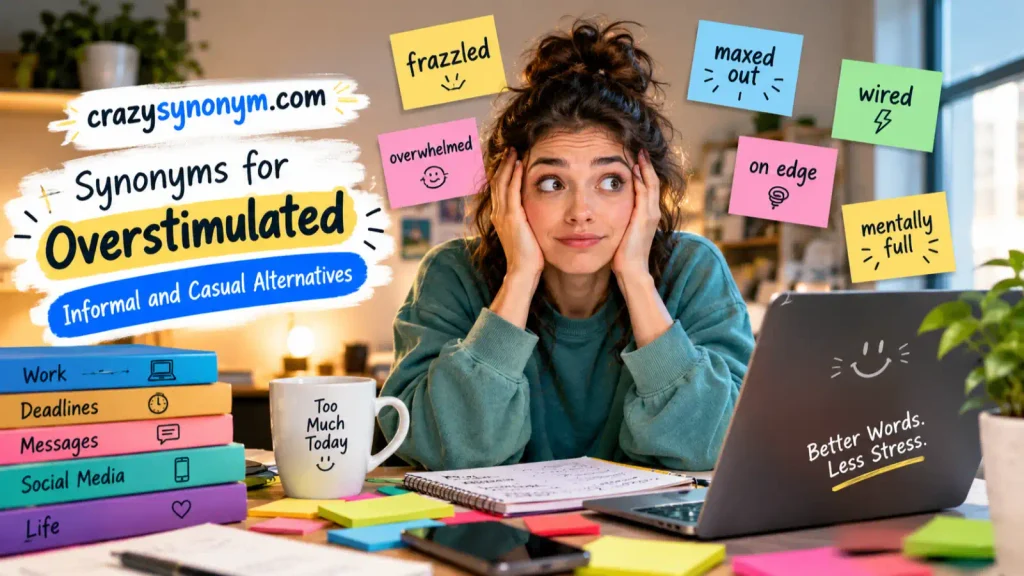
Casual expressions can make personal messages sound more natural. They are useful when talking to friends or colleagues with whom you have a relaxed relationship.
25. Fried
Meaning: Mentally exhausted or unable to concentrate effectively.
Explanation: This is a casual contextual alternative. It describes the drained feeling that can follow a demanding or overstimulating experience.
Example: My brain is fried after that three-hour workshop.
When natural: Casual messages, conversations with friends, and informal team chats.
When to avoid: Formal reports, academic papers, or sensitive professional discussions.
Tone: Very informal.
26. Maxed Out
Meaning: Having reached one’s limit of energy, attention, or capacity.
Explanation: This expression works well when a person cannot comfortably handle any more demands.
Example: I’m maxed out after a day of meetings and constant notifications.
When natural: Informal workplace messages and personal conversations.
When to avoid: Technical writing where the specific problem needs to be identified.
Tone: Casual.
27. Wound Up
Meaning: Feeling tense, excited, or unable to relax.
Explanation: This expression emphasizes activation or tension rather than sensory overload.
Example: The children were wound up after the loud birthday party.
When natural: Casual descriptions of high-energy situations.
When to avoid: Describing someone who is mentally exhausted or emotionally depleted.
Tone: Informal.
28. At My Limit
Meaning: Unable to comfortably manage additional pressure or demands.
Explanation: This phrase conveys personal capacity rather than naming overstimulation directly.
Example: I’m at my limit with all the noise and interruptions today.
When natural: Personal messages and direct conversations about boundaries.
When to avoid: Formal assessments without further explanation.
Tone: Casual and emphatic.
29. All Keyed Up
Meaning: Feeling unusually excited, nervous, or tense.
Explanation: This expression is a contextual alternative for heightened activation, not for every form of overstimulation.
Example: I was all keyed up after the noisy event and needed a quiet evening.
When natural: Casual conversation about excitement or tension.
When to avoid: Describing sensory exhaustion without nervous energy.
Tone: Informal.
30. Burned Out
Meaning: Experiencing prolonged exhaustion associated with ongoing stress or demands.
Explanation: This is not an exact synonym. Overstimulation can contribute to stress, but burnout usually refers to a more persistent state rather than one intense moment.
Example: She felt burned out after months of an unmanageable workload.
When natural: Conversations about long-term work stress or sustained demands.
When to avoid: Describing a short period of noise or excitement.
Tone: Casual to professional, depending on context.
31. Swamped
Meaning: Having too much work or too many demands to manage easily.
Explanation: This expression focuses on workload, not sensory input. It can be useful when overstimulation stems from competing tasks.
Example: I’m swamped with deadlines and messages this afternoon.
When natural: Casual workplace conversations and friendly emails.
When to avoid: Describing a noisy or visually intense environment without workload pressure.
Tone: Informal and familiar.
32. Mentally Wiped Out
Meaning: Feeling completely exhausted mentally.
Explanation: This casual phrase emphasizes the result of a demanding experience rather than its sensory cause.
Example: I’m mentally wiped out after the conference.
When natural: Text messages, conversations with friends, and relaxed team chats.
When to avoid: Formal documents or academic writing.
Tone: Casual.
True Synonyms vs. Contextual Alternatives
Not every alternative conveys the same experience. Use the following table to distinguish close replacements from expressions that only fit certain situations.
| Type | What It Means | Can It Replace the Original? |
|---|---|---|
| True synonym | A phrase with nearly the same meaning in the relevant context, such as sensory overloaded for excessive sensory input | Yes, when the context matches |
| Near synonym | A related state, such as overwhelmed or overaroused | Often, but the emphasis may change |
| Contextual alternative | A related experience, such as distracted or mentally fatigued | Only when that specific aspect is intended |
| Broader expression | A general description, such as under pressure or feeling overloaded | Yes, but it may lose precision |
| Narrower expression | A more specific experience, such as overwhelmed by noise | Yes, when the narrower meaning is accurate |
A useful rule is to identify what is happening before choosing the word. Is the person receiving too much sensory input, struggling to process information, feeling emotionally overwhelmed, or simply tired? The answer determines which alternative communicates the experience most accurately.
Industry-Specific Usage
The best replacement also depends on the type of writing and the reader’s expectations.
Business Writing
Business communication benefits from clear descriptions of workload, concentration, and competing demands.
- Mentally overloaded: Useful when information or tasks are difficult to process.
- Overburdened: Appropriate when responsibilities exceed available capacity.
- Mentally fatigued: Suitable when sustained work has reduced concentration.
- Overwhelmed by competing demands: Helpful when several deadlines or priorities overlap.
Example: The team felt mentally overloaded by the volume of new procedures introduced during the transition.
This wording is more informative than simply stating that the team was overstimulated, because it identifies the likely source of the difficulty.
Corporate Communication
In internal announcements, reports, or policies, describe the working conditions instead of labeling employees.
Example: The current notification volume may create excessive cognitive demands during focused work.
This is more neutral than calling employees overstimulated. It also points toward a practical issue that the organization can address.
Academic Writing
Academic writing requires a clear distinction between sensory input, cognitive load, emotional response, and physiological arousal.
Useful expressions include:
- Sensory overload: When excessive sensory input is the focus.
- Cognitive overload: When information-processing demands exceed available capacity.
- Heightened arousal: When increased physiological or psychological activation is relevant.
- Mental fatigue: When sustained effort leads to reduced mental energy.
Example: Frequent interruptions may contribute to cognitive overload during complex learning tasks.
Avoid using these expressions as if they were interchangeable scientific diagnoses. Describe the specific phenomenon your evidence supports.
Customer Service
Customer service representatives should favor empathetic, plain language over labels that might sound judgmental.
Instead of saying, You seem overstimulated, try:
- It sounds like there’s a lot happening at once.
- Would a quieter setting help?
- We can go through the information one step at a time.
- Let me simplify the options so they’re easier to review.
These alternatives acknowledge the situation without assuming how the other person feels.
Legal Writing
Legal documents require precision. Words such as overwhelmed, agitated, and mentally impaired have different meanings and may carry implications beyond ordinary conversation.
If a document needs to describe sensory or cognitive conditions, state the observed facts and use terminology that fits the relevant evidence. Do not replace a defined legal or technical term with a casual synonym merely to improve style. The correct wording depends on the document and applicable legal context.
Email Communication
In professional emails, alternatives such as mentally overloaded, overwhelmed by the volume of information, or need time to process the details can communicate a concern without sounding dramatic.
For example:
I’m finding it difficult to process all the new information at once. Could we review the main priorities first?
This explains the issue and suggests a practical next step.
synonyms for overstimulated Email Examples Using Alternatives
The following examples show how different expressions work in real messages.
Email 1: Requesting Fewer Interruptions
Subject: Request for Focus Time
Hi Morgan,
I’m finding it difficult to concentrate with the frequent notifications and interruptions. I feel mentally overloaded when several requests arrive at once.
Could we set aside a short block of uninterrupted time for the detailed work?
Thanks for considering it.
Best,
Taylor
Alternative used: Mentally overloaded.
Why it works: It identifies a cognitive difficulty and offers a reasonable solution.
Email 2: Following Up After Training
Subject: Follow-Up on Today’s Session
Hello Priya,
Thank you for walking us through the new system. There was a lot of information to absorb, and I’m feeling mentally fatigued after the session.
Would it be possible to share the reference notes so I can review the steps at my own pace?
Kind regards,
Elliot
Alternative used: Mentally fatigued.
Why it works: It communicates tiredness without suggesting that the training itself was inappropriate.
Email 3: Managing Competing Deadlines
Subject: Clarifying This Week’s Priorities
Hi Jordan,
I’m currently balancing several deadlines and am feeling overwhelmed by the competing demands.
Could you help me confirm which task should take priority? That would help me organize the remaining work more effectively.
Thank you,
Casey
Alternative used: Overwhelmed.
Why it works: It describes the overall pressure and asks for a clear next step.
Email 4: Requesting a Quieter Meeting Space
Subject: A Small Change for Our Next Meeting
Hi Alex,
The open office was quite noisy during our last discussion, and I found it difficult to follow everything being said.
Could we use a quieter room for the next meeting? I think it would make the conversation easier to follow.
Thanks,
Riley
Alternative used: Difficult to follow everything being said.
Why it works: It describes the practical effect without assigning an emotional label.
Email 5: Asking for Time to Review Information
Subject: Time to Review the Proposal
Hello Sam,
I’ve received the proposal and would like some time to process the details before responding. There is quite a bit of information to consider, and I want to give it proper attention.
I’ll send my feedback by Thursday afternoon.
Best regards,
Jamie
Alternative used: Need time to process the details.
Why it works: It communicates a limit while remaining constructive and professional.
synonyms for overstimulated Short Dialogue Examples
These brief conversations illustrate how context changes the best word choice.
At Work
Person A: How was the conference?
Person B: Great information, but I feel mentally overloaded after all those presentations.
In a Classroom
Person A: Why did you leave the noisy room?
Person B: I was feeling overwhelmed by the noise and needed a quieter place.
With a Friend
Person A: Want to watch another movie?
Person B: Not tonight. My brain is fried, and I need some quiet.
At a Customer Service Desk
Person A: Would you like me to explain all the options now?
Person B: Could we take them one at a time? I’m having trouble processing everything together.
During a Family Gathering
Person A: Are you enjoying the party?
Person B: I am, but I’m getting a little frazzled by the noise. I’ll step outside for a few minutes.
How to Replace Overstimulated in a Sentence
Changing the wording can make a sentence more precise, natural, or appropriate for its audience. These examples show the differences.
Example 1: A Busy Environment
Original: I felt overstimulated in the crowded shopping mall.
Alternative: I felt overwhelmed by the noise and activity in the crowded shopping mall.
Why it works: The alternative identifies the source of the discomfort.
Example 2: Too Much Information
Original: The employees were overstimulated during training.
Alternative: The employees were cognitively overloaded during training.
Why it works: This version emphasizes information-processing demands rather than sensory input.
Example 3: A Difficult Workday
Original: I’m overstimulated after a full day of meetings.
Alternative: I’m mentally exhausted after a full day of meetings.
Why it works: The replacement focuses on fatigue at the end of a demanding day.
Example 4: A Noisy Classroom
Original: The child seemed overstimulated by the classroom.
Alternative: The child appeared overwhelmed by the classroom’s noise and activity.
Why it works: The revised sentence gives the reader a clearer description of the situation without assuming a specific cause beyond the observed environment.
Example 5: An Unmanageable Workload
Original: Our team is overstimulated by the number of requests.
Alternative: Our team is overburdened by the number of requests.
Why it works: Overburdened better fits excessive responsibilities or workload.
Example 6: An Informal Message
Original: I’m overstimulated after today’s event.
Alternative: I’m fried after today’s event.
Why it works: The casual version conveys mental exhaustion, although it sounds less precise.
Example 7: Too Many Interruptions
Original: I get overstimulated when people interrupt me repeatedly.
Alternative: I feel mentally overloaded when people interrupt me repeatedly.
Why it works: The replacement emphasizes difficulty maintaining mental focus.
Example 8: High Excitement
Original: The children became overstimulated before the celebration.
Alternative: The children became overexcited before the celebration.
Why it works: Overexcited works if the main issue is excessive excitement rather than distress from sensory input.
Example 9: Long-Term Pressure
Original: She felt overstimulated after months of heavy responsibilities.
Alternative: She felt burned out after months of heavy responsibilities.
Why it works: Burned out better describes prolonged exhaustion, provided the situation genuinely reflects sustained stress.
Example 10: A Professional Request
Original: I’m overstimulated by all these messages.
Alternative: I’m finding it difficult to process the volume of messages arriving at once.
Why it works: The revision is professional, specific, and focused on the practical problem.
synonyms for overstimulated Comparison Table
| Phrase | Tone | Meaning / Scope | Best Use | Example |
|---|---|---|---|---|
| Overwhelmed | Neutral | Broad inability to cope comfortably | General communication | I’m overwhelmed by the activity. |
| Sensory overloaded | Neutral / technical | Too much sensory input | Sensory experiences | The room left me sensory overloaded. |
| Cognitively overloaded | Formal | Excessive information-processing demands | Academic or workplace writing | The instructions left the team cognitively overloaded. |
| Mentally fatigued | Neutral / formal | Mental tiredness | Reports and reflections | I was mentally fatigued after training. |
| Agitated | Neutral / clinical | Restlessness or upset | Behavioral descriptions | He became agitated in the noisy room. |
| Frazzled | Informal | Stressed and mentally worn out | Everyday conversation | I’m frazzled after the busy morning. |
| Maxed out | Casual | At the limit of current capacity | Personal messages | I’m maxed out for today. |
| Burned out | Neutral / casual | Prolonged exhaustion from ongoing demands | Long-term stress discussions | She felt burned out after months of pressure. |
| Overburdened | Formal | Carrying excessive responsibilities | Business communication | The team was overburdened by new tasks. |
| Wound up | Casual | Tense, excited, or unable to relax | Informal conversation | He was wound up after the game. |
| Mentally overloaded | Neutral | Too much mental input or demand | Work and education | I’m mentally overloaded by the new procedures. |
| Overexcited | Neutral | Excessive excitement | High-energy situations | The children were overexcited before the show. |
Which Alternative Should You Choose?
The most effective synonym is the one that describes the actual experience rather than simply sounding sophisticated.
- For formal writing: Choose experiencing sensory overload, cognitively overloaded, or subject to excessive stimulation, depending on the intended meaning.
- For business communication: Use mentally overloaded, overburdened, or overwhelmed by competing demands.
- For academic writing: Prefer precise terms such as cognitive overload, sensory overload, and heightened arousal when the context supports them.
- For legal writing: Describe the relevant facts and preserve any defined terminology. Avoid casual substitutes where exact meaning matters.
- For professional emails: Try I’m finding it difficult to process all this information at once or I need some time to review these details.
- For everyday conversation: Overwhelmed, frazzled, and mentally exhausted are natural options.
- For casual messages: Fried, maxed out, and mentally wiped out can work when you are describing mental exhaustion.
- For excessive excitement: Choose overexcited, wound up, or keyed up when the emphasis is heightened energy rather than distress.
- For prolonged stress: Consider burned out only when the situation reflects ongoing exhaustion rather than a short period of intense stimulation.
synonyms for overstimulated Grammar and Usage Guide
Understanding how overstimulated works grammatically makes it easier to replace without changing the sentence’s meaning.
Is Overstimulated an Adjective?
Yes. Overstimulated commonly functions as an adjective describing a person, animal, or other subject experiencing excessive stimulation.
Examples:
- The child was overstimulated by the noisy room.
- I feel overstimulated after a long day.
- The environment can leave visitors feeling overstimulated.
It can also be used as a past participle in a passive construction: The nervous system was overstimulated by repeated signals. The best interpretation depends on the sentence.
Can You Say Overstimulated by or Overstimulated With?
Both constructions can work, but they emphasize different relationships.
- Overstimulated by: Highlights the cause. I felt overstimulated by the flashing lights.
- Overstimulated with: Can describe what someone is receiving, but it is less natural in many everyday sentences. The session was overstimulated with activity is awkward because the session, rather than the participant, is being described.
For clear writing, use overstimulated by the noise or overwhelmed with information when those constructions fit your meaning.
Is Overstimulated One Word?
Yes. The standard spelling is overstimulated, written as one word. The related forms are overstimulate, overstimulating, and overstimulation.
Examples:
- The noise overstimulated the child.
- The constant interruptions were overstimulating.
- Excessive stimulation may cause discomfort.
Can You Use Overstimulated in Formal Writing?
Yes. The word is appropriate in formal writing when it accurately describes the experience. In technical or academic contexts, a more specific expression such as sensory overload or cognitive overload may be preferable.
What Is the Difference Between Overstimulated and Overwhelmed?
Overstimulated specifically suggests excessive stimulation, which may be sensory, mental, or emotional. Overwhelmed is broader and can refer to excessive work, strong emotions, difficult responsibilities, or too much information.
For example, a person may be overwhelmed by a deadline without being overstimulated by sensory input.
synonyms for overstimulated Common Mistakes to Avoid
Choosing a synonym involves more than swapping one word for another. Watch out for these common errors.
1. Treating every alternative as an exact synonym. Distracted, tired, and overstimulated describe different experiences. Use the word that matches the situation.
2. Using burned out for a brief event. Burnout generally suggests a prolonged pattern of exhaustion or stress. A noisy afternoon alone does not necessarily mean someone is burned out.
3. Confusing excitement with distress. Overexcited suggests high excitement, whereas overstimulated may include discomfort, irritability, or difficulty processing input.
4. Choosing technical language without a reason. Heightened arousal and cognitive overload may be accurate in specialized contexts but can sound unnecessarily complex in everyday writing.
5. Ignoring the cause. If noise is the problem, mention noise. If the issue is too many tasks, describe the workload.
6. Using labels instead of observations. Saying someone is agitated can imply a particular behavior. Describe what you observed if you cannot confidently identify the person’s state.
7. Making professional emails too personal. A phrase such as my brain is fried may work with a teammate but may not suit a formal client message.
8. Replacing a precise term with a vague one. Overwhelmed is flexible, but sensory overload may be more useful when sensory input is the central issue.
9. Repeating the same word too often. Vary wording only when the meaning remains accurate. Clarity matters more than avoiding every repeated term.
When Not to Use the Original Phrase
Although there are many alternatives, overstimulated remains the best choice in several situations.
- When sensory input is central: If noise, light, movement, or touch is causing difficulty, overstimulated or experiencing sensory overload can be more accurate than tired.
- When describing immediate excessive stimulation: The word can communicate a current state without suggesting long-term exhaustion.
- When the source is not yet clear: If you know someone is struggling with too much input but cannot identify whether the main effect is fatigue, agitation, or distraction, overstimulated may preserve that uncertainty.
- When writing for an audience familiar with the term: Accessibility guidance, educational material, and relevant technical discussions may benefit from using the original expression.
- When a replacement would exaggerate the situation: Burned out suggests a more persistent problem, while agitated suggests a particular emotional or behavioral state. Neither should be used without support.
- When you need to distinguish sensory input from workload: Overstimulated may be clearer than overburdened if the person is reacting to a busy environment rather than excessive responsibilities.
The goal is not to eliminate the word. It is to select the most accurate expression for the experience being described.
synonyms for overstimulated Advanced Writer Tips
Control the Tone
Use overwhelmed for a broad, accessible description, cognitively overloaded for mental processing demands, and frazzled for a more conversational tone.
Explain the Cause When It Helps
Compare these sentences:
- I felt overstimulated.
- I felt overstimulated by the constant noise and flashing lights.
The second sentence provides context and makes the experience easier to understand.
Keep Professional Emails Constructive
A useful message describes the problem and offers a next step.
Instead of writing, I’m completely overstimulated by these requests, try:
I’m having difficulty processing several requests at once. Could we review their priorities before I proceed?
Be Precise About Emotional States
Do not assume that overstimulation always means anxiety, anger, or exhaustion. A person may feel excited, uncomfortable, distracted, or simply ready for a quieter environment.
Avoid Overly Complicated Vocabulary
Longer alternatives are not automatically better. Overwhelmed by noise may communicate the intended meaning more effectively than an elaborate technical phrase.
Respect Individual Preferences
When discussing another person, describe their stated experience rather than assigning a label. For example, They said the room was too noisy is more grounded than They were clearly overstimulated when you do not know how they felt.
synonyms for overstimulated Related Questions
What is another way to say overstimulated?
You can say overwhelmed, mentally overloaded, sensory overloaded, frazzled, or unable to process more input. Choose the expression that matches the cause and effect of the experience.
What is a professional alternative to overstimulated?
Professional alternatives include experiencing sensory overload, cognitively overloaded, mentally fatigued, and overwhelmed by competing demands. The best choice depends on whether the concern involves sensory input, mental effort, or workload.
Is overstimulated a formal word?
Yes. Overstimulated can be used in both formal and informal writing. In specialized discussions, more precise terms such as sensory overload may be useful when they accurately describe the phenomenon.
What is the difference between overstimulated and overstressed?
Overstimulated refers to receiving excessive stimulation or input, while overstressed emphasizes excessive pressure or stress. The experiences can overlap, but a demanding workload may cause stress without excessive sensory stimulation.
Is overwhelmed the same as overstimulated?
No. Overwhelmed is broader and can describe too many tasks, responsibilities, emotions, or demands. Overstimulated more specifically points to excessive stimulation. A person may experience both at the same time.
FAQs:
1. What is the closest synonym for overstimulated?
Overwhelmed by stimuli is a close descriptive alternative when excessive input is the main issue. Sensory overloaded is also suitable when the experience specifically involves sound, light, touch, or movement. For mental information overload, cognitively overloaded may be more precise.
2. How do you describe someone who is overstimulated?
You can describe the person as overwhelmed by sensory input, mentally overloaded, restless, or unable to process more information, depending on what they report or what you observe. Avoid assuming a particular emotional state without sufficient information.
3. What is a simple word for overstimulated?
Overwhelmed is a simple, widely understood alternative. It works in many everyday situations, although it is broader than overstimulated and does not always communicate that excessive input is the cause.
4. What is the difference between sensory overload and cognitive overload?
Sensory overload involves difficulty handling excessive sensory input, such as loud sounds or bright lights. Cognitive overload involves difficulty processing too much information or too many mental demands. They can occur together, but they describe different aspects of an experience.
5. Can overstimulated be used to describe children?
Yes. The word can describe a child who is struggling with excessive noise, activity, or other stimulation. However, behavior alone does not establish the cause. A clear description of the setting and the child’s observed response is often more helpful than an unsupported label.
6. What is a casual way to say mentally overstimulated?
You might say my brain is fried, I’m maxed out, or I’m mentally wiped out. These expressions usually emphasize mental exhaustion rather than the precise cause, so they are best suited to informal communication.
7. Is overstimulated the same as overstimulating?
No. Overstimulated describes the person or subject receiving excessive stimulation, while overstimulating describes something that causes or tends to cause excessive stimulation.
For example, I felt overstimulated by the event describes your experience, while The event was overstimulating describes the event’s effect or character.
Key Takeaways:
- Overwhelmed is a versatile alternative, but it is broader than overstimulated.
- Sensory overload is the clearest option when excessive sensory input is the central concern.
- Cognitive overload fits situations involving too much information or mental effort.
- Casual phrases such as fried and maxed out work best in relaxed conversation, not technical writing.
- Choose synonyms based on the cause, the intended meaning, and the reader—not simply on formality or variety.
Conclusion:
Finding the right alternative to overstimulated starts with understanding what the word needs to communicate. If excessive noise, bright lights, or movement is the problem, sensory overloaded or overwhelmed by stimuli may be the most accurate choices. If someone is struggling to process information, mentally overloaded or cognitively overloaded offers greater precision. When the main effect is exhaustion, mentally fatigued or mentally exhausted may fit better.
For everyday conversation, overwhelmed, frazzled, and maxed out sound natural, while professional writing benefits from clear, specific descriptions of the situation. Remember that related expressions can change the meaning: burned out suggests prolonged exhaustion, and overexcited emphasizes heightened excitement rather than distress.
You do not need to replace the original word every time it appears. Use overstimulated whenever it conveys the experience accurately, and choose another expression only when it makes the message clearer, more precise, or better suited to your audience.

I’m Daniel Carter, an English vocabulary writer who enjoys making words simple and easy to understand. At CrazySynonym.com, I create helpful guides on synonyms, meanings, antonyms, and everyday word usage to help readers choose the right words with confidence.