
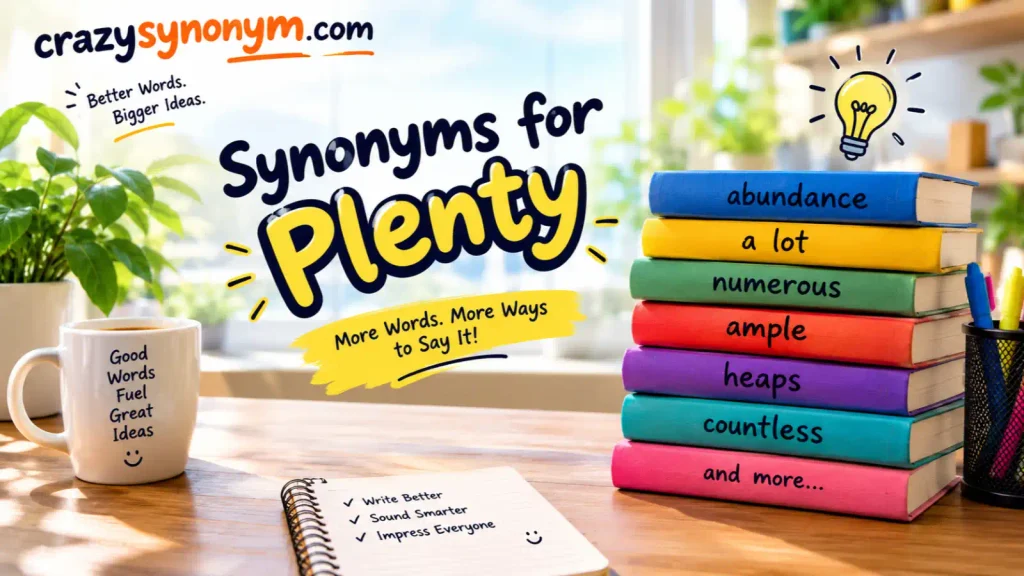
Using the word plenty repeatedly can make your writing sound predictable, especially when describing large quantities, abundant resources, or many opportunities. The best synonyms for plenty depend on what you want to express.
Words such as abundance, ample, numerous, lots, and copious can communicate a similar idea, but they do not always fit the same sentence. For example, ample time suggests enough time to spare, while numerous options emphasizes a large number of choices.
In casual conversations, lots of sounds natural, whereas abundance often suits formal writing. Choosing the right alternative helps you express quantity more precisely without changing your intended meaning. Explore these useful replacements to expand your vocabulary, improve sentence variety, and make your writing clearer, more natural, and appropriate for different situations.
Quick Answer
Common synonyms for plenty include abundance, plenty of, plentiful, abundant, ample, sufficient, numerous, loads, heaps, a lot, a great deal, and more than enough. Use abundant for a large supply, ample for more than enough room or time, and sufficient when something meets a specific need.
Quick List of Synonyms for Plenty
Here are 45 useful alternatives, grouped by meaning and tone.
Closest Alternatives
- Abundance
- Abundant
- Plentiful
- Ample
- A lot
- A great deal
- More than enough
- A large amount
- A large quantity
- A generous supply
Formal Alternatives
- Sufficient
- Substantial
- Copious
- Profuse
- Considerable
- Extensive
- Numerous
- Prolific
- Ample quantities
- An abundance of
Neutral and Everyday Alternatives
- Enough
- Plenty of
- Many
- Much
- Numerous amounts
- A good amount
- A large number
- A wealth of
- A host of
- A wide selection
- A considerable amount
- An ample supply
- A great many
- A substantial number
- More than sufficient
Informal and Casual Alternatives
- Loads
- Heaps
- Tons
- Lots
- A bunch
- A whole lot
- A mountain of
- Oodles
- A boatload
- A ton of
Usage note: These alternatives are not interchangeable in every sentence. Numerous works with countable nouns, much generally accompanies uncountable nouns, and sufficient emphasizes adequacy rather than an unusually large quantity.
Formal Alternatives to Plenty
Formal vocabulary is especially useful in academic writing, business reports, proposals, research, and professional correspondence. The following options offer greater precision than the general word plenty.
1. Abundance
Meaning: A very large quantity of something.
Explanation: Abundance is a close synonym when you want to emphasize a generous supply. Unlike plenty, it is a noun.
Example: The region has an abundance of renewable energy resources.
Best Use: Reports, essays, descriptive writing, and research summaries.
Worst Use: Short, casual messages where a simpler phrase sounds more natural.
Tone: Formal and descriptive.
2. Abundant
Meaning: Existing or available in large quantities.
Explanation: This adjective is one of the closest replacements for plentiful. It describes a large supply rather than simply meeting a minimum need.
Example: The coastal area is abundant in marine life.
Best Use: Environmental writing, research, and formal descriptions.
Worst Use: Situations where the intended meaning is only that something is adequate.
Tone: Neutral to formal.
3. Ample
Meaning: More than enough for a particular purpose.
Explanation: Ample emphasizes comfortable sufficiency. It is especially natural with words such as time, space, opportunity, and evidence.
Example: We have ample time to review the proposal before Friday.
Best Use: Professional emails, reports, and planning documents.
Worst Use: Describing a vast quantity when the emphasis is on abundance rather than adequacy.
Tone: Professional and polished.
4. Sufficient
Meaning: Enough to meet a particular need or requirement.
Explanation: This is a contextual alternative rather than a perfect synonym. It focuses on adequacy, not on having a generous surplus.
Example: The laboratory collected sufficient samples for the initial analysis.
Best Use: Academic, technical, and business writing.
Worst Use: Describing an unusually large or overflowing supply.
Tone: Formal and precise.
5. Copious
Meaning: Available or produced in large quantities.
Explanation: Copious is a strong alternative when describing large amounts of material, information, notes, or liquid. It can sound more elevated than plenty.
Example: The researcher provided copious notes during the review.
Best Use: Academic writing, detailed descriptions, and formal reports.
Worst Use: Simple everyday statements where the word may sound unnecessarily elaborate.
Tone: Formal.
6. Profuse
Meaning: Produced or present in a large or abundant amount.
Explanation: Profuse often describes things that appear freely or in great quantity, such as apologies, praise, sweating, or growth.
Example: The speaker offered profuse thanks to the volunteers.
Best Use: Descriptive prose and formal writing.
Worst Use: General statements about ordinary quantities when ample or plentiful would be clearer.
Tone: Formal and expressive.
7. Substantial
Meaning: Considerable in size, amount, or importance.
Explanation: This word suggests a significant amount, but it does not automatically mean more than enough.
Example: The organization received a substantial amount of funding.
Best Use: Financial reports, business updates, and research.
Worst Use: Situations where you need to confirm that a specific requirement has been met.
Tone: Professional.
8. Considerable
Meaning: Large enough to be important or noticeable.
Explanation: Considerable emphasizes size or significance. It is often suitable for amounts of money, time, effort, or evidence.
Example: The team devoted considerable time to testing the new system.
Best Use: Business communication, essays, and reports.
Worst Use: Informal messages about small, ordinary quantities.
Tone: Formal and neutral.
9. Extensive
Meaning: Covering a large area, range, or scope.
Explanation: Extensive is a contextual alternative. It describes breadth or coverage rather than quantity alone.
Example: The library offers an extensive collection of historical documents.
Best Use: Describing collections, research, knowledge, and services.
Worst Use: Describing a small quantity that is merely enough.
Tone: Formal and professional.
10. Numerous
Meaning: Existing in large numbers.
Explanation: Numerous is appropriate for countable items, people, events, or examples. It cannot normally replace plenty before an uncountable noun.
Example: Numerous applicants expressed interest in the position.
Best Use: Academic writing, business reports, and formal descriptions.
Worst Use: Sentences such as numerous water or numerous information.
Tone: Formal and neutral.
11. Prolific
Meaning: Producing a large amount or number of something.
Explanation: Prolific commonly describes writers, artists, creators, plants, and other sources of repeated output. It does not simply mean that something is available in large quantities.
Example: The prolific author published several novels over the decade.
Best Use: Describing productivity, output, and creative work.
Worst Use: Describing a supply of chairs or money without an appropriate production-related meaning.
Tone: Formal.
12. More Than Sufficient
Meaning: Enough to meet a need, with additional capacity or supply remaining.
Explanation: This phrase combines adequacy with a surplus. It is useful when you want to be clear that requirements have been comfortably met.
Example: The available funding is more than sufficient to cover the basic costs.
Best Use: Reports, planning documents, and professional emails.
Worst Use: Informal conversation where more than enough sounds more natural.
Tone: Formal and reassuring.
synonyms for plenty Neutral and Semi-Formal Alternatives
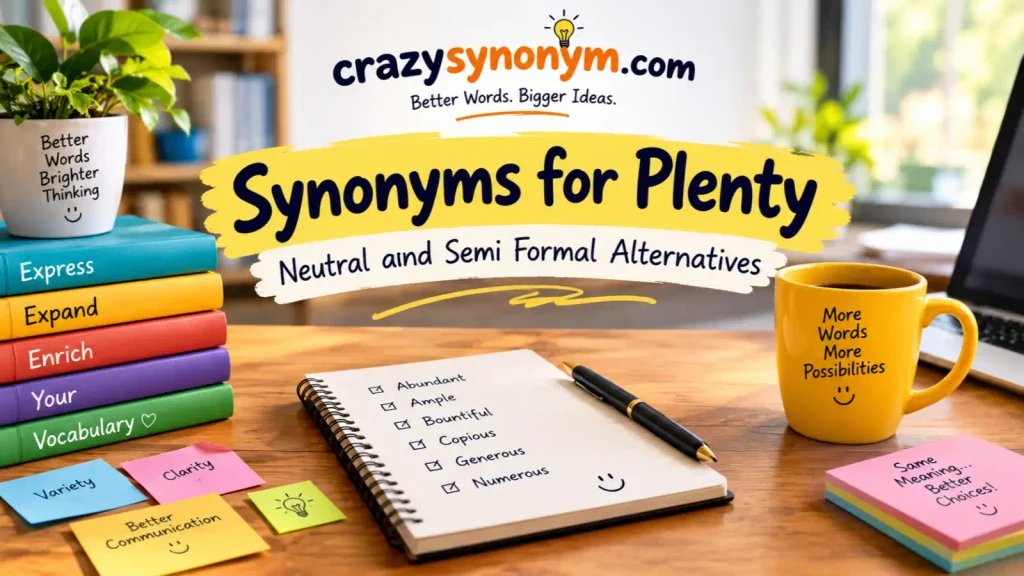
These expressions work in ordinary writing and conversation. They are useful when you want clear language without sounding overly formal.
13. Plentiful
Meaning: Available in large quantities.
Explanation: Plentiful is a close adjective-based alternative to abundant. It works especially well with resources, supplies, food, and natural materials.
Example: Fresh produce is plentiful during the summer harvest.
Best Use: General descriptions, educational writing, and informational websites.
Worst Use: Situations where the supply is only just enough.
Tone: Neutral.
14. A Lot
Meaning: A large amount or number.
Explanation: This is one of the most common everyday alternatives to plenty. Its meaning is broad, so context determines the actual quantity.
Example: We have a lot of time before the presentation begins.
Best Use: Conversation, general writing, and informal emails.
Worst Use: Formal academic writing where a more specific expression is preferable.
Tone: Neutral to casual.
15. A Great Deal
Meaning: A large amount or extent.
Explanation: This phrase is especially useful with uncountable nouns and abstract concepts.
Example: The volunteers invested a great deal of effort in the project.
Best Use: Essays, reports, and everyday writing.
Worst Use: Directly before a plural countable noun, as in a great deal of books.
Tone: Neutral to formal.
16. Many
Meaning: A large number of countable items or people.
Explanation: Many can replace plenty of when the noun is countable, but it does not necessarily suggest a surplus.
Example: Many students attended the evening workshop.
Best Use: Essays, reports, and everyday communication.
Worst Use: Before uncountable nouns such as water or advice.
Tone: Neutral.
17. Much
Meaning: A large amount of an uncountable substance or concept.
Explanation: Much is useful with nouns such as time, money, effort, and information. In positive everyday statements, a lot of often sounds more natural.
Example: Much effort went into preparing the final report.
Best Use: Formal writing, questions, and negative statements.
Worst Use: Before ordinary plural countable nouns, such as much chairs.
Tone: Neutral to formal.
18. More Than Enough
Meaning: A quantity that exceeds what is needed.
Explanation: This phrase closely matches plenty when the intended meaning is comfortable sufficiency.
Example: There is more than enough food for everyone at the picnic.
Best Use: Everyday communication, instructions, and reassuring messages.
Worst Use: Describing a large amount without suggesting that it meets a particular need.
Tone: Neutral and direct.
19. A Wealth Of
Meaning: A large and valuable supply of something.
Explanation: This expression is often figurative. It suggests richness in resources, information, ideas, or opportunities rather than literal money.
Example: The website provides a wealth of practical learning resources.
Best Use: Educational content, professional writing, and descriptions of useful resources.
Worst Use: Simple quantity statements where the idea of value is irrelevant.
Tone: Neutral to formal.
20. A Host Of
Meaning: A large number of people or things.
Explanation: A host of is a collective expression, commonly used with countable plural nouns.
Example: A host of local businesses supported the community event.
Best Use: Articles, reports, and descriptive writing.
Worst Use: Precise measurements or contexts that require an exact quantity.
Tone: Neutral to formal.
21. A Wide Selection
Meaning: Many options or varieties to choose from.
Explanation: This phrase describes variety, not just quantity. It is especially suitable for products, services, courses, and menu choices.
Example: The bookstore carries a wide selection of children’s novels.
Best Use: Retail descriptions, websites, and customer communication.
Worst Use: Describing a large quantity of one single item when variety is not relevant.
Tone: Neutral and professional.
22. A Generous Supply
Meaning: A quantity that is comfortably large for the intended use.
Explanation: This phrase emphasizes practical availability. It may suggest more than the minimum required.
Example: The organizers kept a generous supply of drinking water at each station.
Best Use: Logistics, planning, hospitality, and everyday descriptions.
Worst Use: Abstract ideas that cannot naturally be treated as a supply.
Tone: Neutral.
23. A Considerable Amount
Meaning: A large or significant quantity.
Explanation: This phrase highlights size or importance rather than guaranteeing that there is enough.
Example: The renovation required a considerable amount of work.
Best Use: Reports, proposals, and general professional writing.
Worst Use: Very casual conversation where shorter wording is clearer.
Tone: Professional.
24. A Large Number
Meaning: A high count of individual items or people.
Explanation: This is a direct alternative when the noun is countable. It gives a clearer sense of quantity than the broad word plenty.
Example: A large number of residents attended the public meeting.
Best Use: Surveys, reports, and informational writing.
Worst Use: Uncountable nouns such as furniture or equipment.
Tone: Neutral to formal.
25. A Large Quantity
Meaning: A substantial amount of something.
Explanation: This phrase is useful when quantity matters more than quality, variety, or adequacy.
Example: The factory stores a large quantity of raw materials.
Best Use: Inventory reports, manufacturing, and technical descriptions.
Worst Use: Casual statements about people, where a large number is usually more natural.
Tone: Neutral and precise.
26. A Good Amount
Meaning: A reasonably large or useful amount.
Explanation: This expression is flexible and conversational. It may mean an adequate amount rather than a true surplus.
Example: We made a good amount of progress during the first week.
Best Use: Progress updates, personal communication, and informal reports.
Worst Use: Formal documents requiring a measured or exact quantity.
Tone: Neutral and approachable.
synonyms for plenty Informal and Casual Alternatives
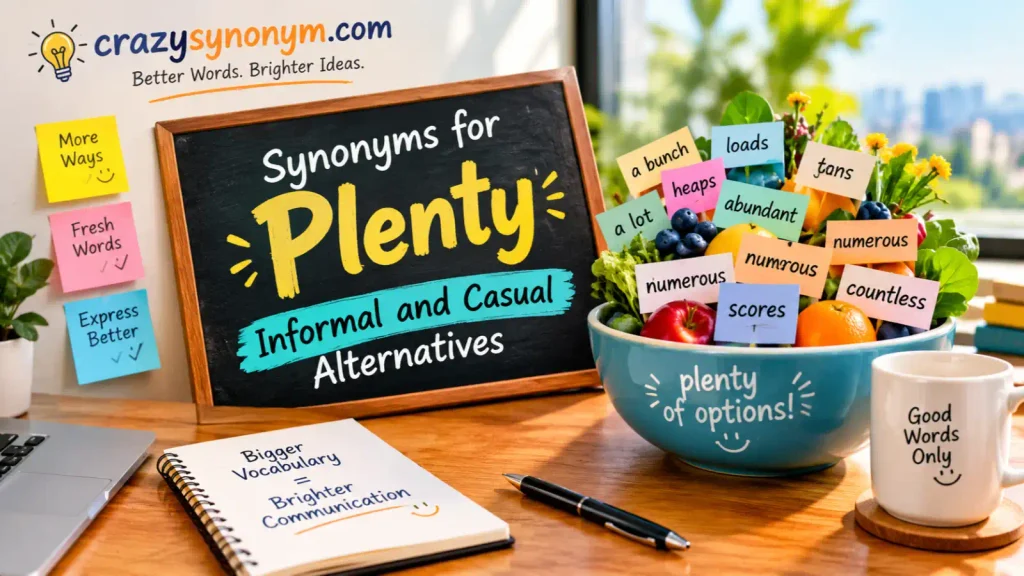
Casual expressions can add warmth and energy to everyday conversations. They are common in spoken American English but may not suit formal documents.
27. Loads
Meaning: A large amount or number.
Explanation: Loads of is an informal equivalent of plenty of. It can refer to countable and uncountable nouns.
Example: We have loads of snacks for the road trip.
When natural: Friendly conversations, text messages, and informal invitations.
When to avoid: Academic papers and formal reports.
Tone: Casual.
28. Heaps
Meaning: A large amount or number.
Explanation: Heaps of is an informal expression, particularly common in some varieties of English. It often communicates abundance with a relaxed tone.
Example: There are heaps of interesting trails near the lake.
When natural: Casual conversations and friendly writing.
When to avoid: Formal business communication.
Tone: Informal.
29. Tons
Meaning: A very large amount or number.
Explanation: Tons of is usually figurative rather than a literal measurement of weight.
Example: We have tons of ideas for the school fundraiser.
When natural: Informal messages and conversations.
When to avoid: Technical contexts where actual weight or quantity must be precise.
Tone: Casual and emphatic.
30. Lots
Meaning: A large amount or number.
Explanation: Lots of is one of the most versatile casual alternatives to plenty of.
Example: There are lots of ways to improve your writing.
When natural: Everyday speech, emails to familiar people, and informal articles.
When to avoid: Formal academic prose where a more precise phrase may be better.
Tone: Casual to neutral.
31. A Bunch
Meaning: A group or informal quantity of things.
Explanation: A bunch of works naturally with people, objects, and some abstract nouns. It can suggest a collection rather than simply a large amount.
Example: We collected a bunch of useful suggestions during the discussion.
When natural: Friendly conversations and relaxed team messages.
When to avoid: Highly formal or technical writing.
Tone: Informal.
32. Oodles
Meaning: A very large amount.
Explanation: Oodles of is playful and expressive. It emphasizes abundance without giving an exact measurement.
Example: The bakery had oodles of freshly baked cookies.
When natural: Humorous writing, family conversations, and playful content.
When to avoid: Formal proposals or serious reports.
Tone: Playful and informal.
33. A Boatload
Meaning: A very large amount or number.
Explanation: A boatload of is an exaggerated casual expression. It emphasizes quantity rather than providing a literal count.
Example: We have a boatload of paperwork to finish before Monday.
When natural: Informal conversations about work or everyday tasks.
When to avoid: Formal reports and precise quantity statements.
Tone: Casual and emphatic.
34. A Whole Lot
Meaning: A large amount or degree.
Explanation: This expression adds emphasis to a lot. It can describe quantity, effort, change, or importance.
Example: A whole lot of planning went into the neighborhood festival.
When natural: Informal speech, messages, and personal writing.
When to avoid: Formal academic writing where a more specific expression would be clearer.
Tone: Casual.
True Synonyms vs. Contextual Alternatives
Understanding the relationship between alternatives helps you avoid changing your meaning accidentally.
| Type | What It Means | Can It Replace the Original? |
|---|---|---|
| True synonym | A close equivalent, such as plentiful for describing a generous supply | Usually, when grammar and context match |
| Near synonym | A related term, such as substantial or considerable | Often, but it may emphasize size rather than sufficiency |
| Contextual alternative | A phrase such as a wide selection | Only when variety is the intended meaning |
| Broader expression | A general phrase such as a lot | Yes, but it may be less precise |
| Narrower expression | A specific phrase such as more than enough time | Yes, when that exact situation applies |
Consider the difference between these statements:
- We have plenty of chairs. This suggests enough chairs, possibly with extras.
- We have numerous chairs. This emphasizes the number of chairs but does not guarantee that there are enough.
- We have sufficient chairs. This confirms that the available chairs meet the need.
- We have an abundance of chairs. This suggests a particularly generous supply.
All four sentences describe quantity, but each communicates a slightly different idea.
Industry-Specific Usage
Business Writing
In business documents, select alternatives that clarify quantity, capacity, or adequacy.
- Ample resources: More than enough resources for a task.
- Sufficient funding: Enough money to meet a requirement.
- Substantial investment: A significant investment, without necessarily implying that it is excessive.
- Numerous opportunities: A large number of opportunities.
- A considerable amount of work: A significant workload.
Example: The department has sufficient funding to complete the first phase of the project.
This is more precise than The department has plenty of funding if the goal is to confirm that the budget meets a defined requirement.
Corporate Communication
Reports and internal announcements benefit from words that distinguish a large quantity from an adequate one.
Example: The company maintains an ample supply of replacement parts to support routine maintenance.
If the supply is merely adequate, use sufficient supply. If the quantity is exceptionally large, abundant supply may be more appropriate.
Academic Writing
Academic writing should favor precise descriptions over vague quantity expressions.
Consider these alternatives:
- Numerous studies for a large number of studies.
- Substantial evidence for evidence of considerable weight or quantity.
- A wealth of research for an extensive and valuable body of research.
- Sufficient evidence when the available evidence meets a defined standard.
- Copious data when the quantity of data is large.
Example: Numerous studies have examined the relationship between sleep and learning.
Do not use numerous evidence, because evidence is generally uncountable in this sense. Write substantial evidence or a large amount of evidence instead.
Customer Service
Customer service messages should make quantities and available choices easy to understand.
Instead of saying, We have plenty of options, consider:
- We have several options available.
- We offer a wide selection of products.
- We have enough stock to fulfill your order.
- There are many appointment times to choose from.
Choose enough stock when confirming availability, and a wide selection when emphasizing variety.
Legal Writing
Legal writing often depends on specific thresholds, obligations, and quantities. A casual synonym may change the intended meaning.
For example, sufficient evidence and plenty of evidence do not necessarily mean the same thing. The first suggests adequacy under a relevant standard; the second is a general description of quantity.
When drafting legal documents, use terms that match the document’s requirements and relevant evidence. This is a language guide, not jurisdiction-specific legal advice.
Email Communication
In professional emails, ample time, sufficient information, and a substantial amount of work can sound more precise than plenty.
Example: We have ample time to review the draft before the submission deadline.
For a friendly message, however, We have plenty of time is perfectly natural.
Email Examples Using Alternatives
Email 1: Confirming Available Time
Subject: Timeline for the Draft
Hi Olivia,
We have ample time to review the draft before the submission date. I’ll read through the latest version this afternoon and send you any suggested changes tomorrow.
Best,
Marcus
Alternative used: Ample.
Why it works: It reassures the recipient that the schedule allows enough time.
Email 2: Requesting Additional Resources
Subject: Resources for the Workshop
Hello Daniel,
We have a substantial amount of material to prepare for next week’s workshop. Could we arrange some additional support with organizing the handouts?
That would help us keep the preparation on schedule.
Thank you,
Nina
Alternative used: Substantial amount.
Why it works: It communicates the scale of the workload without making an unsupported claim that resources are sufficient.
Email 3: Reporting Research Findings
Subject: Initial Research Summary
Hi Elena,
I found numerous sources that discuss the topic from different perspectives. I’m sorting them by relevance now and will share the most useful references in the next update.
Regards,
Peter
Alternative used: Numerous.
Why it works: It is concise and appropriate for describing countable sources.
Email 4: Confirming Inventory
Subject: Stock Availability
Hello Chris,
We currently have a sufficient supply of the requested items to fulfill the order. I’ll confirm the dispatch date once the warehouse team finishes its final check.
Best regards,
Avery
Alternative used: Sufficient supply.
Why it works: It confirms adequacy rather than merely suggesting a large quantity.
Email 5: Sharing Learning Resources
Subject: Additional Study Materials
Hi Sofia,
The course page now includes a wealth of learning resources, including practice exercises, reading suggestions, and review questions.
Feel free to start with the section that matches your current topic.
Best,
Noah
Alternative used: A wealth of.
Why it works: It highlights both the variety and value of the available resources.
Short Dialogue Examples
Workplace Planning
Person A: Do we have enough time to test the new design?
Person B: Yes, we have ample time before the review.
Classroom Discussion
Person A: Did you find sources for your assignment?
Person B: Yes, I found numerous articles at the library.
At a Grocery Store
Person A: Will there be enough bread for the event?
Person B: We have a generous supply in the storeroom.
With Friends
Person A: Should we bring more snacks?
Person B: No, we have loads already!
Customer Service
Person A: Are there other models available?
Person B: Yes, we have a wide selection you can compare.
How to Replace Plenty in a Sentence
The following examples show how to choose an alternative based on meaning, tone, and grammar.
Example 1: Available Time
Original: We have plenty of time to finish the assignment.
Alternative: We have ample time to finish the assignment.
Why it works: Ample sounds slightly more polished while preserving the idea of enough time with room to spare.
Example 2: Food for Guests
Original: There is plenty of food for everyone.
Alternative: There is more than enough food for everyone.
Why it works: The new version directly emphasizes that the food supply meets the group’s needs.
Example 3: Research Sources
Original: There are plenty of articles on this topic.
Alternative: Numerous articles discuss this topic.
Why it works: Numerous is appropriate because articles are countable. The revised sentence is also more concise.
Example 4: Funding
Original: The project has plenty of funding.
Alternative: The project has a substantial amount of funding.
Why it works: The alternative emphasizes the size of the funding rather than confirming that it exceeds requirements.
Example 5: Natural Resources
Original: The region has plenty of natural resources.
Alternative: The region has abundant natural resources.
Why it works: Abundant is a natural adjective for describing a large supply of resources.
Example 6: Study Materials
Original: The course offers plenty of study materials.
Alternative: The course offers a wealth of study materials.
Why it works: The revised sentence suggests that the materials are both plentiful and useful.
Example 7: Available Choices
Original: The shop has plenty of products to choose from.
Alternative: The shop offers a wide selection of products.
Why it works: This version emphasizes variety, not just quantity.
Example 8: Workload
Original: We have plenty of work to complete this week.
Alternative: We have a considerable amount of work to complete this week.
Why it works: The alternative sounds more professional and emphasizes the scale of the workload. It does not necessarily mean the work is excessive.
Example 9: Casual Plans
Original: We have plenty of snacks for the trip.
Alternative: We have tons of snacks for the trip.
Why it works: Tons of gives the sentence a relaxed, emphatic tone. It is figurative, not a literal weight measurement.
Example 10: Information
Original: The report contains plenty of useful information.
Alternative: The report contains a great deal of useful information.
Why it works: A great deal of works naturally with the uncountable noun information and suits neutral or professional writing.
Comparison Table
| Phrase | Tone | Meaning / Scope | Best Use | Example |
|---|---|---|---|---|
| Abundant | Neutral / formal | Existing in large quantities | Resources and supplies | The area has abundant wildlife. |
| Plentiful | Neutral | Available in large quantities | Food and materials | Fresh fruit is plentiful. |
| Ample | Professional | More than enough for a purpose | Time and space | We have ample time. |
| Sufficient | Formal | Enough to meet a need | Funding and evidence | We have sufficient funds. |
| Numerous | Formal / neutral | A large count of items | People and studies | Numerous studies support the topic. |
| Copious | Formal | Large quantities | Notes and data | She collected copious notes. |
| Substantial | Professional | Significant in size or amount | Investment and workload | It requires substantial effort. |
| Considerable | Formal | Large or important enough to notice | Time and resources | It took considerable effort. |
| A great deal | Neutral | A large amount or extent | Effort and information | We learned a great deal. |
| A wealth of | Neutral / formal | A large, valuable supply | Resources and knowledge | The site offers a wealth of advice. |
| Loads of | Casual | A large amount or number | Everyday conversation | We have loads of time. |
| Tons of | Casual | An emphatically large amount | Informal messages | There are tons of choices. |
Which Alternative Should You Choose?
Use this quick decision guide to match the expression to your writing situation.
- Formal writing: Choose abundant, ample, considerable, or substantial, depending on the intended meaning.
- Business communication: Use sufficient resources when confirming adequacy, or a substantial amount when emphasizing size.
- Academic writing: Choose numerous studies, substantial evidence, or a wealth of research where grammatically appropriate.
- Legal writing: Prefer precise wording that reflects the relevant standard, requirement, or quantity.
- Professional emails: Use ample time, sufficient information, or a considerable amount of work.
- Everyday conversation: A lot, lots of, plenty of, and more than enough sound natural.
- Casual messages: Loads, tons, and heaps add an informal tone.
- Countable nouns: Use numerous books, many people, or a large number of examples.
- Uncountable nouns: Use a great deal of information, much effort, or an abundance of water.
- Variety rather than quantity: Choose a wide selection or a broad range.
Grammar and Usage Guide
Is Plenty a Noun or an Adjective?
Plenty most commonly functions as a noun in expressions such as plenty of time and plenty of opportunities. It can also appear in informal constructions such as plenty good enough, although this usage is less common and more conversational.
Examples:
- We have plenty of time.
- There are plenty of seats.
- That is plenty for today.
The adjective plentiful and the adjective abundant are useful alternatives when you need to describe a noun directly.
Should You Use Plenty of or Plenty?
Use plenty of before a noun when describing an ample quantity.
- Correct: We have plenty of water.
- Correct: There are plenty of opportunities.
- Natural standalone use: That’s plenty.
In ordinary American English, plenty by itself is not normally placed directly before a noun without of.
Is Plenty Used With Singular or Plural Nouns?
Plenty of can accompany both uncountable nouns and plural countable nouns.
- Uncountable: Plenty of information is available.
- Plural countable: Plenty of books are available.
In these examples, the verb agrees with the noun phrase that follows of: information is and books are.
What Is the Difference Between Plenty and Plentiful?
Plenty is generally a noun or part of the expression plenty of. Plentiful is an adjective.
- The garden has plenty of flowers.
- Flowers are plentiful in the garden.
Both sentences communicate abundance, but their grammatical structures differ.
Can Plenty Be Used in Formal Writing?
Yes. Plenty is not incorrect in formal writing, but more precise expressions may work better when quantity or adequacy needs to be clear.
For example:
- General: There is plenty of evidence.
- More precise: The study provides substantial evidence.
- Adequacy-focused: There is sufficient evidence to support the conclusion.
The best choice depends on what the evidence actually shows.
Common Mistakes to Avoid
1. Treating sufficient and abundant as identical. Sufficient means enough; abundant suggests a large supply.
2. Using numerous with uncountable nouns. Write numerous books but a great deal of information.
3. Confusing quantity with variety. A wide selection emphasizes options, not necessarily a large quantity of each item.
4. Using casual phrases in formal reports. Tons of paperwork may be fine in conversation, while a substantial amount of paperwork is more professional.
5. Assuming substantial means more than enough. It means significant in amount or size, not necessarily adequate for a specific purpose.
6. Using much incorrectly. Much information is grammatically correct, but a lot of information is often more natural in positive everyday statements.
7. Overusing elevated vocabulary. Replacing every instance of plenty with copious or profuse can make writing sound unnatural.
8. Ignoring noun countability. Many opportunities is correct; many advice is not. Use much advice or a lot of advice.
9. Confusing more than enough with a large amount. A large amount may still be insufficient if the requirement is unusually high.
When Not to Use Plenty
Although plenty is flexible and natural, some situations call for a more precise word.
- When an exact quantity matters: Use a number, measurement, or defined amount instead of plenty.
- When confirming that a requirement is met: Choose sufficient if you mean that a supply meets a specific need.
- When writing technical reports: Use terms that describe the actual quantity, scale, or scope.
- When emphasizing variety: Use a wide selection or a broad range rather than plenty.
- When describing countable items formally: Numerous or a large number of may be more suitable.
- When describing an especially large supply: Abundant or copious may communicate the intended scale more clearly.
Still, plenty is often the best choice in everyday writing. It is short, familiar, and easy to understand. You should not replace it merely to make a sentence sound more sophisticated.
Advanced Writer Tips
Match the Word to the Intended Meaning
Decide whether you want to express a large quantity, adequate supply, wide variety, or significant amount. These ideas overlap but are not identical.
For instance, ample time emphasizes a comfortable margin, while a substantial amount of time emphasizes the amount itself.
Use Precise Quantifiers in Professional Writing
Compare:
- We have plenty of staff.
- We have sufficient staff to cover all shifts.
- We have numerous staff members available for training.
The second sentence confirms adequacy, while the third emphasizes the number of people available for a particular purpose.
Avoid Inflated Language
A simple word can be more effective than an elaborate alternative. Use a lot of useful ideas if the audience expects plain language. Choose a wealth of useful ideas when the more descriptive tone fits the context.
Keep Countability in Mind
Before choosing a synonym, check whether the noun can be counted individually.
- Countable: many options, numerous examples, a large number of visitors.
- Uncountable: much time, a great deal of information, a substantial amount of effort.
This small check prevents many common grammar mistakes.
Add Context When Quantity Is Vague
If the exact amount matters, replace a vague expression with a concrete detail.
Instead of We have plenty of supplies, write We have enough supplies for all 24 participants if that figure is accurate.
Specific wording helps readers understand the claim without guessing.
Related Questions
What is another word for plenty?
Useful alternatives include abundant, plentiful, ample, sufficient, numerous, loads, and a great deal. Choose the word according to the noun and whether you want to emphasize abundance, adequacy, or quantity.
What is a professional alternative to plenty?
Professional alternatives include ample, sufficient, substantial, considerable, and a large quantity. For example, We have sufficient resources to complete the project is more precise when confirming that the available resources meet a requirement.
Is plenty formal or informal?
Plenty is a standard English word that works in many contexts, from everyday conversations to professional writing. However, expressions such as loads of and tons of are more casual, while sufficient and substantial often suit formal documents.
What is the difference between plenty and enough?
Enough means that a quantity meets a need or requirement. Plenty often suggests that there is enough with something to spare. For example, We have enough chairs for the guests confirms adequacy, while We have plenty of chairs may suggest a surplus.
FAQs:
1. What is the best synonym for plenty?
Abundance is a strong alternative when describing a large quantity, while ample works well when something is more than sufficient for a purpose. The best synonym depends on whether the sentence emphasizes quantity, adequacy, or variety.
2. What is a fancy word for plenty?
Copious, abundant, profuse, and substantial are more formal alternatives in suitable contexts. Copious describes large quantities, abundant suggests a generous supply, and substantial emphasizes a significant amount or size.
3. What is a simple word for plenty?
Lots or a lot are simple, common alternatives. Many works for countable nouns, while much is used with uncountable nouns. For example, say lots of books and lots of information.
4. What is the difference between plenty and abundance?
Plenty usually appears in expressions such as plenty of food, while abundance is a noun that emphasizes a large supply. Both can express more than enough, but abundance often sounds more formal or descriptive.
5. Can numerous replace plenty in every sentence?
No. Numerous refers to a large number of countable items and does not always imply that the quantity is sufficient. You can say numerous opportunities, but plenty of time is more natural than numerous time.
6. What is the difference between ample and sufficient?
Ample suggests that there is comfortably enough, often with room to spare. Sufficient means that a quantity meets a requirement. For example, ample time suggests a comfortable margin, while sufficient time confirms that the deadline can be met.
7. What is an informal way to say plenty?
Common informal expressions include loads, heaps, tons, lots, and oodles. These phrases work well in conversation and casual messages. For formal reports or academic assignments, use alternatives such as abundant, sufficient, or a considerable amount, as appropriate.
Key Takeaways:
- Abundant and plentiful emphasize a generous supply, while ample emphasizes having more than enough for a purpose.
- Sufficient is best when you need to confirm that a quantity meets a specific requirement.
- Numerous and many work with countable nouns, while much and a great deal of work with uncountable nouns.
- Loads, tons, and oodles are conversational choices that can make casual writing more expressive.
- The strongest synonym is the one that preserves your intended meaning, grammatical structure, and tone.
Conclusion:
Choosing among the many synonyms for plenty becomes easier when you focus on the message you want to convey. Words such as abundant and plentiful describe generous supplies, while ample suggests that there is comfortably enough for a particular purpose.
If you need to confirm that a requirement has been met, sufficient is usually more precise. For formal writing, substantial, considerable, and numerous can communicate size or quantity clearly, provided they fit the noun and context.Everyday communication offers more relaxed choices, including lots, loads, heaps, and tons. These expressions sound natural in conversations but may be too informal for academic or technical documents.
Also remember that quantity, variety, and adequacy are different ideas: a wide selection emphasizes choice, while more than enough emphasizes surplus. Rather than replacing plenty automatically, select an alternative that makes your sentence more accurate, readable, and appropriate for its audience.

I’m Daniel Carter, an English vocabulary writer who enjoys making words simple and easy to understand. At CrazySynonym.com, I create helpful guides on synonyms, meanings, antonyms, and everyday word usage to help readers choose the right words with confidence.