
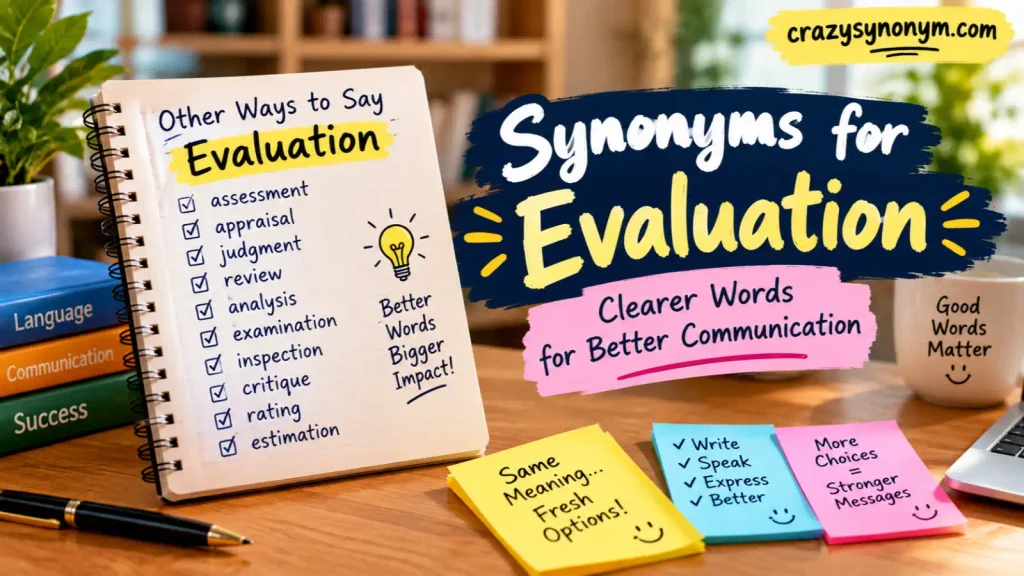
The best synonyms for evaluation include assessment, appraisal, review, analysis, examination, and judgment. Each word describes the process of examining something, but the right choice depends on what you are evaluating. For example, assessment often refers to measuring performance or ability, appraisal can describe judging value or employee performance, and analysis emphasizes studying details.
Finding another word for evaluation can improve essays, reports, business emails, academic papers, and professional documents. Repeating the same term may make your writing feel dull, while choosing an inaccurate replacement can change your intended meaning. A performance evaluation is not always the same as an analysis, and an evaluation of a product may differ from an appraisal of its financial value.
This guide explores more than 31 alternatives, explains their meanings and differences, and provides practical examples to help you select the most accurate word for your audience and purpose.
Quick Answer
Common synonyms for evaluation include assessment, appraisal, review, analysis, examination, judgment, rating, estimation, inspection, and critique. Use assessment to measure performance or ability, appraisal to judge value or performance, review to examine something broadly, and analysis to study details. The best replacement depends on the purpose and context.
Quick List of Synonyms for Evaluation
Here are 40 alternatives grouped by their meaning and typical use.
Closest alternatives
- Assessment
- Appraisal
- Review
- Examination
- Analysis
- Judgment
- Consideration
- Evaluation process
Formal and professional alternatives
- Performance assessment
- Critical appraisal
- Systematic review
- Analytical assessment
- Formal review
- Merit assessment
- Quality assessment
- Value assessment
Neutral and everyday alternatives
- Inspection
- Rating
- Estimation
- Appraisal report
- Feedback
- Assessment process
- Study
- Investigation
- Check
- Measurement
- Audit
- Comparison
Critical and analytical alternatives
- Critique
- Interpretation
- Verification
- Scrutiny
- Diagnostic assessment
- Feasibility analysis
- Impact assessment
- Risk assessment
Context-specific alternatives
- Performance review
- Grading
- Valuation
- Testing
- Benchmarking
- Review of findings
- Quality check
- Decision assessment
These expressions are related, but not all are interchangeable. Valuation focuses on determining monetary or material worth, while grading assigns a score or level. Critique emphasizes critical examination, and audit often involves a systematic check against standards or records.
Formal Alternatives to Evaluation
Formal alternatives are especially useful in research papers, corporate reports, official documents, and professional communication. Choose the word that reflects the actual method or purpose.
1. Assessment
Meaning: The process of measuring, judging, or determining the nature, quality, or performance of something.
Explanation: Assessment is one of the closest general synonyms for evaluation. It often involves criteria, evidence, or measurable outcomes.
Example: The committee completed an assessment of the proposed training program.
Best Use: Education, workplace performance, risk management, and project planning.
Worst Use: When you specifically mean determining the market price of an asset.
Tone: Formal and neutral.
2. Appraisal
Meaning: A considered judgment of the value, quality, or performance of something.
Explanation: Appraisal is particularly common in employee reviews, property valuation, and professional assessments. It may imply a structured process.
Example: The manager scheduled an annual appraisal for each team member.
Best Use: Employee performance, real estate, and asset valuation.
Worst Use: General scientific analysis when no judgment of value or performance is intended.
Tone: Formal and professional.
3. Review
Meaning: A careful examination of something to understand its quality, progress, or suitability.
Explanation: A review may include evaluation, but it can also summarize information or check progress without making a final judgment.
Example: The board requested a review of the department’s annual results.
Best Use: Reports, policies, projects, documents, and business processes.
Worst Use: Situations that require a precise numerical measurement rather than a broad examination.
Tone: Neutral to formal.
4. Analysis
Meaning: A detailed study of information or parts of a subject to understand how they relate or what they reveal.
Explanation: Analysis is a near synonym when evaluation involves examining evidence. However, analysis focuses on understanding details, while evaluation usually emphasizes judging merit or effectiveness.
Example: The research team conducted an analysis of the survey results before recommending changes.
Best Use: Research, finance, strategy, and technical reports.
Worst Use: A simple performance rating that requires no detailed examination.
Tone: Formal and analytical.
5. Examination
Meaning: A careful inspection or study of something.
Explanation: Examination emphasizes looking closely at a subject. It can lead to an evaluation, but the examination itself does not always include a judgment.
Example: A detailed examination of the proposal revealed several gaps.
Best Use: Academic research, document checks, and formal investigations.
Worst Use: A situation where the only task is assigning a score.
Tone: Formal.
6. Critical Appraisal
Meaning: A careful examination of the strengths, weaknesses, and quality of something.
Explanation: This phrase is more specific than evaluation because it emphasizes reasoned judgment. It is common in research and professional review.
Example: The committee prepared a critical appraisal of the proposed policy.
Best Use: Research papers, evidence reviews, and policy analysis.
Worst Use: A routine administrative check with no critical component.
Tone: Highly formal.
7. Systematic Review
Meaning: A structured review that follows a defined method to identify and assess relevant evidence.
Explanation: This is a specialized term, particularly in research. It is not a general substitute for every kind of evaluation.
Example: The researchers conducted a systematic review of published studies on the intervention.
Best Use: Evidence-based research and academic literature reviews.
Worst Use: A casual review of a product or employee.
Tone: Technical and academic.
8. Audit
Meaning: A systematic examination of records, processes, finances, or compliance with standards.
Explanation: An audit may include evaluation, but it typically follows specific procedures and criteria.
Example: The organization commissioned an audit of its expense records.
Best Use: Finance, compliance, operations, and quality management.
Worst Use: A general opinion about a book, service, or creative project.
Tone: Formal and procedural.
9. Scrutiny
Meaning: Close and careful examination.
Explanation: Scrutiny emphasizes the intensity of inspection rather than the final judgment. It can be appropriate when a decision or claim receives close attention.
Example: The proposed budget came under scrutiny before approval.
Best Use: Policy discussions, reports, and critical examination.
Worst Use: A quick, informal opinion.
Tone: Formal and sometimes skeptical.
10. Impact Assessment
Meaning: A structured examination of the likely or actual effects of an action, project, or policy.
Explanation: This narrower expression is appropriate when the main purpose is to understand consequences.
Example: The agency completed an impact assessment before introducing the new program.
Best Use: Policy development, environmental planning, and project management.
Worst Use: Judging the general quality of a product when its effects are not the main concern.
Tone: Formal and technical.
11. Risk Assessment
Meaning: The process of identifying and evaluating potential risks.
Explanation: Risk assessment is a specific type of evaluation. It focuses on the likelihood and possible consequences of unwanted events.
Example: The team performed a risk assessment before launching the service.
Best Use: Safety planning, business decisions, cybersecurity, and project management.
Worst Use: General performance reviews unrelated to risk.
Tone: Formal and analytical.
12. Feasibility Analysis
Meaning: An examination of whether a proposed plan or project is practical and achievable.
Explanation: This phrase is appropriate when evaluation involves resources, costs, constraints, and the likelihood of success.
Example: A feasibility analysis helped determine whether the new branch could operate within budget.
Best Use: Business proposals, engineering, and project planning.
Worst Use: Assessing completed work when its practicality is not in question.
Tone: Professional and technical.
Neutral and Semi-Formal Alternatives

These words fit everyday writing, school assignments, websites, emails, and professional discussions without sounding overly technical.
13. Judgment
Meaning: An opinion or decision formed after considering relevant information.
Explanation: Judgment is a near synonym that emphasizes the conclusion rather than the process of gathering evidence.
Example: Her judgment of the proposal took both cost and long-term value into account.
Best Use: Decision-making, personal opinions, and professional recommendations.
Worst Use: A formal measurement process that requires documented criteria and scores.
Tone: Neutral to formal.
14. Rating
Meaning: A score or level assigned according to a scale or set of criteria.
Explanation: Rating is narrower than evaluation because it generally refers to the result expressed as a score, grade, or category.
Example: The product received a high customer satisfaction rating.
Best Use: Product reviews, service quality, surveys, and performance systems.
Worst Use: A detailed qualitative examination with no scoring component.
Tone: Neutral.
15. Estimation
Meaning: An approximate calculation or judgment of an amount, size, value, or quantity.
Explanation: Estimation is appropriate when the evaluation involves an approximate figure. It does not necessarily imply a full examination of quality.
Example: The initial cost estimation helped the team set a realistic budget.
Best Use: Planning, budgeting, construction, and forecasting.
Worst Use: Assessing the overall quality of a written assignment.
Tone: Neutral and practical.
16. Inspection
Meaning: A close check of something to determine its condition or whether it meets requirements.
Explanation: Inspection focuses on observable details and compliance. It may be part of an evaluation rather than a complete replacement.
Example: The technician carried out an inspection of the equipment before use.
Best Use: Safety, maintenance, manufacturing, and quality control.
Worst Use: Assessing abstract ideas or personal development without observable criteria.
Tone: Neutral to formal.
17. Feedback
Meaning: Information or comments about performance, quality, or results.
Explanation: Feedback can support an evaluation, but it usually refers to the information communicated to someone rather than the full process of judging performance.
Example: The instructor provided feedback on the students’ presentations.
Best Use: Education, coaching, creative work, and workplace development.
Worst Use: A formal assessment that requires a documented score or decision.
Tone: Neutral and constructive.
18. Measurement
Meaning: The process of determining the size, amount, level, or degree of something.
Explanation: Measurement is appropriate when evaluation depends on numerical or clearly defined indicators.
Example: The measurement of customer response times helped the team compare service performance.
Best Use: Research, operations, testing, and performance tracking.
Worst Use: A purely qualitative judgment with no measurable criteria.
Tone: Neutral and technical.
19. Investigation
Meaning: A systematic effort to discover facts or understand what happened.
Explanation: Investigation can include evaluation, but its primary goal is usually to establish facts, causes, or circumstances.
Example: The company began an investigation into the recurring equipment failures.
Best Use: Troubleshooting, research, and formal inquiries.
Worst Use: A routine review that does not seek to uncover facts.
Tone: Neutral to formal.
20. Comparison
Meaning: The process of examining two or more things to identify similarities and differences.
Explanation: Comparison can support an evaluation by showing relative strengths and weaknesses. It does not necessarily produce a final judgment.
Example: A comparison of the three proposals helped the committee identify the best fit.
Best Use: Product selection, vendor decisions, and research.
Worst Use: Evaluating one subject without a reference point.
Tone: Neutral.
21. Study
Meaning: A careful examination of a subject or question.
Explanation: Study is a broad alternative that emphasizes learning or investigation rather than necessarily judging quality.
Example: The school completed a study of student attendance patterns.
Best Use: Research, planning, and exploratory work.
Worst Use: A formal employee rating that follows a specific scoring system.
Tone: Neutral to formal.
22. Verification
Meaning: The process of checking whether information, details, or results are correct.
Explanation: Verification is narrower than evaluation. It establishes accuracy or conformity rather than assessing overall merit.
Example: Verification of the figures was completed before the report was published.
Best Use: Data checking, quality assurance, and document review.
Worst Use: Evaluating creativity or general performance without a clear correctness standard.
Tone: Formal and precise.
23. Grading
Meaning: Assigning a grade or level based on established criteria.
Explanation: Grading is a specific form of evaluation, commonly used in education and assessment systems.
Example: The grading of the final projects followed a shared rubric.
Best Use: Schoolwork, examinations, and structured performance scoring.
Worst Use: A business assessment that does not involve grades or levels.
Tone: Neutral and educational.
24. Benchmarking
Meaning: Comparing performance or processes with a standard, target, or other organizations.
Explanation: Benchmarking helps evaluate relative performance, but it is not identical to evaluation because comparison with a reference point is central to the process.
Example: Benchmarking delivery times helped the company identify areas for improvement.
Best Use: Business strategy, operations, and quality management.
Worst Use: A personal reflection that does not involve standards or comparisons.
Tone: Professional.
Informal and Casual Alternatives
Evaluation is a fairly neutral word, so casual substitutes usually describe the activity rather than offer exact synonyms.
25. Check
Meaning: A quick examination to see whether something is correct, ready, or acceptable.
Explanation: A check is generally less detailed than an evaluation.
Example: Let’s do a quick check of the presentation before sharing it.
When natural: Conversations, quick messages, and simple tasks.
When to avoid: Formal reports that require a thorough assessment.
Tone: Casual and direct.
26. Look-Over
Meaning: A brief examination of something.
Explanation: This informal expression suggests a quick review rather than a structured process.
Example: Could you give my draft a look-over before I submit it?
When natural: Friendly emails, informal requests, and everyday conversation.
When to avoid: Official performance assessments or technical reports.
Tone: Informal.
27. Once-Over
Meaning: A quick look or examination.
Explanation: This expression usually suggests a fast inspection and may not involve detailed analysis.
Example: I’ll give the figures one more once-over before sending them.
When natural: Casual conversation and informal workplace exchanges.
When to avoid: Academic writing or formal documents.
Tone: Casual.
28. Take a Look
Meaning: Examine something, often to form an initial opinion or identify a problem.
Explanation: This phrase describes an action rather than a formal evaluation process.
Example: Can you take a look at the new layout and tell me what you think?
When natural: Messages to coworkers, friends, or collaborators.
When to avoid: A formal document where the process and criteria must be explicit.
Tone: Conversational.
29. Give It a Rating
Meaning: Assign a score or level to something.
Explanation: This expression is useful when the evaluation is specifically about rating quality, satisfaction, or performance.
Example: After testing the app, give it a rating from one to five.
When natural: Surveys, reviews, and informal feedback requests.
When to avoid: A detailed assessment requiring written evidence or multiple criteria.
Tone: Casual and clear.
True Synonyms vs. Contextual Alternatives
| Type | What It Means | Can It Replace the Original? |
|---|---|---|
| True synonym | A word with nearly the same meaning in a particular context, such as assessment | Usually, when the context matches |
| Near synonym | A related term, such as review or analysis | Often, but the focus may change |
| Contextual alternative | A term tied to a particular task, such as inspection | Only when that task is intended |
| Broader expression | A general term, such as examination | Yes, but it may be less specific |
| Narrower expression | A specialized form, such as risk assessment | Yes, when that specific purpose applies |
The main distinction is between examining something and judging its value, quality, or effectiveness. A review may simply summarize findings, an analysis may explain why something happened, and an evaluation usually goes further by judging how well something meets its purpose or criteria.
Industry-Specific Usage
Business Writing
In business documents, choose a word that explains the purpose of the task.
- Assessment: Measuring performance against criteria.
- Appraisal: Reviewing employee performance or asset value.
- Analysis: Studying information to understand patterns.
- Audit: Checking records or processes against defined requirements.
- Benchmarking: Comparing results with a standard or competitor.
Example: The department completed a performance assessment to identify training needs and set clear development goals.
Corporate Communication
Reports and internal announcements benefit from terms that indicate the scope of a review.
Example: The quarterly review examined project progress, spending, and unresolved risks.
Use audit when the work involves a formal, systematic check. Use review when the purpose is broader and may include discussion or recommendations.
Academic Writing
Academic writing often requires a distinction between collecting evidence, analyzing it, and judging the results.
- Assessment: Judging quality or performance against criteria.
- Analysis: Examining data, arguments, or relationships.
- Critical appraisal: Judging the strengths and weaknesses of a study.
- Examination: Studying a topic in detail.
- Grading: Assigning an academic score or level.
Example: The study included an assessment of the intervention’s effectiveness using predefined outcome measures.
Avoid using analysis and evaluation as if they always mean the same thing. Analysis can inform a judgment without making that judgment itself.
Customer Service
Customer service teams often need clear, approachable language when asking for opinions or checking outcomes.
Useful alternatives include:
- Feedback: Asking what worked and what did not.
- Rating: Requesting a score.
- Review: Examining a customer’s experience.
- Check: Confirming that an issue has been resolved.
Example: We would appreciate your feedback on how well our support team resolved the issue.
Legal Writing
Legal writing requires careful attention to the specific meaning of each term. An assessment, review, audit, and valuation may describe different processes, and replacing a defined term can alter the scope of a document.
For instance, a financial valuation is not automatically equivalent to a general assessment. Use the term required by the document and relevant professional standards. This is a language guide, not jurisdiction-specific legal advice.
Email Communication
In professional emails, review, assessment, and feedback are often more natural than repeating evaluation.
Examples:
- Could you review the proposal before Friday?
- We have completed the initial assessment of the applications.
- Please share your feedback on the revised design.
- The team is conducting a risk assessment before implementation.
The most suitable word depends on whether you are asking someone to examine a document, judge performance, or share an opinion.
Email Examples Using Alternatives
Email 1: Reviewing a Proposal
Subject: Review of the Updated Proposal
Hi Elena,
I’ve attached the revised proposal for your review. The budget and delivery schedule have both been updated based on our last discussion.
Could you check the assumptions in the final section and let me know if anything needs clarification?
Thanks,
Marcus
Alternative used: Review.
Why it works: It asks for a broad examination without implying a formal scoring process.
Email 2: Requesting Employee Feedback
Subject: Feedback on the Training Session
Hello everyone,
I’d appreciate your feedback on yesterday’s training session. Please share which parts were useful and where additional examples or explanation would help.
Your comments will help us plan the next session.
Best,
Nina
Alternative used: Feedback.
Why it works: It invites comments and suggestions rather than requesting a formal performance judgment.
Email 3: Sharing an Assessment
Subject: Initial Assessment of Applications
Hi David,
I’ve completed the initial assessment of the applications received this week. Three candidates appear to meet the main requirements, while two need further review.
I’ve included the criteria and notes in the attached document.
Regards,
Olivia
Alternative used: Assessment.
Why it works: It communicates a structured process based on defined criteria.
Email 4: Checking Financial Figures
Subject: Verification of the Final Figures
Hello Peter,
Before we circulate the report, could you verify the totals in the final spreadsheet against the source records?
I’d like to confirm that the figures are accurate before they are included in the published version.
Thank you,
Grace
Alternative used: Verification.
Why it works: The request concerns accuracy rather than the overall quality of the report.
Email 5: Reviewing Project Risks
Subject: Project Risk Assessment
Hi Jordan,
We’re preparing for the next project phase and need to complete the risk assessment. Please identify any major dependencies, possible delays, or resource gaps that should be considered.
Could you send your notes by Wednesday afternoon?
Best regards,
Cameron
Alternative used: Risk assessment.
Why it works: The phrase identifies the specific purpose of the evaluation and clarifies what information is needed.
Short Dialogue Examples
At Work
Person A: Have you finished the evaluation of the new process?
Person B: I’ve completed the initial assessment and am checking the results now.
In a Classroom
Person A: How will the teacher evaluate our presentations?
Person B: She’ll use a grading rubric that covers clarity, evidence, and delivery.
During a Product Discussion
Person A: What did you think of the software?
Person B: My review was positive, but the analysis showed a few performance issues.
In Customer Service
Person A: Could you complete an evaluation of your support experience?
Person B: Sure. I’ll leave feedback about the response time and how the issue was handled.
In a Project Meeting
Person A: Do we know whether the proposal is practical?
Person B: Not yet. We need a feasibility analysis before making that decision.
How to Replace Evaluation in a Sentence
The right replacement can improve clarity while preserving the sentence’s purpose.
Example 1: Employee Performance
Original: The manager completed an evaluation of the employee.
Alternative: The manager completed a performance appraisal of the employee.
Why it works: Appraisal is a natural choice for a structured employee performance review.
Example 2: Research Findings
Original: The evaluation of the results revealed a clear pattern.
Alternative: The analysis of the results revealed a clear pattern.
Why it works: Analysis is more suitable when the sentence focuses on examining data and identifying patterns rather than judging overall merit.
Example 3: A Project Proposal
Original: The team began an evaluation of the proposal.
Alternative: The team began a review of the proposal.
Why it works: Review sounds natural when the team is examining the proposal before making a decision.
Example 4: Product Quality
Original: The evaluation of the product was positive.
Alternative: The assessment of the product was positive.
Why it works: Assessment preserves the general meaning while sounding natural in a professional report.
Example 5: Financial Worth
Original: The evaluation determined the property’s market value.
Alternative: The valuation determined the property’s market value.
Why it works: Valuation is more precise when the specific goal is determining monetary worth.
Example 6: Accuracy of Records
Original: The evaluation confirmed that the figures were correct.
Alternative: The verification confirmed that the figures were correct.
Why it works: Verification emphasizes checking correctness rather than judging overall quality.
Example 7: Student Performance
Original: The teacher’s evaluation considered each student’s progress.
Alternative: The teacher’s assessment considered each student’s progress.
Why it works: Assessment is widely used in education to describe measuring learning and progress.
Example 8: Reviewing a Scientific Paper
Original: The researchers conducted an evaluation of the published studies.
Alternative: The researchers conducted a critical appraisal of the published studies.
Why it works: The revised phrase emphasizes judging the quality and limitations of the research.
Example 9: Project Safety
Original: The evaluation identified possible safety problems.
Alternative: The risk assessment identified possible safety problems.
Why it works: The alternative is more specific because the focus is on identifying and examining risks.
Example 10: Asking for an Opinion
Original: Please send your evaluation of the new website.
Alternative: Please share your feedback on the new website.
Why it works: Feedback sounds more inviting when the goal is to collect comments rather than request a formal judgment.
Comparison Table
| Phrase | Tone | Meaning / Scope | Best Use | Example |
|---|---|---|---|---|
| Assessment | Neutral / formal | Measures quality or performance | Education and business | The assessment identified skill gaps. |
| Appraisal | Formal | Judges value or performance | Employees and property | The appraisal covered annual performance. |
| Review | Neutral | Examines progress or quality | Documents and projects | The review is complete. |
| Analysis | Formal | Studies details and relationships | Research and data | The analysis revealed a trend. |
| Examination | Formal | Studies something carefully | Academic and technical contexts | The examination revealed several errors. |
| Judgment | Neutral | Forms an opinion or decision | Decision-making | Her judgment was based on evidence. |
| Rating | Neutral | Assigns a score or level | Products and services | The service received a high rating. |
| Estimation | Neutral | Approximates a quantity or value | Planning and budgeting | The cost estimation was reasonable. |
| Audit | Formal | Checks records or processes systematically | Finance and compliance | The audit found missing records. |
| Inspection | Neutral / formal | Checks condition or compliance | Safety and quality control | The inspection found a defect. |
| Feedback | Neutral | Shares comments about performance | Coaching and customer service | The feedback was constructive. |
| Critique | Formal / analytical | Examines strengths and weaknesses | Art, writing, and research | The critique highlighted weak arguments. |
| Valuation | Formal | Determines monetary worth | Finance and property | The valuation reflected current market conditions. |
| Benchmarking | Professional | Compares performance with standards | Business strategy | Benchmarking revealed a gap. |
| Verification | Formal | Confirms accuracy or correctness | Data and records | Verification confirmed the totals. |
Which Alternative Should You Choose?
Use this guide to match your wording to the task.
- Formal writing: Choose assessment, appraisal, examination, or critical appraisal, depending on the subject.
- Business communication: Use review for a general examination, assessment for structured judgment, and audit for a systematic compliance or records check.
- Academic writing: Prefer analysis for studying evidence, assessment for judging results, and critical appraisal for examining research quality.
- Legal writing: Preserve defined terms and use review, valuation, or assessment only when the intended process matches.
- Professional emails: Use review when asking someone to examine a document, feedback when requesting comments, and verification when checking facts.
- Everyday conversation: Choose check, look-over, or take a look for a quick examination.
- Casual messages: Say give it a rating when asking for a score or take a look when inviting someone to share an opinion.
- Financial decisions: Use valuation when determining worth and risk assessment when considering potential losses.
- Education: Use assessment as a broad term for judging learning and grading when assigning a score or level.
Grammar and Usage Guide
Is Evaluation a Noun?
Yes. Evaluation is a noun that describes the process or result of judging something.
Examples:
- The evaluation took two weeks.
- Her evaluation of the proposal was detailed.
- We need an evaluation before the launch.
The related verb is evaluate.
- Correct: We need to evaluate the proposal.
- Incorrect: We need to evaluation the proposal.
Evaluation or Evaluations?
Use the singular form for one process or general concept and the plural for multiple separate assessments.
- Singular: The evaluation of the program is complete.
- Plural: The evaluations of all five departments are complete.
Which Prepositions Work With Evaluation?
The most common constructions include:
- Evaluation of: The evaluation of the project is complete.
- Evaluation by: The evaluation by the external team is underway.
- Evaluation for: The evaluation for the award took place last month.
- Evaluation based on: The evaluation was based on documented results.
Choose the preposition that expresses the relationship you intend.
Evaluation vs. Evaluation of
Evaluation names the process, while evaluation of introduces the thing being assessed.
For example, The evaluation is complete is grammatically complete on its own. In The evaluation of the new policy is complete, the additional phrase identifies the subject.
Is Evaluation Countable or Uncountable?
Evaluation is commonly used as a countable noun when referring to individual processes or reports.
- The team conducted an evaluation.
- The committee completed three evaluations.
It can also describe the general activity of judging quality:
– Evaluation is an important part of the research process.
Evaluation vs. Assessment
These words often overlap. Assessment commonly emphasizes measuring performance, ability, or condition against criteria. Evaluation often emphasizes judging value, quality, effectiveness, or success. In many settings, either word may be correct, but the distinction matters when a process has a defined purpose.
Common Mistakes to Avoid
1. Treating every alternative as identical. A review may summarize findings, while an evaluation may judge their quality or effectiveness.
2. Using analysis when you mean judgment. Analysis examines information; evaluation assesses its merit or success. One can support the other.
3. Confusing appraisal with valuation. Appraisal may assess performance or worth, while valuation specifically focuses on determining value.
4. Using audit for an ordinary review. An audit generally implies a systematic check against records, standards, or requirements.
5. Replacing a formal term with slang. A look-over is suitable for an informal request but may be too casual for a formal report.
6. Choosing a narrow term for a broad process. Grading works when scores or levels are assigned, not for every kind of evaluation.
7. Using feedback as a direct substitute in every sentence. Feedback is information or comments, not necessarily the evaluation process itself.
8. Ignoring the purpose of the sentence. If the goal is checking accuracy, verification may be better than assessment.
9. Repeating evaluation unnecessarily. Use a precise alternative when it improves clarity, but do not replace a word merely to avoid repetition.
When Not to Use the Original Word
Although evaluation is versatile, another term may be more precise in these situations.
- When assigning a score: Use rating or grading if the result is a score or level.
- When determining monetary worth: Choose valuation or appraisal when appropriate.
- When confirming accuracy: Use verification if the goal is to establish whether facts or figures are correct.
- When examining records for compliance: Audit is more specific when the process follows formal procedures.
- When studying data patterns: Analysis may better describe the examination of relationships and trends.
- When requesting informal comments: Feedback or a quick review may sound more natural.
- When identifying potential dangers: Use risk assessment to make the purpose explicit.
Still, evaluation is often the best choice when you mean the broader process of judging quality, merit, effectiveness, or value. There is no need to replace it if it already communicates the intended meaning clearly.
Advanced Writer Tips
Match the Word to the Intended Outcome
Before choosing a synonym, ask what the process is meant to produce. A score points toward rating or grading. A decision about effectiveness may call for assessment. An examination of patterns suggests analysis.
Use Clear Language in Professional Emails
Instead of writing, Please conduct an evaluation of this document, consider:
Could you review this document and flag any sections that need revision?
The second version makes the requested action clear.
Distinguish the Process From Its Result
Evaluation can refer to the activity or the resulting judgment. A rating is usually a result; an assessment can describe either the process or the outcome. Making that distinction helps prevent ambiguity.
Use Specific Terms When They Add Meaning
Risk assessment, performance appraisal, and impact assessment tell readers what kind of evaluation is involved. These phrases are useful when the context requires precision.
Avoid Unnecessary Formality
A simple request such as Could you check these figures? may work better than Could you undertake a comprehensive verification of these figures? Use technical wording when it adds clarity, not merely to sound professional.
Keep Evidence and Judgment Separate
In research and reporting, explain what the evidence shows before stating your evaluation. This makes the reasoning easier to follow and helps readers understand how the conclusion was reached.
Related Questions
What is another word for evaluation in a report?
Assessment, review, analysis, and appraisal are common alternatives. Use analysis for examining data, assessment for judging results against criteria, and review for a broad examination of progress or quality.
What is a professional alternative to evaluation?
Assessment is a strong general-purpose choice. Performance appraisal suits employee reviews, risk assessment suits risk-related decisions, and critical appraisal fits a careful examination of evidence or research quality.
Is evaluation a formal word?
Yes. Evaluation is suitable for professional, academic, and everyday writing. It is especially useful when describing a process of judging quality, effectiveness, or merit.
What is the difference between evaluation and assessment?
The meanings overlap considerably. Assessment often focuses on measuring ability, performance, or condition against criteria. Evaluation more often emphasizes judging value, quality, effectiveness, or success. The preferred term can vary by industry and organization.
FAQs:
1. What are the five best synonyms for evaluation?
The five most versatile alternatives are assessment, appraisal, review, analysis, and examination. Assessment works for measuring performance, appraisal often suits performance or value judgments, review is broad, analysis focuses on details, and examination emphasizes careful study.
2. What is the simplest word for evaluation?
Assessment is a useful simple alternative in many contexts. In casual conversation, check or review may be more natural if you mean a quick examination rather than a structured judgment.
3. What is the difference between evaluation and appraisal?
Evaluation is a broad process of judging quality, merit, or effectiveness. Appraisal often refers to a structured judgment of value or performance, especially in employee reviews and property valuation. Their meanings overlap, but appraisal is more common in those specific contexts.
4. Can review and evaluation be used interchangeably?
Sometimes. A review can involve evaluating quality or performance, but it may simply summarize information or check progress. Use evaluation when a judgment against a purpose or criteria is central to the task.
5. What is an academic synonym for evaluation?
Academic alternatives include assessment, critical appraisal, analysis, and examination. Choose critical appraisal when judging the strengths and limitations of research, and analysis when studying data, arguments, or relationships.
6. What is the difference between evaluation and analysis?
Analysis involves examining information to understand its parts, patterns, or relationships. Evaluation involves judging quality, value, or effectiveness. An analysis can provide evidence for an evaluation, but the two processes are not always the same.
7. How can I avoid repeating the word evaluation in an essay?
Choose an alternative that matches the task in each sentence. Use assessment for measuring outcomes, analysis for examining evidence, review for a broad examination, and judgment for the conclusion. Keep evaluation where it remains the clearest term.
Key Takeaways
- Assessment is one of the most versatile alternatives when measuring performance, quality, or condition.
- Review, analysis, and evaluation describe different activities: examining information, studying its details, and judging its merit are related but distinct tasks.
- Specialized alternatives improve precision: risk assessment, performance appraisal, and valuation identify specific purposes.
- Choose language that fits the reader: a formal report may need critical appraisal, while a casual request may need only take a look.
- Preserve meaning over variety: a synonym is useful only when it communicates the same intended idea or accurately reflects the narrower context.
Conclusion:
Choosing the right synonym for evaluation can make your writing more precise and easier to understand. Assessment, appraisal, review, analysis, and examination are strong alternatives, but each emphasizes a different part of the process. Assessment often measures performance or condition, appraisal can judge value or employee performance, review provides a broad examination, and analysis studies details before a conclusion is reached.
For specialized situations, terms such as risk assessment, critical appraisal, valuation, and verification communicate the purpose more clearly than a general word. In informal communication, check, look-over, and take a look can sound more natural. The key is to consider what you are examining, what decision you need to make, and how much detail your reader expects.
Rather than changing every instance of evaluation, replace it when another term improves accuracy or tone. Clear, purposeful wording will serve your readers better than variety for its own sake.

I’m Daniel Carter, an English vocabulary writer who enjoys making words simple and easy to understand. At CrazySynonym.com, I create helpful guides on synonyms, meanings, antonyms, and everyday word usage to help readers choose the right words with confidence.