
A family custom, a cultural custom, and a customer’s usual buying custom may sound similar, but each calls for different words. The best synonyms for custom depend on what you mean: a long-standing tradition, a regular habit, a shared social practice, or a personalized feature made to suit someone’s needs.
Words such as tradition, practice, habit, convention, and bespoke can work in different contexts, but they are not always interchangeable. For example, a wedding custom may be a tradition, while a custom-made suit is better described as tailored or bespoke.
Choosing the right alternative makes your writing clearer and more precise, whether you are working on an essay, a business document, or everyday communication. Understanding these subtle differences helps you express your exact meaning without repeating the same word.
Quick Answer
Useful synonyms for custom include tradition, convention, practice, habit, routine, usage, ritual, norm, and established practice when referring to something people regularly do. For a product made to suit a specific person, use personalized, tailored, made-to-order, or bespoke. The best alternative depends on the sentence.
Quick List of Custom Synonyms
Not every word below means exactly the same thing. Choose an alternative that matches the intended meaning of custom.
Closest alternatives
- Tradition
- Practice
- Convention
- Habit
- Usage
- Established practice
- Accepted practice
- Social norm
- Ritual
- Routine
Formal alternatives
- Convention
- Customary practice
- Established usage
- Traditional practice
- Cultural practice
- Social convention
- Standard practice
- Accepted norm
- Protocol
- Observance
Neutral and everyday alternatives
- Habit
- Routine
- Regular practice
- Usual way
- Common practice
- Way of doing things
- Pattern
- Procedure
- Method
- Local tradition
Alternatives for personalized products or services
- Personalized
- Customized
- Tailored
- Bespoke
- Made-to-order
- Made-to-measure
- Specially made
- Individually designed
Casual or context-specific alternatives
- Usual thing
- Regular way
- Personal preference
- Go-to routine
- Family tradition
- Local habit
- Special arrangement
A quick distinction: Custom as a noun often means a traditional practice. Custom as an adjective often describes something designed for a particular person or purpose, as in custom furniture. These two meanings require different alternatives.
Synonyms for Custom Formal Alternatives to Custom
Formal alternatives work well in reports, academic writing, cultural studies, policy documents, and professional communication. The entries below focus mainly on custom as a traditional or established practice.
1. Tradition
Meaning: A practice, belief, or activity passed down through generations.
Explanation: Tradition is one of the closest alternatives when a custom has a historical or cultural background. It often suggests that people continue the practice because of its connection to the past.
Example: Preparing a special meal for the spring festival is a family tradition.
Best Use: Cultural writing, family history, ceremonies, and community events.
Worst Use: Describing a one-time procedure that has no connection to the past.
Tone: Neutral to formal.
2. Convention
Meaning: A way of behaving or doing something that a group generally accepts.
Explanation: A convention may be social, professional, or cultural. Unlike a tradition, it does not always need to continue across generations.
Example: It is a convention to address the chairperson before speaking at the meeting.
Best Use: Academic essays, social behavior, professional etiquette, and formal writing.
Worst Use: A deeply personal habit that no group shares.
Tone: Formal and neutral.
3. Established practice
Meaning: A method or activity that people have followed for some time.
Explanation: This phrase emphasizes consistency and acceptance. It may describe a workplace method as easily as a community custom.
Example: Reviewing each application twice is an established practice at the organization.
Best Use: Policies, reports, professional documents, and workplace procedures.
Worst Use: A new idea that has not yet become routine.
Tone: Formal.
4. Customary practice
Meaning: An action that is usual or accepted within a particular group or setting.
Explanation: This phrase directly connects an activity with what people normally do. It can sound more formal than custom.
Example: It is customary practice to offer guests refreshments before the ceremony.
Best Use: Cultural descriptions, formal explanations, and institutional writing.
Worst Use: Informal conversation where a simpler phrase would be clearer.
Tone: Formal.
5. Social convention
Meaning: A commonly accepted rule of behavior in society or a group.
Explanation: A social convention concerns shared expectations. It may be informal and unwritten rather than legally required.
Example: Waiting for everyone to receive their food before eating is a social convention in some families.
Best Use: Sociology, etiquette, cultural analysis, and essays.
Worst Use: A private routine that does not involve social expectations.
Tone: Formal.
6. Usage
Meaning: An accepted way of using a word, expression, or practice.
Explanation: Usage is especially useful when discussing language or established patterns of use. It does not replace custom naturally in every cultural context.
Example: This spelling reflects common usage in American English.
Best Use: Language guides, grammar discussions, and descriptions of established practices.
Worst Use: Referring to a family celebration without a language-related context.
Tone: Neutral to formal.
7. Protocol
Meaning: A set of accepted steps or rules for a particular situation.
Explanation: Protocol is narrower than custom because it usually involves formal procedures or expected conduct. Some customs are not organized enough to be called protocols.
Example: The delegation followed the official protocol during the welcome ceremony.
Best Use: Diplomacy, formal events, healthcare, and organizational procedures.
Worst Use: A casual personal preference, such as taking a walk after lunch.
Tone: Formal.
8. Observance
Meaning: The act of following or marking a custom, rule, or special occasion.
Explanation: Observance focuses on carrying out a practice, often one connected to religion, culture, or a commemorative event.
Example: The annual observance includes music, food, and community activities.
Best Use: Religious, cultural, and commemorative contexts.
Worst Use: Everyday behavior that is not being formally marked or followed.
Tone: Formal.
9. Cultural practice
Meaning: An activity or behavior associated with a particular culture or community.
Explanation: This phrase makes the cultural context clear. It is useful when custom feels too broad or when discussing several different practices.
Example: Storytelling is an important cultural practice in the community.
Best Use: Research, education, anthropology, and cultural reporting.
Worst Use: A purely personal routine with no cultural connection.
Tone: Formal and descriptive.
10. Accepted norm
Meaning: A behavior or standard that a group generally considers normal.
Explanation: A norm describes an expectation more than a repeated action. It is suitable when the emphasis falls on what people expect others to do.
Example: Giving colleagues credit for their work is an accepted norm in the department.
Best Use: Workplace culture, social research, and policy discussions.
Worst Use: A specific ceremony or activity when the event itself matters more than the expectation.
Tone: Formal.
11. Standard practice
Meaning: A method commonly followed in a particular field or organization.
Explanation: This term often refers to a regular professional method. It can overlap with custom, but it does not necessarily carry cultural or historical meaning.
Example: Keeping a record of each payment is standard practice for the accounts team.
Best Use: Business, education, administration, and technical writing.
Worst Use: A family tradition that is meaningful mainly because it has been passed down.
Tone: Formal and professional.
12. Traditional practice
Meaning: An activity maintained because of its historical or cultural roots.
Explanation: This phrase emphasizes the link between an action and the past. It is a useful alternative when the word tradition alone feels too broad.
Example: The traditional practice of welcoming new neighbors brings the community together.
Best Use: Cultural reports, historical writing, and community descriptions.
Worst Use: A recently introduced office process.
Tone: Formal and neutral.
Synonyms for Custom Neutral and Everyday Alternatives
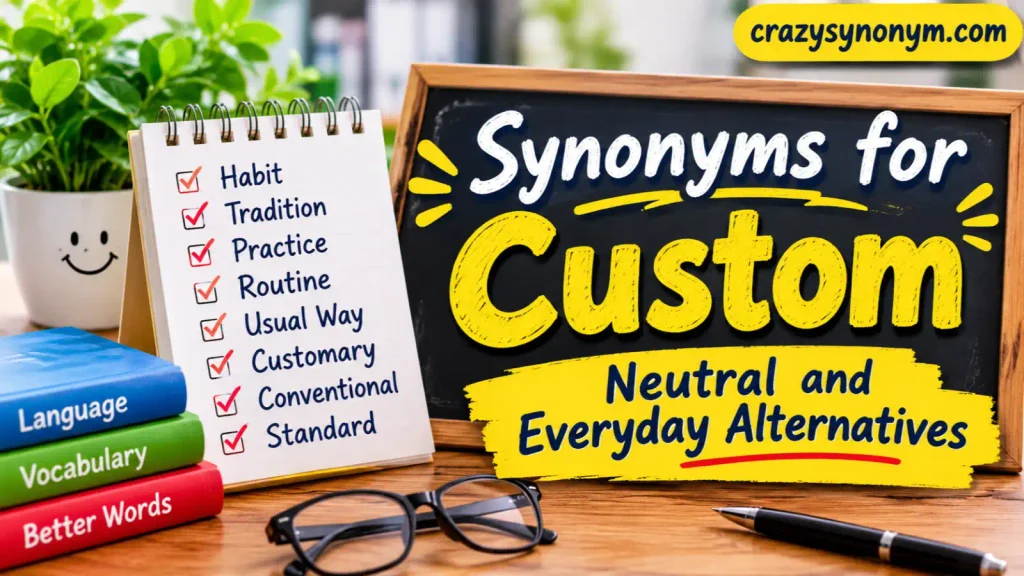
These words are useful when you want natural language without sounding too formal. Some are close synonyms; others describe only a specific part of a custom’s meaning.
13. Habit
Meaning: Something a person does regularly, often without much thought.
Explanation: A habit is usually personal or individual, while a custom is often shared by a group. Use habit when repetition matters more than cultural meaning.
Example: Checking the weather before leaving home is a habit of mine.
Best Use: Personal behavior, daily routines, and lifestyle writing.
Worst Use: A community ceremony that has been practiced for generations.
Tone: Neutral.
14. Routine
Meaning: A regular sequence of activities.
Explanation: A routine usually involves repeated steps. It may be planned and practical rather than traditional.
Example: Our morning routine includes a short team meeting.
Best Use: Work schedules, home life, study plans, and daily activities.
Worst Use: A cultural belief or ceremony with deep historical meaning.
Tone: Neutral.
15. Practice
Meaning: A repeated way of doing something.
Explanation: Practice is broad enough for professional, personal, and cultural situations. It is often one of the safest replacements for custom when the context is clear.
Example: Sharing updates at the end of each shift is a useful practice.
Best Use: Work, education, health, and everyday explanations.
Worst Use: A sentence where the reader needs to know that an activity is specifically traditional.
Tone: Neutral to formal.
16. Common practice
Meaning: Something many people or organizations regularly do.
Explanation: This phrase emphasizes how widespread an action is. It does not prove that everyone follows it or that it is required.
Example: Sending a confirmation email after a booking is common practice.
Best Use: Explanations, business writing, and general information.
Worst Use: A unique tradition followed by only one family.
Tone: Neutral.
17. Usual way
Meaning: The way something is normally done.
Explanation: This plain expression is useful when you want to avoid formal language. It describes a familiar method but does not necessarily suggest a tradition.
Example: The usual way to enter the building is through the side door.
Best Use: Instructions, casual explanations, and everyday conversation.
Worst Use: Academic writing that requires a precise term for a cultural practice.
Tone: Casual to neutral.
18. Regular practice
Meaning: An activity performed repeatedly or consistently.
Explanation: It highlights frequency rather than history. A regular practice can become a custom, but the terms do not mean exactly the same thing.
Example: Backing up files every Friday is a regular practice for our team.
Best Use: Workplace routines, personal systems, and instructions.
Worst Use: A single event or occasional ceremony.
Tone: Neutral.
19. Pattern
Meaning: A repeated or recognizable way that something happens.
Explanation: A pattern may emerge naturally rather than being deliberately followed. It is less specific than custom.
Example: The pattern of greeting visitors at the entrance has continued for years.
Best Use: Analysis, reports, behavior descriptions, and observations.
Worst Use: A formal ceremony with defined steps.
Tone: Neutral.
20. Procedure
Meaning: A set of steps for completing a task.
Explanation: A procedure is more structured than a typical custom. It works best when the action involves an ordered process rather than a social tradition.
Example: The office procedure requires visitors to sign in at reception.
Best Use: Manuals, workplace instructions, and administrative writing.
Worst Use: A casual habit or a symbolic cultural tradition.
Tone: Neutral to formal.
21. Method
Meaning: A particular way of doing something.
Explanation: Method emphasizes how an action is carried out. It is a contextual alternative rather than a direct synonym for a tradition.
Example: This method of preparing the dough has been used by local bakers for years.
Best Use: Instructions, teaching, practical tasks, and technical explanations.
Worst Use: A custom that involves social expectations rather than a specific technique.
Tone: Neutral.
22. Local tradition
Meaning: A practice associated with a particular town, region, or community.
Explanation: This phrase is more specific than custom. Use it when location and shared cultural identity matter.
Example: The summer lantern parade is a local tradition.
Best Use: Travel writing, community news, and cultural descriptions.
Worst Use: A private habit unrelated to a place or community.
Tone: Neutral.
23. Family tradition
Meaning: An activity or practice passed down or repeated within a family.
Explanation: This is a narrower expression that clearly identifies the group involved.
Example: Baking bread together on the first Sunday of winter is a family tradition.
Best Use: Personal stories, family history, and lifestyle content.
Worst Use: A practice followed across an entire profession or society.
Tone: Warm and neutral.
24. Personal preference
Meaning: An individual’s choice based on taste or comfort.
Explanation: A preference is not necessarily a custom because it may not involve repeated behavior. It works when the main idea is what someone likes or chooses.
Example: Choosing a quiet table is a personal preference, not a shared custom.
Best Use: Recommendations, customer communication, and descriptions of individual choices.
Worst Use: A long-standing community tradition.
Tone: Neutral.
25. Way of doing things
Meaning: A general approach to carrying out an activity.
Explanation: This flexible phrase can describe an individual, team, or community. It is less precise than custom but often sounds more natural in conversation.
Example: Every workshop has its own way of doing things.
Best Use: Informal explanations and workplace discussions.
Worst Use: Formal research where the exact nature of the practice needs to be identified.
Tone: Casual to neutral.
Synonyms for Custom Informal Alternatives to Custom
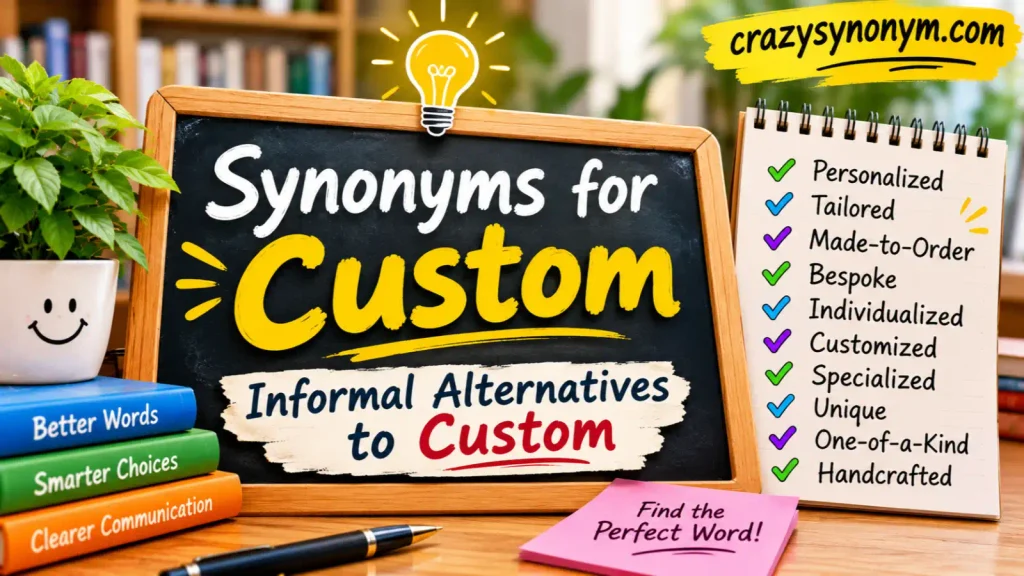
Informal expressions can make a sentence sound more natural, but they are not exact substitutes in every setting.
26. Usual thing
Meaning: Something a person or group normally does.
Explanation: This casual phrase works when the activity is familiar and the details are already clear.
Example: Meeting at the park on Saturday is our usual thing.
When natural: Friendly conversations and personal messages.
When to avoid: Academic papers, policies, and formal reports.
Tone: Casual.
27. Regular way
Meaning: The normal method used by a person or group.
Explanation: It focuses on how an activity is usually done rather than why it exists.
Example: We use the regular way of checking tickets before boarding.
When natural: Everyday instructions and informal workplace talk.
When to avoid: Describing a culturally important ceremony where tradition is more accurate.
Tone: Casual to neutral.
28. Go-to routine
Meaning: A familiar sequence of actions someone often relies on.
Explanation: This phrase suggests a preferred routine, not necessarily a custom shared by a community.
Example: A short walk is my go-to routine after a long day.
When natural: Lifestyle writing, blogs, and conversations about habits.
When to avoid: Legal or academic writing that requires precise terminology.
Tone: Casual.
29. The way we do it
Meaning: The method or practice a particular group follows.
Explanation: This phrase can communicate a group custom without using a formal noun. It may also sound rigid if used to dismiss other approaches.
Example: Serving tea before dinner is simply the way we do it at home.
When natural: Family conversations and informal team discussions.
When to avoid: Formal reports or situations where the practice needs a clear name.
Tone: Casual.
30. Old habit
Meaning: A behavior someone has followed for a long time.
Explanation: It emphasizes personal repetition and may suggest that the behavior is difficult to change. It is not a good substitute for every cultural custom.
Example: Reading a paper book before bed is an old habit of hers.
When natural: Personal stories and relaxed conversation.
When to avoid: Describing a respected community tradition if old habit sounds dismissive.
Tone: Casual.
Alternatives When Custom Means Made for Someone
The adjective custom has a different meaning in phrases such as custom suit, custom software, and custom furniture. Here, it means designed or made for a particular person, need, or purpose. The following alternatives fit this meaning, not the meaning of a social tradition.
31. Customized
Meaning: Changed or designed to meet specific needs.
Explanation: This is often the closest alternative to adjective custom, especially for products, software, and services.
Example: The company offers customized training plans for new employees.
Best Use: Business services, technology, products, and customer solutions.
Worst Use: Replacing custom in a sentence about a traditional greeting.
Tone: Neutral and professional.
32. Personalized
Meaning: Adapted to an individual, often using their name, preferences, or needs.
Explanation: Personalization often focuses on the person receiving the item or service. It may involve less physical redesign than customization.
Example: Each guest received a personalized welcome card.
Best Use: Gifts, customer experiences, messages, and marketing.
Worst Use: Describing a product that was built to exact technical specifications when custom-built is more accurate.
Tone: Neutral and friendly.
33. Tailored
Meaning: Adjusted to fit a person’s needs or a specific situation.
Explanation: Tailored can describe clothing literally and plans, advice, or services figuratively.
Example: The adviser prepared a tailored savings plan for the client.
Best Use: Consulting, financial services, clothing, and professional recommendations.
Worst Use: A general product that has not been adapted to any specific need.
Tone: Professional.
34. Bespoke
Meaning: Made specifically for an individual or customer.
Explanation: This word is common in British English and luxury markets. In American English, it may sound more specialized or high-end than custom-made.
Example: The hotel commissioned bespoke furniture for its main lounge.
Best Use: Luxury products, tailored clothing, design, and specialized services.
Worst Use: Everyday items where the word may sound unnecessarily grand.
Tone: Formal or premium.
35. Made-to-order
Meaning: Produced after a customer places an order, often according to selected requirements.
Explanation: This term describes the production arrangement. It does not always mean the item is uniquely designed; a standard product may also be made to order.
Example: The bakery prepares made-to-order cakes for special events.
Best Use: Food, furniture, clothing, and manufacturing.
Worst Use: A finished item available for immediate purchase.
Tone: Neutral and commercial.
36. Made-to-measure
Meaning: Made using measurements taken for a specific person or space.
Explanation: This is more specific than customized. It often applies to clothing, curtains, and fitted furnishings.
Example: He ordered a made-to-measure jacket for the ceremony.
Best Use: Tailoring, interior fittings, and products requiring precise measurements.
Worst Use: Software or services that do not depend on physical measurements.
Tone: Neutral to formal.
37. Specially made
Meaning: Created for a particular purpose or request.
Explanation: This plain expression is easy to understand and can replace custom-made when technical detail is unnecessary.
Example: The school ordered a specially made display stand for the science fair.
Best Use: General writing, product descriptions, and everyday explanations.
Worst Use: Professional specifications where the exact production method matters.
Tone: Neutral.
38. Individually designed
Meaning: Designed separately for a particular person, client, or requirement.
Explanation: This phrase stresses the design process. It does not necessarily guarantee that the finished item is manufactured from scratch.
Example: Each garden layout was individually designed to suit the available space.
Best Use: Architecture, design, services, and project descriptions.
Worst Use: A standard product selected from a catalog without design changes.
Tone: Professional.
39. Custom-built
Meaning: Built according to specific requirements rather than using only a standard design.
Explanation: This is a strong option for equipment, computers, furniture, and structures. It usually refers to construction or assembly.
Example: The studio uses a custom-built computer for video editing.
Best Use: Technology, engineering, construction, and specialized equipment.
Worst Use: A message or card that has only been personalized with a name.
Tone: Neutral and technical.
40. Purpose-built
Meaning: Designed and built for a particular function.
Explanation: A purpose-built item is created to perform a specific task. It may serve a group or general use rather than one individual.
Example: The laboratory installed a purpose-built room for equipment testing.
Best Use: Architecture, engineering, facilities, and technical writing.
Worst Use: A product that is merely decorated or personalized.
Tone: Formal and technical.
41. Bespoke-designed
Meaning: Designed specifically for a particular customer or brief.
Explanation: This phrase combines the individual focus of bespoke with a clear emphasis on design. It can be redundant because bespoke already suggests individual creation.
Example: The client requested a bespoke-designed reception desk.
Best Use: Premium design descriptions when the design process needs emphasis.
Worst Use: Simple, everyday copy where custom-designed is clearer.
Tone: Formal and promotional.
42. Adapted
Meaning: Changed to suit a different need, person, or condition.
Explanation: An adapted item may begin as a standard product or method. Unlike custom-built, it does not imply that the item was created from the beginning for one purpose.
Example: The teacher adapted the lesson for students with different learning needs.
Best Use: Education, accessibility, procedures, and existing products.
Worst Use: A new item built entirely to a client’s specifications.
Tone: Neutral.
True Synonyms vs. Contextual Alternatives
The meaning of custom changes with the sentence. The table below shows how closely each alternative matches the original.
| Type | What It Means | Can It Replace the Original? |
|---|---|---|
| True or close synonym | A word with nearly the same meaning in the given context, such as tradition for a cultural custom | Often, if the context matches |
| Near synonym | A related term with a slightly different focus, such as habit | Sometimes |
| Contextual alternative | A phrase that fits a particular situation, such as protocol for formal procedures | Only in suitable contexts |
| Broader expression | A general phrase, such as way of doing things | Yes, but it may lose precision |
| Narrower expression | A specific type, such as family tradition | Only when that specific meaning is intended |
| Formal equivalent | A more formal phrase, such as customary practice | Usually, if the meaning matches |
| Casual equivalent | A conversational phrase, such as usual thing | In informal settings only |
A useful rule is to identify the intended meaning before choosing a replacement. If custom means a community’s long-standing practice, tradition is usually a strong choice. If it means a product made for a particular customer, customized or custom-built may be more accurate.
Synonyms for Custom Industry-Specific Usage
Business Writing
In business writing, choose words that describe what people actually do.
- Use standard practice for an accepted workplace method.
- Use procedure for a set of steps employees must follow.
- Use routine for repeated daily work.
- Use convention for an accepted communication or behavior norm.
- Use customized for a service or product adapted to a client’s needs.
Example:
Less precise: The office has a custom of checking every order.
Clearer: Checking every order before shipment is standard practice at the office.
The second sentence makes the operational meaning clearer. If the action is instead a long-standing cultural tradition within the organization, custom may still be appropriate.
Corporate Communication
Policies and internal reports often need a distinction between what is common and what is required.
- Protocol suggests formal steps or expected conduct.
- Standard practice describes a common method.
- Established practice highlights a method that has been followed over time.
- Norm describes an accepted expectation within a group.
Do not use standard practice to imply a legal requirement unless the relevant policy or law supports that claim.
Academic Writing
For essays and research papers, the best choice depends on the field and argument.
- Tradition suits practices passed between generations.
- Social convention suits accepted social behavior.
- Cultural practice suits activities connected to a community’s culture.
- Norm suits shared expectations.
- Usage suits accepted language patterns.
Example:
Original: The custom affects how visitors greet their hosts.
Alternative: The social convention affects how visitors greet their hosts.
The alternative emphasizes shared expectations. If the practice is a historical tradition rather than a general social rule, custom or tradition may be more precise.
Customer Service
Customer-facing writing should be simple and clear.
- Use personalized when an experience is adapted to a customer.
- Use tailored when a service is adjusted to meet a need.
- Use usual process when explaining normal steps.
- Use standard procedure when explaining an established service process.
Example:
We can provide a tailored solution based on your requirements.
This sounds helpful and professional without suggesting that every part of the service will be created from scratch.
Legal Writing
Legal use requires special care. A custom can sometimes have significance in a legal context, but its meaning and effect depend on the issue and applicable law.
Words such as practice, usage, tradition, and convention may carry different implications. Replacing one term with another can change the scope or suggest something that the original wording did not establish.
For general legal or policy writing:
- Keep custom if it is the precise term used by the relevant source.
- Use practice only when the focus is on repeated conduct.
- Use usage when the discussion concerns an accepted way of using or doing something.
- Do not assume that a common practice is legally binding.
For legal documents, preserve defined terms and seek qualified legal review when wording could affect rights or obligations.
Email Communication
Email language should match the relationship and purpose.
- Established practice works in a formal internal explanation.
- Standard procedure is suitable for instructions.
- Tradition fits a friendly note about an annual event.
- Personalized describes a service adapted to a recipient.
- Usual approach sounds natural in a relaxed professional exchange.
The goal is not to replace custom every time. It is to make the sentence more exact and easier to understand.
Synonyms for Custom Email Examples Using Alternatives to Custom
Email 1: Explaining a workplace practice
Subject: Order Review Process
Hi Morgan,
Our standard practice is to review each order before it leaves the warehouse. Please include the completed checklist with tomorrow’s shipment.
Thanks,
Riley
Email 2: Inviting colleagues to a yearly event
Subject: Annual Team Breakfast
Hello everyone,
We are keeping our tradition of hosting a team breakfast before the winter break. Please let me know by Thursday if you plan to attend.
Best,
Nadia
Email 3: Discussing a client-specific service
Subject: Your Training Plan
Hello Mr. Patel,
We can prepare a tailored training plan based on your team’s experience and goals. I’ll send a draft schedule after our call on Tuesday.
Kind regards,
Elena
Email 4: Clarifying a formal process
Subject: Visitor Check-In
Hi all,
The building’s standard procedure requires visitors to sign in at reception and wear a visitor badge. Please share these steps with anyone hosting a guest this week.
Thank you,
Jordan
Email 5: Describing a community tradition
Subject: Neighborhood Festival Details
Hi Sam,
The lantern walk is a long-standing local tradition, and this year’s event will begin at the community center at 6 p.m. Feel free to bring your family.
Warmly,
Avery
Email 6: Requesting a personalized product
Subject: Design Requirements for the Display
Hello Priya,
Could you provide a customized display design that fits the dimensions in the attached brief? We would also appreciate an estimate for production and delivery.
Best regards,
Noah
Synonyms for Custom Short Dialogue Examples
Workplace
Person A: Why do we review the reports on Friday?
Person B: It’s an established practice. It gives the team time to fix errors before Monday.
Classroom
Person A: Why does everyone bring a dish to the final class?
Person B: It’s a tradition our teacher started several years ago.
Customer service
Person A: Can you change the plan to fit my schedule?
Person B: Yes. We can offer a tailored plan based on your availability.
Family
Person A: Why do we take a picture before dinner every holiday?
Person B: It’s a family tradition we’ve kept since I was little.
Professional meeting
Person A: Should I send the agenda before the meeting?
Person B: Yes, that’s our usual procedure so everyone can prepare.
Synonyms for Custom How to Replace Custom in a Sentence
The right replacement depends on what the original sentence is trying to say.
Example 1
Original: It is a custom to greet guests at the door.
Alternative: It is a tradition to greet guests at the door.
Why it works: Tradition fits if the greeting is a long-standing cultural or family practice. If it is simply an expected social behavior, convention may be more accurate.
Example 2
Original: Checking the figures twice is a custom in our office.
Alternative: Checking the figures twice is standard practice in our office.
Why it works: Standard practice sounds more natural for an established workplace method.
Example 3
Original: She has a custom of reading before bed.
Alternative: She has a habit of reading before bed.
Why it works: Habit is a better fit for a repeated personal action.
Example 4
Original: The company offers custom training sessions.
Alternative: The company offers tailored training sessions.
Why it works: Tailored shows that the training is adjusted to specific needs.
Example 5
Original: The village follows an old custom during the harvest.
Alternative: The village observes an old tradition during the harvest.
Why it works: Observes fits a practice or ceremony that people continue to mark. It slightly changes the sentence structure.
Example 6
Original: This is the custom way to submit the form.
Alternative: This is the usual way to submit the form.
Why it works: Custom way is awkward here unless the intended meaning is a specialized or customized method. Usual way communicates the normal process.
Example 7
Original: We ordered a custom table for the dining room.
Alternative: We ordered a made-to-order table for the dining room.
Why it works: Made-to-order emphasizes that the table is produced after the order. If it has a unique design, custom-made may be more precise.
Example 8
Original: The custom of exchanging gifts brings the family together.
Alternative: The family tradition of exchanging gifts brings everyone together.
Why it works: The alternative makes the group involved explicit and gives the sentence a warmer tone.
Example 9
Original: The organization has a custom for handling complaints.
Alternative: The organization has a procedure for handling complaints.
Why it works: Procedure is more suitable if the organization follows specific steps. It should not be used if the sentence refers only to an informal habit.
Example 10
Original: The designer created a custom dress for the event.
Alternative: The designer created a made-to-measure dress for the event.
Why it works: Made-to-measure works if the dress was cut to the wearer’s measurements. If the design itself was unique, custom-designed may be better.
Synonyms for Custom Comparison Table
| Phrase | Tone | Meaning / Scope | Best Use | Example |
|---|---|---|---|---|
| Tradition | Neutral | Practice passed down over time | Culture and family | It is a family tradition. |
| Convention | Formal | Accepted group behavior | Etiquette and society | That is a social convention. |
| Habit | Neutral | Repeated individual behavior | Daily life | It is a useful habit. |
| Routine | Neutral | Regular sequence of actions | Work and personal schedules | Follow your morning routine. |
| Practice | Neutral | Repeated way of doing something | Work and general writing | This is common practice. |
| Protocol | Formal | Defined steps or conduct | Official situations | Follow the safety protocol. |
| Usage | Formal | Accepted use or pattern | Language and established practice | Current usage favors this term. |
| Procedure | Formal | Ordered steps | Instructions and administration | Follow the procedure. |
| Norm | Formal | Shared expectation | Social and workplace behavior | That is an accepted norm. |
| Personalized | Neutral | Adapted to an individual | Gifts and services | Choose a personalized card. |
| Tailored | Professional | Adjusted to particular needs | Plans and services | Request a tailored solution. |
| Bespoke | Premium | Made for a specific customer | Luxury products | They ordered bespoke furniture. |
| Made-to-order | Neutral | Produced after an order | Retail and manufacturing | The cake is made to order. |
| Custom-built | Technical | Built for specific requirements | Equipment and structures | They need a custom-built computer. |
| Usual way | Casual | Normal method | Everyday conversation | That’s the usual way to do it. |
Which Alternative Should You Choose?
Use this guide when you need to make a quick decision.
- Formal writing: Choose convention, customary practice, or established practice when the meaning fits.
- Business communication: Use standard practice for common workplace methods and procedure for defined steps.
- Academic writing: Choose tradition, social convention, cultural practice, or norm based on your argument.
- Legal writing: Keep custom when it is the precise term. Do not replace it casually if legal meaning may change.
- Professional email: Use usual process, standard procedure, tailored, or personalized according to the situation.
- Everyday conversation: Try habit, routine, usual way, or family tradition.
- Casual messages: Use usual thing or the way we do it when the context is informal and clear.
- Products and services: Use customized, custom-built, made-to-order, or made-to-measure to describe the actual type of adaptation.
A simple test helps: ask whether the sentence is about a repeated behavior, a shared tradition, an accepted rule, or something designed for a particular need. That answer usually points to the best word.
Synonyms for Custom Grammar and Usage Guide
1. Know whether custom is a noun or an adjective
As a noun, custom often refers to a traditional practice.
- The custom dates back many years.
- The community maintains an old custom.
As an adjective, it describes something made or adjusted for a specific purpose.
- We ordered custom cabinets.
- The firm provides custom software.
The adjective often appears before a noun. Do not replace it with a noun synonym such as tradition.
2. Understand countable and uncountable use
When custom means a particular tradition, it is countable:
- The region has several customs.
- One custom involves welcoming new guests.
In phrases such as by custom or according to custom, the word may refer to customary behavior in a broader sense.
3. Use customary when you need an adjective
Customary means usual or established by custom.
- It is customary to thank the host.
- The customary greeting varies by region.
Do not confuse customary with customized. The first describes what is usual; the second describes something adapted to specific needs.
4. Choose natural collocations
These combinations are common and clear:
- Follow a custom
- Observe a tradition
- Maintain a practice
- Establish a routine
- Follow a procedure
- Meet a protocol requirement
- Provide a customized service
- Order custom-made furniture
The verb matters. People usually observe a tradition, follow a procedure, and develop a habit.
5. Use hyphens carefully
Hyphenation depends on the phrase and the style guide. Common forms include custom-made, made-to-order, made-to-measure, and purpose-built when used before a noun.
- She bought a custom-made desk.
- The desk was custom made for her office.
Follow your publication’s style guide for consistency.
6. Avoid awkward combinations
The phrase custom way is often unclear. If you mean the normal method, say usual way. If you mean a method designed for one specific purpose, say customized method or custom approach.
Synonyms for Custom Common Mistakes to Avoid
- Treating every alternative as an exact synonym. A habit is often personal, while a custom may be shared by a group.
- Using tradition for every repeated action. A routine can happen daily without having historical or cultural importance.
- Confusing custom with customized. One can mean a social practice; the other describes something adapted to particular needs.
- Using protocol too broadly. A protocol usually suggests formal or defined conduct, not any repeated behavior.
- Calling something standard practice without support. The phrase suggests that a method is commonly followed in the relevant setting.
- Making a sentence too formal. Established practice may be unnecessary when usual way communicates the idea clearly.
- Using bespoke when custom-made is clearer. Bespoke may suggest a premium product or specialized service.
- Ignoring cultural context. A phrase that describes a tradition respectfully in one context may sound dismissive in another.
- Choosing a vague replacement. Way of doing things may hide useful details that procedure or tradition would make clear.
- Changing the meaning while editing. Read the full sentence after replacing the word to ensure that the original point remains accurate.
Synonyms for Custom When Not to Use Custom
Although alternatives can improve clarity, custom is still the best choice in several situations.
1. When discussing a recognized cultural practice
If the point is a long-standing social or cultural practice, custom may be more precise than routine or method.
2. When the source uses a specific term
In academic, historical, or legal material, preserve the original wording when it has a defined meaning. A stylistic change should not distort the source.
3. When the meaning is already clear
If the sentence reads naturally and the intended meaning is obvious, replacing custom just to avoid repetition may make the writing worse.
4. When describing a custom-made product
The adjective custom is concise and widely understood in American English. There is no need to replace it with a longer phrase unless the alternative adds useful detail.
5. When distinguishing a tradition from a rule
A custom may be followed because people expect it, not because an authority requires it. Avoid replacing it with rule or requirement unless that stronger meaning is accurate.
6. When a legal or technical source uses the term deliberately
Preserve terminology in source-based writing unless you can confirm that the replacement has the same meaning in context.
Synonyms for Custom Advanced Writer Tips
Match the word to the intended meaning
Before editing, identify whether custom refers to a cultural practice, a personal habit, a shared expectation, or a specially made item. This prevents a simple word change from altering the message.
Use a specific word instead of a longer phrase
Compare:
- Vague: The company has a custom for checking returns.
- Clear: The company follows a standard procedure for checking returns.
The second version tells readers what kind of practice is involved.
Keep professional emails direct
A short phrase such as usual process can be more readable than established customary practice. Choose formal wording only when it adds precision or suits the audience.
Avoid treating frequency as proof of acceptance
An activity that happens often is not automatically a social norm or a standard practice. Use common practice when it is generally followed in the relevant setting, and habit when describing an individual’s repeated behavior.
Describe product differences accurately
Use personalized for individual details, tailored for adjusted needs, made-to-measure for exact measurements, and custom-built for items built to particular requirements. These distinctions make product descriptions more useful.
Read the sentence aloud
A replacement may be technically correct but still sound awkward. Reading the sentence aloud helps reveal stiff wording, unclear meaning, and unnecessary formality.
Synonyms for Custom Related Questions
What is another word for custom?
For a traditional practice, try tradition, convention, practice, or usage. For a repeated personal action, habit or routine may fit better. For an item made for a specific customer, use customized or custom-made.
What is a professional alternative to custom?
In professional writing, established practice, standard practice, and procedure are useful alternatives when describing workplace methods. For a service adapted to a client, tailored or customized is often more appropriate.
Is custom a formal word?
Yes. Custom is suitable for both everyday and formal writing. It can describe a cultural tradition, a shared practice, or a specially made product. The context determines which meaning readers understand.
What is the difference between custom and tradition?
A custom is an established way of behaving or doing something. A tradition usually emphasizes a practice passed down over time. Their meanings overlap, but tradition often carries a stronger sense of history or heritage.
What is the difference between custom and habit?
A habit is usually an individual’s repeated behavior, such as reading before bed. A custom is often a practice shared by a family, community, or group. The distinction is not absolute, but it is useful in most writing.
FAQs:
1. What are the closest synonyms for custom?
The closest alternatives are tradition, practice, convention, and usage, depending on the sentence. Tradition suits long-standing cultural practices, while practice is broader and works in professional and everyday contexts.
2. What is a formal synonym for custom?
Customary practice, established practice, social convention, and accepted norm are formal alternatives. Choose the one that describes the situation accurately rather than selecting the most formal-sounding phrase.
3. What is a synonym for custom in business?
In business, standard practice, procedure, and established practice often fit workplace methods. If custom means a product or service adapted to a client, use customized or tailored instead.
4. What is another word for a cultural custom?
Tradition, cultural practice, and social convention are useful options. Use tradition when historical continuity matters, and cultural practice when you want a clear descriptive term.
5. What is a synonym for custom-made?
Depending on the item, alternatives include custom-built, customized, bespoke, made-to-order, made-to-measure, and specially made. These terms differ in whether they emphasize design, construction, production, or individual fit.
6. Can habit and custom be used interchangeably?
Sometimes, but not always. A habit usually describes repeated individual behavior, whereas a custom often refers to an established practice shared by a group. Consider the sentence’s context before switching between them.
7. What is the difference between custom and convention?
A custom is an established practice or way of behaving. A convention is generally an accepted way of acting within a group or society. A convention often emphasizes shared expectations, while a custom may emphasize the practice itself or its history.
Key Takeaways:
- Tradition is a strong choice for a long-standing cultural or family practice.
- Practice, routine, and habit describe repeated actions but differ in scope and purpose.
- Convention, norm, and protocol can express accepted behavior or formal expectations.
- Customized, tailored, bespoke, and custom-built describe different ways an item or service meets specific needs.
- Always check the sentence before replacing custom; accuracy matters more than variety.
Conclusion:
Choosing a synonym for custom starts with understanding what the word means in your sentence. If you are writing about a cultural practice, tradition, convention, or cultural practice may communicate the idea more clearly. For repeated personal behavior, habit and routine are usually more natural. In professional settings, standard practice, established practice, and procedure can describe workplace methods without adding unnecessary formality.
The meaning changes when custom describes something made for a particular customer. In that case, customized, tailored, made-to-order, and custom-built may be better options, depending on how the item is designed or produced. These terms are related, but they are not identical.
Before choosing a replacement, consider the audience, tone, and intended meaning. A precise word makes writing easier to understand and helps prevent confusion. Use the alternative that best expresses your idea, and keep custom whenever it remains the clearest and most accurate choice.

I’m Daniel Carter, an English vocabulary writer who enjoys making words simple and easy to understand. At CrazySynonym.com, I create helpful guides on synonyms, meanings, antonyms, and everyday word usage to help readers choose the right words with confidence.