

Dessert is the sweet treat many people look forward to after a meal. But sometimes, the word dessert does not quite fit the sentence you are writing. You might need a more elegant term for a restaurant menu, a professional phrase for a food review, or a fun alternative for a blog post. That is where 38+ synonyms for dessert can help you find the right words.
The best alternative depends on the food, the setting, and the feeling you want to create. Sweet treat sounds friendly, confection feels refined, and pudding has a more specific meaning in some English-speaking countries. This guide explains more than 38 useful alternatives, including formal terms, everyday expressions, and names for particular kinds of sweet food. You will also find examples, email samples, grammar tips, and practical advice to help you choose a word that sounds natural.
Quick Answer
Useful synonyms and alternatives for dessert include sweet treat, sweet course, after-dinner treat, confection, sweet, pudding, pastry, cake, pie, and frozen treat. Some are close substitutes, while others describe specific foods or occasions. Choose the expression that matches the dish and the context, especially when writing menus, recipes, food reviews, or casual messages.
Quick List of Dessert Alternatives
Here are 40 words and expressions related to dessert, grouped by how they are commonly used. Remember that some name the whole category, while others refer to particular foods.
Closest Alternatives
- Sweet treat
- Sweet course
- After-dinner treat
- Sweet dish
- Sweet
- Dessert course
- Final course
- Post-meal treat
Formal and Refined Alternatives
- Confection
- Confectionery
- Patisserie
- Sweet delicacy
- Pastry creation
- Culinary creation
- Sweet course offering
- Petit four
Neutral and Everyday Alternatives
- Cake
- Pie
- Pudding
- Pastry
- Ice cream
- Fruit course
- Baked sweet
- Frozen treat
- Sweet snack
- Baked dessert
Casual and Playful Expressions
- Something sweet
- A little treat
- After-dinner sweet
- Sugar fix
- Sweet bite
- Yummy treat
Contextual Alternatives
- Sorbet
- Mousse
- Custard
- Tart
- Brownie
- Cheesecake
- Crumble
- Gelato
- Trifle
- Sweetened fruit
Writing tip: If you need a direct replacement for the general word dessert, start with sweet treat, sweet course, or after-dinner treat. If you know the exact dish, naming it directly is often clearer.
Synonyms for Dessert Formal Alternatives for Dessert
Formal alternatives work well in restaurant menus, culinary writing, event descriptions, food journalism, and hospitality materials. Some describe the role of the food, while others refer to a particular type of sweet preparation.
1. Confection
Meaning: A sweet food, especially candy or a carefully prepared sugary item.
Explanation: Confection is a refined term for certain sweet foods. It does not cover every dessert equally well, since a fruit plate or a simple bowl of ice cream may not naturally be called a confection.
Example: The chef presented a delicate chocolate confection with a raspberry center.
Best Use: Gourmet food writing, pastry descriptions, and elegant menus.
Worst Use: Referring to every kind of dessert, including plain fresh fruit.
Tone: Refined and culinary.
2. Confectionery
Meaning: Sweets and sweet products, especially candy and similar treats.
Explanation: This word often refers to a category of products or the business of making and selling sweets. It is not a universal substitute for a dessert served at the end of a meal.
Example: The shop specializes in handmade confectionery.
Best Use: Bakery descriptions, candy shops, and food industry writing.
Worst Use: Replacing dessert in a sentence about a restaurant’s final course.
Tone: Professional and product-focused.
3. Sweet Course
Meaning: The sweet part of a meal, usually served after the main course.
Explanation: This is a close functional alternative to dessert. It emphasizes the structure of a meal rather than a particular dish.
Example: The tasting menu ends with a sweet course featuring seasonal berries.
Best Use: Fine dining, tasting menus, catering, and formal meal descriptions.
Worst Use: Casual conversation where a simpler phrase sounds more natural.
Tone: Formal and precise.
4. Final Course
Meaning: The last course in a meal.
Explanation: A final course is not always dessert. It may include cheese, fruit, or another serving depending on the menu. Use it when the order of the meal matters more than sweetness.
Example: The final course paired lemon tart with freshly brewed coffee.
Best Use: Restaurant reviews and descriptions of multi-course meals.
Worst Use: When you need to make it clear that the food is sweet.
Tone: Neutral to formal.
5. Patisserie
Meaning: French-style pastry making or a shop specializing in pastries.
Explanation: This word is associated with delicate baked goods, such as éclairs, tarts, and layered pastries. It can describe a style of baking or a business, not simply any dessert.
Example: The hotel added a French-inspired patisserie selection to its afternoon menu.
Best Use: Upscale bakeries, pastry menus, and culinary features.
Worst Use: A general reference to fruit, pudding, or every after-dinner dish.
Tone: Sophisticated and specialized.
6. Sweet Delicacy
Meaning: A special or carefully prepared sweet food.
Explanation: This descriptive phrase suggests craftsmanship or an unusual flavor. It is more expressive than the general word dessert but may sound overly grand for an everyday dish.
Example: Guests received a pistachio sweet delicacy with their tea.
Best Use: Event menus, food features, and special-occasion descriptions.
Worst Use: Simple recipes where direct wording is more helpful.
Tone: Elegant and descriptive.
7. Petit Four
Meaning: A small, usually decorative sweet bite served with coffee, tea, or as part of a dessert selection.
Explanation: A petit four is a specific type of small confection or pastry, not a general synonym for dessert.
Example: Each guest received a fruit petit four after the meal.
Best Use: Wedding catering, afternoon tea, and fine-dining menus.
Worst Use: Referring to a large cake or a full dessert course.
Tone: Formal and culinary.
8. Culinary Creation
Meaning: A dish prepared with particular skill or creativity.
Explanation: This phrase can describe a dessert, but it can also refer to savory food. The context must make the meaning clear.
Example: The pastry chef’s latest culinary creation combines pear, ginger, and dark chocolate.
Best Use: Chef profiles, food reviews, and promotional menu copy.
Worst Use: Everyday writing that benefits from a specific food name.
Tone: Professional and promotional.
9. Pastry Creation
Meaning: A sweet baked item made using pastry techniques.
Explanation: This is narrower than dessert because not all desserts are pastries. It is useful when the dish’s construction or baking style is important.
Example: The bakery unveiled a delicate pastry creation filled with vanilla cream.
Best Use: Bakery marketing and pastry-focused articles.
Worst Use: Describing ice cream, fruit salad, or pudding.
Tone: Refined and descriptive.
10. Sweet Course Offering
Meaning: A sweet item or selection provided as part of a meal or menu.
Explanation: This is a formal descriptive phrase rather than a direct lexical synonym. It suits hospitality documents but can sound stiff in ordinary prose.
Example: The venue expanded its sweet course offerings for private events.
Best Use: Catering proposals, hospitality reports, and menu planning.
Worst Use: Friendly social posts or informal conversations.
Tone: Businesslike and formal.
Synonyms for Dessert Neutral and Everyday Alternatives
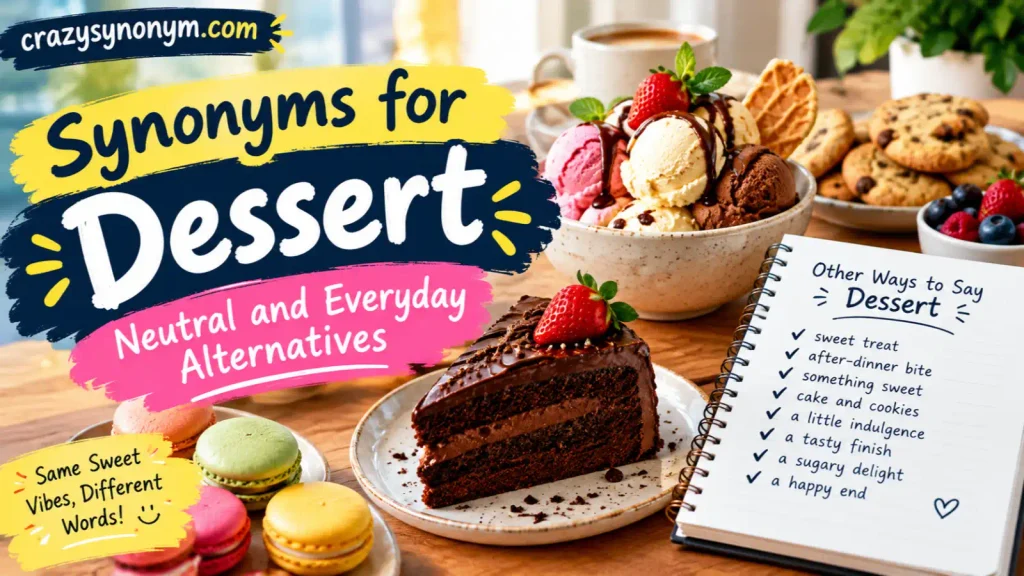
These expressions are easier to use in recipes, food blogs, school assignments, restaurant reviews, and daily conversation. Their accuracy depends on what you are describing.
11. Sweet Treat
Meaning: Something sweet that people enjoy as a snack or reward.
Explanation: This is one of the most flexible alternatives. It can refer to a dessert after dinner, a cupcake during the day, or a small piece of candy.
Example: We shared a sweet treat after our weekend lunch.
Best Use: Blogs, captions, family conversations, and general writing.
Worst Use: Technical culinary writing that needs an exact dish or course.
Tone: Friendly and accessible.
12. Sweet
Meaning: A sweet food; in some varieties of English, especially British English, it can mean a dessert or candy.
Explanation: The meaning changes by region and context. In American English, sweets often means candy, while a sweet may sound less common than a dessert.
Example: British guests may ask what sweets are available after dinner.
Best Use: Regional dialogue and writing for audiences familiar with the usage.
Worst Use: Global copy where readers may interpret it as candy rather than a meal’s final course.
Tone: Casual to neutral, depending on region.
13. Sweet Dish
Meaning: A dish with a sweet flavor, often served as part of a meal.
Explanation: This phrase works well for many home-cooked desserts. It may also describe sweet dishes served during the meal rather than afterward.
Example: Her favorite sweet dish is warm rice pudding with cinnamon.
Best Use: Recipe collections, home cooking, and food discussions.
Worst Use: When the meal’s final course needs to be distinguished from other sweet foods.
Tone: Neutral.
14. After-Dinner Treat
Meaning: Something enjoyable and sweet eaten after dinner.
Explanation: This expression highlights the occasion rather than the dish. It is close to dessert in many everyday situations, but it can also refer to candy or a small snack.
Example: Fresh strawberries made a simple after-dinner treat.
Best Use: Family menus, lifestyle articles, and casual writing.
Worst Use: Formal menus where the course name should be concise.
Tone: Warm and conversational.
15. After-Dinner Sweet
Meaning: A sweet item enjoyed after dinner.
Explanation: This phrase is clear, though it may sound more natural to some British English speakers than to American English speakers.
Example: The host served an after-dinner sweet with coffee.
Best Use: Descriptive writing and dialogue where the phrasing fits the audience.
Worst Use: Technical recipe instructions or copy that needs a widely familiar term.
Tone: Neutral to casual.
16. Sweet Snack
Meaning: A small sweet food eaten between meals or whenever someone wants a bite.
Explanation: A sweet snack is not necessarily dessert. The expression works if the food is small or eaten outside a formal meal.
Example: A date stuffed with almond butter makes a quick sweet snack.
Best Use: Snack recipes and everyday food advice.
Worst Use: Describing an elaborate restaurant dessert course.
Tone: Casual and practical.
17. Baked Sweet
Meaning: A sweet baked item.
Explanation: This broad expression may refer to cookies, cakes, pastries, or similar foods. It does not cover frozen or chilled desserts.
Example: The market stall sold a different baked sweet every morning.
Best Use: Bakery descriptions and general discussions of baked goods.
Worst Use: Referring to ice cream or a chilled mousse.
Tone: Neutral and descriptive.
18. Frozen Treat
Meaning: A cold, frozen food enjoyed as a snack or dessert.
Explanation: This is a useful umbrella term for ice cream, sorbet, and some frozen fruit desserts. It is narrower than dessert because it excludes many non-frozen dishes.
Example: Homemade mango sorbet is a refreshing frozen treat.
Best Use: Summer recipes, family-friendly content, and casual menus.
Worst Use: Describing a warm pie or baked pudding.
Tone: Friendly and informal.
19. Fruit Course
Meaning: A serving of fruit presented as a separate course.
Explanation: Fruit can serve as dessert, but the term describes the ingredient or course structure rather than all sweet dishes.
Example: The meal finished with a fruit course of sliced peaches and berries.
Best Use: Formal menus and meals emphasizing fresh fruit.
Worst Use: Referring to chocolate cake or a pastry assortment.
Tone: Neutral to formal.
20. Sweet Bite
Meaning: A small portion of sweet food.
Explanation: This expression emphasizes size. It can describe a mini tart, a small cookie, or a bite-sized confection, but not necessarily a full serving.
Example: Everyone sampled a sweet bite from the dessert platter.
Best Use: Party menus, food captions, and small-portion descriptions.
Worst Use: A large plated dessert that deserves a more precise name.
Tone: Casual and inviting.
21. Baked Dessert
Meaning: A dessert prepared in an oven.
Explanation: This is a clear category label for items such as cobbler, cake, pie, and crumble. It is not suitable for desserts that are only chilled or frozen.
Example: Apple crumble is a classic baked dessert for autumn gatherings.
Best Use: Recipe categories and cooking instructions.
Worst Use: Describing gelatin, ice cream, or chilled custard.
Tone: Neutral and informative.
22. Sweet Snack Course
Meaning: A sweet serving treated as part of a meal or planned menu.
Explanation: This is a descriptive phrase, not a standard culinary term in every setting. A simpler phrase such as sweet course will usually be clearer.
Example: The event schedule included a sweet snack course between activities.
Best Use: Informal catering plans when a small serving is intended.
Worst Use: Professional menus that need established culinary language.
Tone: Neutral but somewhat awkward.
23. Sweetened Fruit
Meaning: Fruit served with added sweetness, such as syrup, honey, or sugar.
Explanation: Sweetened fruit can be a dessert, but it is an ingredient-based description rather than a general synonym.
Example: The cook served sweetened fruit with plain yogurt.
Best Use: Recipe writing and descriptions of fruit-based dishes.
Worst Use: Referring to a cake or pastry.
Tone: Neutral and specific.
Synonyms for Dessert Casual Expressions for Dessert
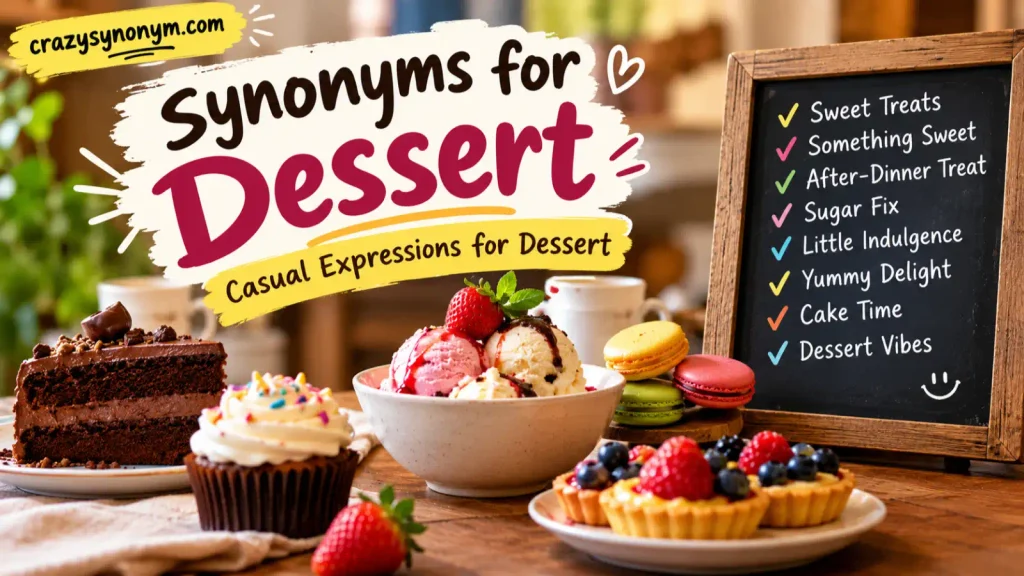
Casual language works well in texts, social media captions, family chats, and friendly blog posts. These phrases add personality, but most are not suitable for formal menus.
24. Something Sweet
Meaning: Any sweet food the speaker wants to eat or serve.
Example: Let’s find something sweet before we head home.
When Natural: Everyday conversations and informal invitations.
When to Avoid: Formal writing where readers need to know which dish is being offered.
Tone: Relaxed and friendly.
25. A Little Treat
Meaning: A small enjoyable food, often something sweet.
Example: I saved a little treat for everyone after the movie.
When Natural: Family messages, lifestyle content, and friendly captions.
When to Avoid: Describing a large or elaborate dessert without qualification.
Tone: Warm and playful.
26. Sugar Fix
Meaning: An informal expression for satisfying a craving for something sugary.
Example: Those chocolate brownies gave me the sugar fix I wanted.
When Natural: Casual conversation, humorous writing, and social posts.
When to Avoid: Medical, nutrition, or formal food writing where the expression could be imprecise.
Tone: Playful and informal.
27. Yummy Treat
Meaning: A tasty food enjoyed for pleasure.
Example: The kids chose a yummy treat from the bakery counter.
When Natural: Family-friendly writing, children’s content, and cheerful captions.
When to Avoid: Fine-dining reviews or professional culinary descriptions.
Tone: Very casual and enthusiastic.
28. After-Dinner Indulgence
Meaning: A pleasurable food enjoyed after dinner, often something rich or special.
Example: A slice of chocolate tart was her favorite after-dinner indulgence.
When Natural: Food blogs, lifestyle articles, and descriptions of rich desserts.
When to Avoid: Neutral writing where the dessert is ordinary or the word indulgence may imply excess.
Tone: Expressive and slightly luxurious.
29. Sweet Bite to Finish
Meaning: A small sweet item enjoyed at the end of a meal.
Example: We had one final sweet bite to finish the picnic.
When Natural: Casual food writing and conversational storytelling.
When to Avoid: Formal culinary documentation or when the portion is large.
Tone: Friendly and descriptive.
True Synonyms vs. Related Food Terms
Not every sweet food name can replace dessert. The table below shows how the alternatives differ in meaning and scope.
| Type | What It Means | Can It Replace the Original? |
|---|---|---|
| True or close synonym: sweet treat | A sweet food enjoyed for pleasure | Often, especially in casual writing |
| Functional alternative: sweet course | The sweet part of a meal | Yes, when describing the meal structure |
| Near synonym: after-dinner treat | Something sweet eaten after dinner | Usually, but it emphasizes timing |
| Contextual alternative: confection | A sweet product, often candy or a crafted sweet | Only when the food fits |
| Broader expression: culinary creation | A prepared dish of any type | Only if the context clearly means dessert |
| Narrower expression: pastry | A particular type of baked food | Only when the dessert is a pastry |
| Narrower expression: pudding | A specific dessert category in many contexts | Only when pudding is the dish |
| Narrower expression: frozen treat | A frozen sweet food | Only for frozen desserts |
| Casual equivalent: something sweet | An unspecified sweet food | Often in conversation |
| Regional alternative: sweet | A sweet item; sometimes dessert or candy | Depends on the audience and variety of English |
The safest replacement depends on what you want to communicate. Sweet course describes a meal’s structure, sweet treat describes the experience, and pastry identifies a type of food.
Synonyms for Dessert Industry-Specific Usage
Business Writing
In business writing, use direct, clear terms. A bakery business plan might use dessert menu, sweet product range, or baked goods selection, depending on what the document covers.
- Example: The café will expand its sweet product range before the holiday season.
- Why it works: Product range suits business planning better than a vague phrase such as yummy treats.
- Watch out: A product range may include candy and packaged sweets, not only desserts served after meals.
Corporate Communication
Corporate messages often describe catering, employee events, product launches, or hospitality arrangements.
- Example: The event menu includes a seasonal sweet course after the main meal.
- Why it works: The phrase sounds organized and makes the serving order clear.
- Watch out: Avoid overly decorative language in schedules and logistics documents.
Academic Writing
Academic writing should favor specific descriptions over colorful substitutions.
- Example: The study compared consumer preferences for cakes, frozen desserts, and fruit-based dishes.
- Why it works: Naming the food categories makes the sentence more precise.
- Watch out: Confection and patisserie should not be used as general replacements unless the research concerns those categories.
Customer Service
When answering a customer, choose wording that is friendly but clear.
- Example: We offer three desserts today, including lemon tart and vanilla ice cream.
- Alternative: We have three sweet treats available today, including lemon tart and vanilla ice cream.
- Best approach: Use desserts when customers need a clear menu category. Use sweet treats when a warmer tone fits the conversation.
Legal Writing
Legal writing may describe food services, catering obligations, product categories, or menu commitments. The exact term depends on the document.
- Example: The agreement specifies the dessert items included in the catering package.
- Possible alternative: The agreement specifies the sweet food items included in the catering package.
- Important distinction: Sweet food items may be broader than dessert items. If a contract defines a category, changing the wording could alter its scope. Legal terms should be reviewed in context, and this example is not jurisdiction-specific legal advice.
Email Communication
For email, match the wording to the purpose and recipient.
- Internal planning: sweet course, dessert selection, or catering menu
- Client communication: dessert options or after-dinner selection
- Friendly invitation: something sweet or a little treat
- Restaurant inquiry: dessert menu or available desserts
A natural phrase is usually better than a fancy one. The goal is to make the food and the plan easy to understand.
Email Examples Using Dessert Alternatives
These examples show how to use different alternatives in realistic messages.
Email 1: Asking a Restaurant About Its Menu
Subject: Question About the Dessert Menu
Hello,
I’m planning a dinner for six next Friday and wanted to ask about your current dessert menu. Do you offer any fruit-based options alongside the cakes and pastries?
Please let me know if you have a menu I can review before booking.
Thank you,
Morgan
Why it works: Dessert menu is clear and standard for a restaurant inquiry.
Email 2: Organizing Office Catering
Subject: Sweet Course for the Team Lunch
Hi Priya,
The main lunch menu is confirmed. Could you check whether the caterer can provide a sweet course with at least one dairy-free option?
We expect around 24 people, so a selection that is easy to serve would be ideal.
Thanks,
Evan
Why it works: Sweet course fits a planned meal and keeps the request professional.
Email 3: Suggesting a Bakery Collaboration
Subject: Seasonal Pastry Selection
Hello Jamie,
I enjoyed seeing your autumn menu and would like to discuss a possible collaboration. Our café is interested in featuring a small pastry selection made with seasonal fruit.
Would you be available for a short call early next week?
Best,
Lena
Why it works: Pastry selection is more precise than dessert because the proposed items are baked goods.
Email 4: Inviting Friends to Dinner
Subject: Dinner at My Place on Saturday
Hey everyone,
Dinner is at my place this Saturday at 7. I’ll handle the main meal, and I have something sweet planned for afterward.
Let me know if you have any food allergies so I can plan ahead.
See you soon,
Alex
Why it works: Something sweet sounds natural and friendly without revealing the exact dish.
Email 5: Responding to a Customer
Subject: Re: Catering Options for Your Event
Hello Taylor,
Thank you for sharing the event details. We can provide a choice of desserts, including a seasonal fruit tart and a chocolate mousse.
If you would prefer a lighter option, we can also discuss a fresh fruit course.
Please let me know which direction best suits your guests.
Kind regards,
Riley
Events Coordinator
Why it works: Desserts and fruit course communicate two different levels of specificity without confusing the customer.
Synonyms for Dessert Short Dialogue Examples
At a Restaurant
Person A: What comes after the main course?
Person B: You can choose a dessert or a small cheese plate.
Person A: I’ll have the lemon tart for dessert.
Planning a Family Meal
Person A: Should I make a cake for Sunday lunch?
Person B: That would be lovely. Everyone enjoys a sweet treat after lunch.
Person A: Great. I’ll bake it on Saturday.
In a Bakery
Person A: Are these all your pastries?
Person B: Yes, and the chocolate éclairs are today’s special.
Person A: I’ll take two for dessert tonight.
At School
Person A: What did you bring for the class party?
Person B: Mini brownies and fruit cups.
Person A: Those will make great sweet bites for everyone.
Discussing a Menu
Person A: The menu has a lot of rich dishes. Should we add ice cream?
Person B: Sorbet might work better as a lighter frozen treat.
Person A: Good idea. Let’s include lemon sorbet.
How to Replace Dessert in a Sentence
The examples below show how an alternative can change the tone or meaning.
1. General Writing
Original: We ordered dessert after dinner.
Alternative: We ordered a sweet treat after dinner.
Why it works: The replacement sounds warmer and more casual. It may suggest a small or informal serving.
2. Restaurant Menu
Original: Dessert is included in the package.
Alternative: The sweet course is included in the package.
Why it works: Sweet course sounds suitable for a structured meal. It may be less familiar to some customers than dessert.
3. Food Review
Original: The dessert was the best part of the meal.
Alternative: The final course was the best part of the meal.
Why it works: This emphasizes the course’s position in the meal. However, it does not explicitly say the course was sweet.
4. Bakery Description
Original: The shop sells many desserts.
Alternative: The shop sells a variety of pastries and cakes.
Why it works: The alternative names specific products, giving readers a clearer idea of the selection. It narrows the scope if other dessert types are sold.
5. Family Conversation
Original: We need to buy dessert for the children.
Alternative: We need to buy something sweet for the children.
Why it works: The wording sounds relaxed and leaves the exact food open.
6. Catering Proposal
Original: The event includes two desserts.
Alternative: The event includes two sweet course options.
Why it works: The revised sentence suits formal event planning, although dessert options may be clearer to a general audience.
7. Summer Recipe
Original: This dessert is perfect for hot weather.
Alternative: This frozen treat is perfect for hot weather.
Why it works: The alternative works if the dish is frozen. It would not be accurate for a warm fruit crumble.
8. Gourmet Food Writing
Original: The chef prepared a special dessert.
Alternative: The chef prepared a delicate confection.
Why it works: The revised sentence suggests a crafted sweet, often a candy or small confection. It is not suitable for every plated dessert.
9. Recipe Category
Original: Add this dessert to your holiday menu.
Alternative: Add this baked dessert to your holiday menu.
Why it works: The phrase is more specific if the recipe is baked. Do not use it for a no-bake cheesecake or frozen dish.
10. Casual Invitation
Original: Would you like dessert?
Alternative: Would you like a little treat?
Why it works: The alternative feels friendly and informal. It may suggest a small serving rather than a full dessert course.
Dessert Alternatives at a Glance
| Phrase | Tone | Meaning / Scope | Best Use | Example |
|---|---|---|---|---|
| Sweet treat | Friendly | Broad sweet food | Casual writing | We shared a sweet treat. |
| Sweet course | Formal | Sweet part of a meal | Menus | The sweet course follows the main dish. |
| Confection | Refined | Crafted sweet, often candy | Culinary writing | The chef made a chocolate confection. |
| Patisserie | Specialized | French-style pastry making or shop | Bakery features | The patisserie sells éclairs. |
| Final course | Neutral | Last part of a meal | Meal reviews | The final course was memorable. |
| Sweet dish | Neutral | Sweet prepared food | Recipes | Rice pudding is a popular sweet dish. |
| After-dinner treat | Casual | Sweet food eaten after dinner | Lifestyle writing | We enjoyed an after-dinner treat. |
| Sweet snack | Casual | Sweet food eaten as a snack | Snack recipes | Fruit and yogurt make a sweet snack. |
| Frozen treat | Casual | Frozen sweet food | Summer content | Sorbet is a refreshing frozen treat. |
| Pastry | Neutral | A specific baked-food category | Bakery menus | The pastry was filled with cream. |
| Pudding | Regional or specific | A dessert category or particular dish | Recipes and regional dialogue | We served chocolate pudding. |
| Petit four | Formal | Small decorative sweet | Events | Each guest received a petit four. |
| Something sweet | Casual | Unspecified sweet food | Conversation | Let’s get something sweet. |
| Sweetened fruit | Descriptive | Fruit with added sweetener | Recipes | Sweetened fruit topped the yogurt. |
Which Dessert Alternative Should You Choose?
Use this decision guide to match the phrase to your audience and purpose.
- Formal writing: Choose sweet course when describing a meal’s structure, or confection when referring to a suitable crafted sweet.
- Business communication: Use dessert selection, sweet product range, or catering menu, depending on the subject.
- Academic writing: Name the exact food or use a defined category such as baked desserts or frozen desserts.
- Legal writing: Preserve the original meaning of defined terms. Do not replace dessert with a broader or narrower phrase unless the scope remains correct.
- Professional email: Prefer dessert options, sweet course, or pastry selection when the specific food category matters.
- Everyday conversation: Dessert, sweet treat, and something sweet are natural choices.
- Casual messages: Try a little treat or sugar fix when a playful tone suits the recipient.
- Restaurant menus: Use the actual dish name whenever possible, such as lemon tart, chocolate mousse, or mango sorbet.
If the reader needs to know exactly what is being served, a specific name is usually better than a broad substitute.
Grammar and Usage Guide
Is Dessert Countable or Uncountable?
Dessert is usually countable when it refers to a serving or type of sweet food.
- We ordered a dessert to share.
- The restaurant offers six desserts.
- Chocolate mousse is my favorite dessert.
It can also be used in broader, uncountable ways when discussing dessert as a course or category.
- We will serve dessert after the main meal.
- Is dessert included with the meal?
The correct form depends on whether you mean a serving, several varieties, or the course in general.
Use the Right Plural
The plural of dessert is desserts. Do not confuse it with deserts, which usually refers to dry regions or the act of leaving someone or something behind.
- Correct: The café offers homemade desserts.
- Incorrect for food: The café offers homemade deserts.
Choose Natural Collocations
A collocation is a group of words that commonly appear together. These combinations sound natural in English:
- Serve dessert
- Order dessert
- Dessert menu
- Dessert recipe
- Dessert course
- Dessert options
- After-dinner treat
- Sweet course
- Chocolate dessert
- Frozen dessert
Use the word that fits the action. People usually order dessert at a restaurant, prepare a dessert at home, and choose from a dessert menu.
Use Capitalization Consistently
In normal sentences, dessert is lowercase.
– We served dessert after dinner.
Capitalize it only when it begins a sentence or appears in a title using title case.
- Dessert was served at the end of the meal.
- 38+ Synonyms for Dessert
Do Not Treat Regional Words as Universal
In American English, dessert is the standard term for the sweet course after a meal. In British English, pudding can refer more broadly to dessert in certain contexts, while sweets often refers to candy.
- American usage: What would you like for dessert?
- British usage: What’s for pudding?
These patterns vary by speaker and situation, so use the term that fits your intended audience.
Common Mistakes to Avoid
- Calling every sweet food a dessert. Candy, sweetened drinks, and snack bars can be sweet without being desserts.
- Using confection for every dish. The word often suggests candy or a crafted sweet rather than any final course.
- Treating pudding as a universal substitute. Its meaning varies by region and may identify a particular type of dish.
- Using pastry too broadly. A cake, ice cream, or fruit salad is not necessarily a pastry.
- Choosing fancy language over clarity. Sweet course offering may sound formal, but dessert options is often easier to understand.
- Ignoring portion size. Sweet bite and a little treat suggest something small.
- Using casual expressions in formal documents. Sugar fix is playful, not a neutral menu label.
- Confusing dessert with desert. The spelling changes the meaning.
- Ignoring regional differences. Sweet, sweets, and pudding do not mean exactly the same thing to every English speaker.
When Not to Use the Word Dessert
The word dessert is useful, but another term may be more precise in certain situations.
1. When You Know the Exact Dish
Instead of saying dessert, write apple pie, vanilla custard, or strawberry sorbet. Specific names help readers understand the food immediately.
2. When Describing a Small Candy
If you mean one piece of chocolate or a sugar confection, candy or confection may be more accurate than dessert.
3. When the Food Is a Snack
A cookie eaten during a morning break may be better described as a sweet snack than as dessert.
4. When the Meal Structure Matters
Use sweet course when discussing the sequence of a formal meal and final course when the last course is not necessarily sweet.
5. When Writing About Frozen Foods
If the recipe focuses on ice cream, sorbet, or another frozen product, frozen dessert or frozen treat can be more specific.
6. When a Regional Audience Expects Another Term
In some British English contexts, pudding may sound natural where American English speakers would usually say dessert. Match the wording to the audience.
7. When the Original Word Is Already Clear
Do not replace dessert just to avoid repetition if the alternative is awkward or less accurate. Clear writing matters more than using a different word in every sentence.
Advanced Writer Tips
Match the Word to the Desired Feeling
A menu that says sweet delicacy creates a different impression from one that says sweet treat. The first sounds elegant, while the second feels relaxed. Neither is automatically better; the audience determines the best choice.
Make Professional Emails Easy to Understand
Use a familiar phrase when asking a clear question. For example, Could you send me the dessert options? is usually more direct than Could you provide the available sweet course offerings?
Keep Politeness Natural
You do not need an elaborate phrase to sound polite. A simple request, a clear question, and a friendly closing work well in most professional messages.
Choose Precision Over Variety
If you are describing a lemon tart, call it a lemon tart. If you are comparing several categories, use broader terms such as baked desserts or frozen desserts. The level of detail should match the purpose of the sentence.
Avoid Repetition Without Losing Meaning
If dessert appears several times in a paragraph, revise the sentence structure before adding an inaccurate synonym. You can name the dish, refer to the final course, or remove a repeated word when the meaning is already clear.
Write for the Reader’s English Variety
American and British readers may interpret pudding and sweets differently. For a global audience, dessert and sweet treat are often safer general choices, though the exact food name remains the clearest option.
Related Questions About Dessert Synonyms
What is another way to say dessert?
Another way to say dessert is sweet treat, sweet course, or after-dinner treat. The best choice depends on whether you are describing a formal meal, a casual snack, or a specific sweet dish.
What is a professional word for dessert?
Sweet course is a professional alternative when describing the sweet part of a meal. Confection may work for a crafted sweet, while dessert selection is clear in business and catering communication.
Is dessert a formal word?
Yes. Dessert is a standard, neutral word that works in formal and informal settings. It is appropriate for restaurant menus, academic writing, business documents, recipes, and everyday conversation.
What is the difference between dessert and pudding?
Dessert is the general term for a sweet course served after a meal. Pudding can name a particular dish, such as rice pudding, or refer more broadly to dessert in some British English contexts. The terms are not interchangeable in every situation.
Can sweet treat replace dessert?
Yes, sweet treat can replace dessert in many casual sentences. It sounds warmer and less formal, but it may describe candy or a snack eaten at any time, not only the final course of a meal.
FAQs:
What are the closest synonyms for dessert?
The closest alternatives are sweet treat, sweet course, after-dinner treat, and sweet dish. Sweet treat is flexible in casual writing, while sweet course is useful for describing a meal. The other options emphasize the food or the occasion.
What is a fancy word for dessert?
Confection is a refined word for a crafted sweet, while patisserie refers to French-style pastry making or a pastry shop. Neither is a universal replacement for dessert, so choose the term that accurately describes the food.
What is another word for dessert on a restaurant menu?
Dessert selection, sweet course, and dessert options work well on restaurant menus. If the menu lists individual dishes, names such as chocolate mousse, lemon tart, and mango sorbet give customers more useful information.
Is confection the same as dessert?
No. A confection is generally a sweet product, often candy or a carefully made sugary item. Dessert is a broader category that can include cakes, fruit, ice cream, pies, and other foods served at the end of a meal.
What is a casual way to say dessert?
Casual alternatives include something sweet, a little treat, and sweet treat. These phrases work well in friendly conversations and social posts. They may sound too informal for a formal restaurant menu or a professional report.
What is the difference between a sweet snack and a dessert?
A sweet snack is usually eaten between meals or whenever someone wants a small sweet bite. Dessert is commonly served after a meal. The same food, such as a cookie, can be either a snack or a dessert depending on when and how it is eaten.
How can I avoid repeating the word dessert in an essay?
Use the exact name of the dish, a suitable phrase such as sweet course, or a more specific category such as frozen dessert. Do not substitute unrelated terms simply for variety. If the original word is the clearest option, repeating it is better than changing the meaning.
Key Takeaways
- Sweet treat is one of the most flexible casual alternatives, while sweet course fits formal meal descriptions.
- Words such as confection, patisserie, and petit four have narrower culinary meanings and should be used carefully.
- Pudding, sweet, and sweets can vary by region, so consider your audience.
- Naming the exact dish is often more useful than replacing dessert with a broad phrase.
- Choose alternatives based on meaning, tone, portion size, and context rather than avoiding repetition at all costs.
Conclusion:
Finding the right alternative to dessert is less about using a fancy word and more about describing the food accurately. Sweet treat works well in friendly messages, sweet course suits formal meal descriptions, and after-dinner treat highlights when the food is served. For a more specific description, words such as pastry, confection, pudding, and frozen treat can be useful, provided they match the dish.
Think about the reader before choosing a replacement. A restaurant customer needs clear menu language, a food blogger may want a vivid description, and a friend may prefer a relaxed phrase such as something sweet. Regional differences matter, too, especially with words like pudding and sweets.
When the exact food is known, naming it directly is often the strongest choice. Use synonyms to improve clarity and tone, not simply to make every sentence different. The best wording lets readers picture the food and understand the message without having to guess.

I’m Daniel Carter, an English vocabulary writer who enjoys making words simple and easy to understand. At CrazySynonym.com, I create helpful guides on synonyms, meanings, antonyms, and everyday word usage to help readers choose the right words with confidence.